

Fine particles are also a subject to this mechanism.
Their random motion and change in the flight
directory increase the probability of hitting the
filter fiber (Fig. 4c).
Diffusion appears mostly at low air velocities
and by small particles ([2]). The literature also
describes the mechanism of electrostatic deposition, which is very effective but often neglected,
due to problems with quantification [71]. The
electrostatic deposition will be further described
in the section on “Electrostatic Precipitator”.
Generally, the smallest removal efficiency for
fibrous filters is observed at a particle diameter of
approximately 300 nm. This is due to different
deposition mechanism playing a key role in particle removal at different particle sizes. Particles
smaller than 300 nm are mostly subject to diffusion. Bigger particles are usually removed by
inertial impaction or interception. Particles
in-between are either too big or too small to be
removed by one of the mechanisms; therefore
their penetration will be higher than for others
[73]. Diffusion batteries are devices dedicated
for removal of very fine particles of a diameter
between 2 and 200 nm. They consist of a bundle
of circular or rectangular channels of size in the
mm range and rely on the deposition of the particles in the channels by diffusion from laminar
flow [71].
The structure of the filter will change over time
due to particle deposition on it. Particles occupy
finite space on the filter, and at some point, they
will clog the filter, blocking the airflow through it
and significantly increasing pressure drop. Particles collected on the filter material tend to accumulate and form dendrites which initially increase
the removal efficiency [71], but ultimately the
filter cake will constrict air flow. At this point,
the filter should be replaced [74].
Frequently used for high dust concentrations
and for industrial applications, fabric filtration is
often confused with fibrous filtration. The former
is often a large installation of high-efficiency filters made of woven or felted fabrics. The idea
behind the fabric filtration is that their initially
low particle removal efficiency will increase
with a dust layer building up on the fabric
(similar to the vacuum cleaner system). Because
of accumulating dust, the fabric filters operate at a
much higher pressure drop than other filters [71].
Thermal Oxidation
Thermal oxidation or incineration is a hightemperature process in which waste molecules
are oxidized and turned into simpler substances
such as water and carbon dioxide (mineralization). In order to use thermal oxidation efficiently,
the inlet gasses must be substances which can be
oxidized, typically VOC and CO [9]. The idea
behind this process is to raise the temperature of
the polluting gas to its auto-ignition point in the
presence of oxygen and maintain this high
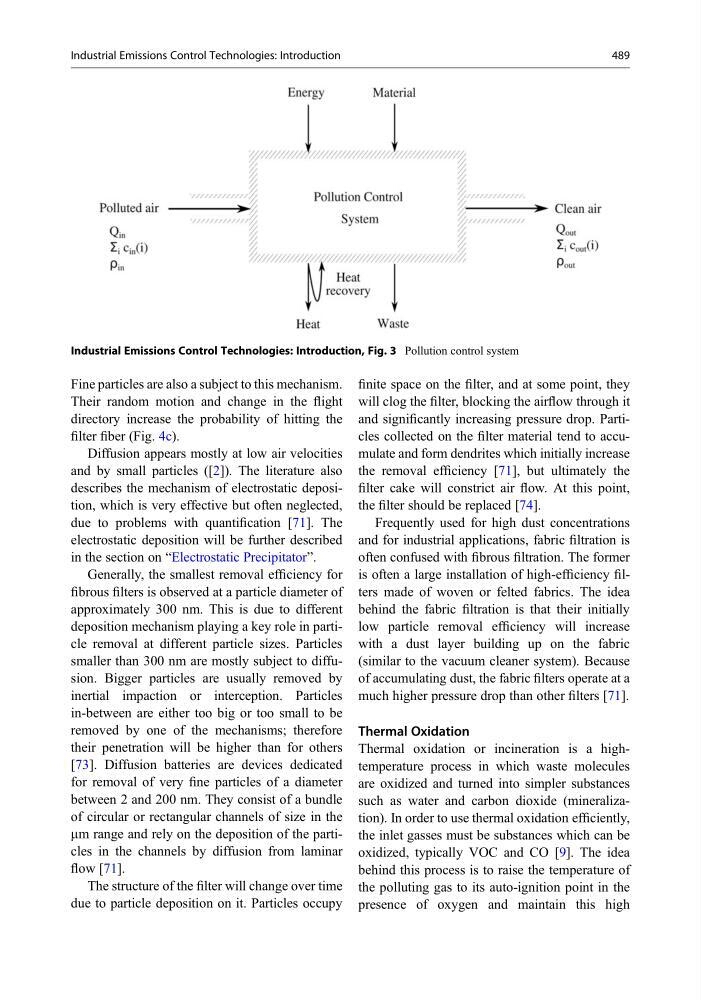
Industrial Emissions Control Technologies: Introduction, Fig. 3 Pollution control system
Industrial Emissions Control Technologies: Introduction
489
Their random motion and change in the flight
directory increase the probability of hitting the
filter fiber (Fig. 4c).
Diffusion appears mostly at low air velocities
and by small particles ([2]). The literature also
describes the mechanism of electrostatic deposition, which is very effective but often neglected,
due to problems with quantification [71]. The
electrostatic deposition will be further described
in the section on “Electrostatic Precipitator”.
Generally, the smallest removal efficiency for
fibrous filters is observed at a particle diameter of
approximately 300 nm. This is due to different
deposition mechanism playing a key role in particle removal at different particle sizes. Particles
smaller than 300 nm are mostly subject to diffusion. Bigger particles are usually removed by
inertial impaction or interception. Particles
in-between are either too big or too small to be
removed by one of the mechanisms; therefore
their penetration will be higher than for others
[73]. Diffusion batteries are devices dedicated
for removal of very fine particles of a diameter
between 2 and 200 nm. They consist of a bundle
of circular or rectangular channels of size in the
mm range and rely on the deposition of the particles in the channels by diffusion from laminar
flow [71].
The structure of the filter will change over time
due to particle deposition on it. Particles occupy
finite space on the filter, and at some point, they
will clog the filter, blocking the airflow through it
and significantly increasing pressure drop. Particles collected on the filter material tend to accumulate and form dendrites which initially increase
the removal efficiency [71], but ultimately the
filter cake will constrict air flow. At this point,
the filter should be replaced [74].
Frequently used for high dust concentrations
and for industrial applications, fabric filtration is
often confused with fibrous filtration. The former
is often a large installation of high-efficiency filters made of woven or felted fabrics. The idea
behind the fabric filtration is that their initially
low particle removal efficiency will increase
with a dust layer building up on the fabric
(similar to the vacuum cleaner system). Because
of accumulating dust, the fabric filters operate at a
much higher pressure drop than other filters [71].
Thermal Oxidation
Thermal oxidation or incineration is a hightemperature process in which waste molecules
are oxidized and turned into simpler substances
such as water and carbon dioxide (mineralization). In order to use thermal oxidation efficiently,
the inlet gasses must be substances which can be
oxidized, typically VOC and CO [9]. The idea
behind this process is to raise the temperature of
the polluting gas to its auto-ignition point in the
presence of oxygen and maintain this high
Industrial Emissions Control Technologies: Introduction, Fig. 3 Pollution control system
Industrial Emissions Control Technologies: Introduction
489