

material) and the thickness of the material or
reducing fiber diameter. On the other hand, it
will also drastically increase resistance to the air
flowing through it, called pressure drop. The best
fibrous filters are those with highest RE% at the
lowest possible pressure drop [71]. To reduce the
pressure drop, one can use pleated fibrous filters
which will increase the effective filtration
area [72].
Particle removal by the filter is based on a few
deposition mechanisms. Interception occurs when
the streamline carrying the particle happens to
pass the surface of the fiber within one particle
radius (Fig. 4a). Regardless of the particle size,
inertia, or Brownian motion, the particle will be
collected [71]. Inertial impaction occurs when the
carried particle is too big to follow curving
streamlines near the fiber (Fig. 4b). Its inertia is
so big that it continues its original path and hits
the filter element even if by following the streamline it would miss it. This happens usually at high
gas velocities and in dense filters [2, 71]. The
mechanism of diffusion is based on random
(Brownian) motion of gas particles in the stream.
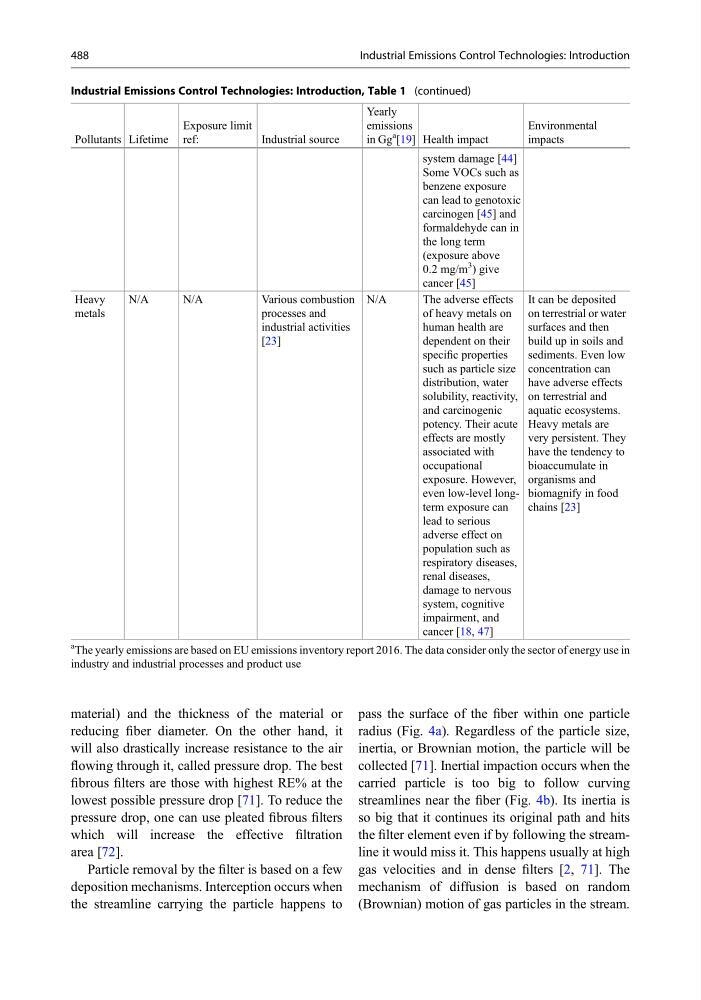
Industrial Emissions Control Technologies: Introduction, Table 1 (continued)
Pollutants Lifetime
Exposure limit
ref:
Industrial source
Yearly
emissions
in Gg
a [19] Health impact
Environmental
impacts
system damage [44]
Some VOCs such as
benzene exposure
can lead to genotoxic
carcinogen [45] and
formaldehyde can in
the long term
(exposure above
0.2 mg/m
3
) give
cancer [45]
Heavy
metals
N/A
N/A
Various combustion
processes and
industrial activities
[23]
N/A
The adverse effects
of heavy metals on
human health are
dependent on their
specific properties
such as particle size
distribution, water
solubility, reactivity,
and carcinogenic
potency. Their acute
effects are mostly
associated with
occupational
exposure. However,
even low-level longterm exposure can
lead to serious
adverse effect on
population such as
respiratory diseases,
renal diseases,
damage to nervous
system, cognitive
impairment, and
cancer [18, 47]
It can be deposited
on terrestrial or water
surfaces and then
build up in soils and
sediments. Even low
concentration can
have adverse effects
on terrestrial and
aquatic ecosystems.
Heavy metals are
very persistent. They
have the tendency to
bioaccumulate in
organisms and
biomagnify in food
chains [23]
a The yearly emissions are based on EU emissions inventory report 2016. The data consider only the sector of energy use in
industry and industrial processes and product use
488
Industrial Emissions Control Technologies: Introduction
reducing fiber diameter. On the other hand, it
will also drastically increase resistance to the air
flowing through it, called pressure drop. The best
fibrous filters are those with highest RE% at the
lowest possible pressure drop [71]. To reduce the
pressure drop, one can use pleated fibrous filters
which will increase the effective filtration
area [72].
Particle removal by the filter is based on a few
deposition mechanisms. Interception occurs when
the streamline carrying the particle happens to
pass the surface of the fiber within one particle
radius (Fig. 4a). Regardless of the particle size,
inertia, or Brownian motion, the particle will be
collected [71]. Inertial impaction occurs when the
carried particle is too big to follow curving
streamlines near the fiber (Fig. 4b). Its inertia is
so big that it continues its original path and hits
the filter element even if by following the streamline it would miss it. This happens usually at high
gas velocities and in dense filters [2, 71]. The
mechanism of diffusion is based on random
(Brownian) motion of gas particles in the stream.
Industrial Emissions Control Technologies: Introduction, Table 1 (continued)
Pollutants Lifetime
Exposure limit
ref:
Industrial source
Yearly
emissions
in Gg
a [19] Health impact
Environmental
impacts
system damage [44]
Some VOCs such as
benzene exposure
can lead to genotoxic
carcinogen [45] and
formaldehyde can in
the long term
(exposure above
0.2 mg/m
3
) give
cancer [45]
Heavy
metals
N/A
N/A
Various combustion
processes and
industrial activities
[23]
N/A
The adverse effects
of heavy metals on
human health are
dependent on their
specific properties
such as particle size
distribution, water
solubility, reactivity,
and carcinogenic
potency. Their acute
effects are mostly
associated with
occupational
exposure. However,
even low-level longterm exposure can
lead to serious
adverse effect on
population such as
respiratory diseases,
renal diseases,
damage to nervous
system, cognitive
impairment, and
cancer [18, 47]
It can be deposited
on terrestrial or water
surfaces and then
build up in soils and
sediments. Even low
concentration can
have adverse effects
on terrestrial and
aquatic ecosystems.
Heavy metals are
very persistent. They
have the tendency to
bioaccumulate in
organisms and
biomagnify in food
chains [23]
a The yearly emissions are based on EU emissions inventory report 2016. The data consider only the sector of energy use in
industry and industrial processes and product use
488
Industrial Emissions Control Technologies: Introduction