

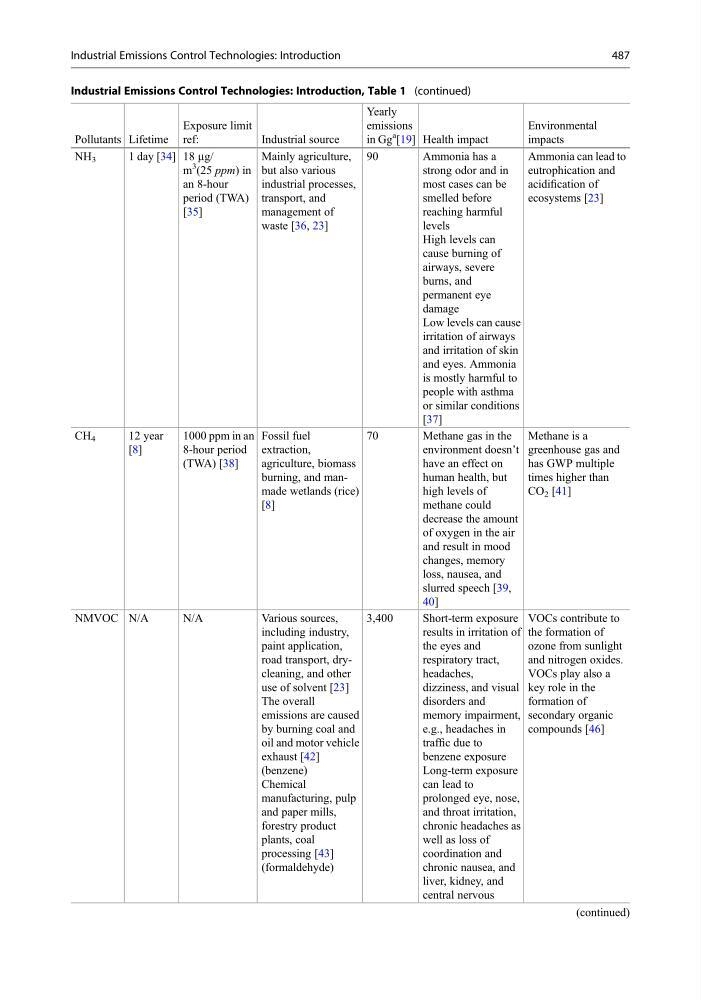
Industrial Emissions Control Technologies: Introduction, Table 1 (continued)
Pollutants Lifetime
Exposure limit
ref:
Industrial source
Yearly
emissions
in Gg
a [19] Health impact
Environmental
impacts
NH 3
1 day [34] 18 mg/
m
3
(25 ppm) in
an 8-hour
period (TWA)
[35]
Mainly agriculture,
but also various
industrial processes,
transport, and
management of
waste [36, 23]
90
Ammonia has a
strong odor and in
most cases can be
smelled before
reaching harmful
levels
High levels can
cause burning of
airways, severe
burns, and
permanent eye
damage
Low levels can cause
irritation of airways
and irritation of skin
and eyes. Ammonia
is mostly harmful to
people with asthma
or similar conditions
[37]
Ammonia can lead to
eutrophication and
acidification of
ecosystems [23]
CH 4
12 year
[8]
1000 ppm in an
8-hour period
(TWA) [38]
Fossil fuel
extraction,
agriculture, biomass
burning, and manmade wetlands (rice)
[8]
70
Methane gas in the
environment doesn’t
have an effect on
human health, but
high levels of
methane could
decrease the amount
of oxygen in the air
and result in mood
changes, memory
loss, nausea, and
slurred speech [39,
40]
Methane is a
greenhouse gas and
has GWP multiple
times higher than
CO 2 [41]
NMVOC N/A
N/A
Various sources,
including industry,
paint application,
road transport, drycleaning, and other
use of solvent [23]
The overall
emissions are caused
by burning coal and
oil and motor vehicle
exhaust [42]
(benzene)
Chemical
manufacturing, pulp
and paper mills,
forestry product
plants, coal
processing [43]
(formaldehyde)
3,400
Short-term exposure
results in irritation of
the eyes and
respiratory tract,
headaches,
dizziness, and visual
disorders and
memory impairment,
e.g., headaches in
traffic due to
benzene exposure
Long-term exposure
can lead to
prolonged eye, nose,
and throat irritation,
chronic headaches as
well as loss of
coordination and
chronic nausea, and
liver, kidney, and
central nervous
VOCs contribute to
the formation of
ozone from sunlight
and nitrogen oxides.
VOCs play also a
key role in the
formation of
secondary organic
compounds [46]
(continued)
Industrial Emissions Control Technologies: Introduction
487
Pollutants Lifetime
Exposure limit
ref:
Industrial source
Yearly
emissions
in Gg
a [19] Health impact
Environmental
impacts
NH 3
1 day [34] 18 mg/
m
3
(25 ppm) in
an 8-hour
period (TWA)
[35]
Mainly agriculture,
but also various
industrial processes,
transport, and
management of
waste [36, 23]
90
Ammonia has a
strong odor and in
most cases can be
smelled before
reaching harmful
levels
High levels can
cause burning of
airways, severe
burns, and
permanent eye
damage
Low levels can cause
irritation of airways
and irritation of skin
and eyes. Ammonia
is mostly harmful to
people with asthma
or similar conditions
[37]
Ammonia can lead to
eutrophication and
acidification of
ecosystems [23]
CH 4
12 year
[8]
1000 ppm in an
8-hour period
(TWA) [38]
Fossil fuel
extraction,
agriculture, biomass
burning, and manmade wetlands (rice)
[8]
70
Methane gas in the
environment doesn’t
have an effect on
human health, but
high levels of
methane could
decrease the amount
of oxygen in the air
and result in mood
changes, memory
loss, nausea, and
slurred speech [39,
40]
Methane is a
greenhouse gas and
has GWP multiple
times higher than
CO 2 [41]
NMVOC N/A
N/A
Various sources,
including industry,
paint application,
road transport, drycleaning, and other
use of solvent [23]
The overall
emissions are caused
by burning coal and
oil and motor vehicle
exhaust [42]
(benzene)
Chemical
manufacturing, pulp
and paper mills,
forestry product
plants, coal
processing [43]
(formaldehyde)
3,400
Short-term exposure
results in irritation of
the eyes and
respiratory tract,
headaches,
dizziness, and visual
disorders and
memory impairment,
e.g., headaches in
traffic due to
benzene exposure
Long-term exposure
can lead to
prolonged eye, nose,
and throat irritation,
chronic headaches as
well as loss of
coordination and
chronic nausea, and
liver, kidney, and
central nervous
VOCs contribute to
the formation of
ozone from sunlight
and nitrogen oxides.
VOCs play also a
key role in the
formation of
secondary organic
compounds [46]
(continued)
Industrial Emissions Control Technologies: Introduction
487