

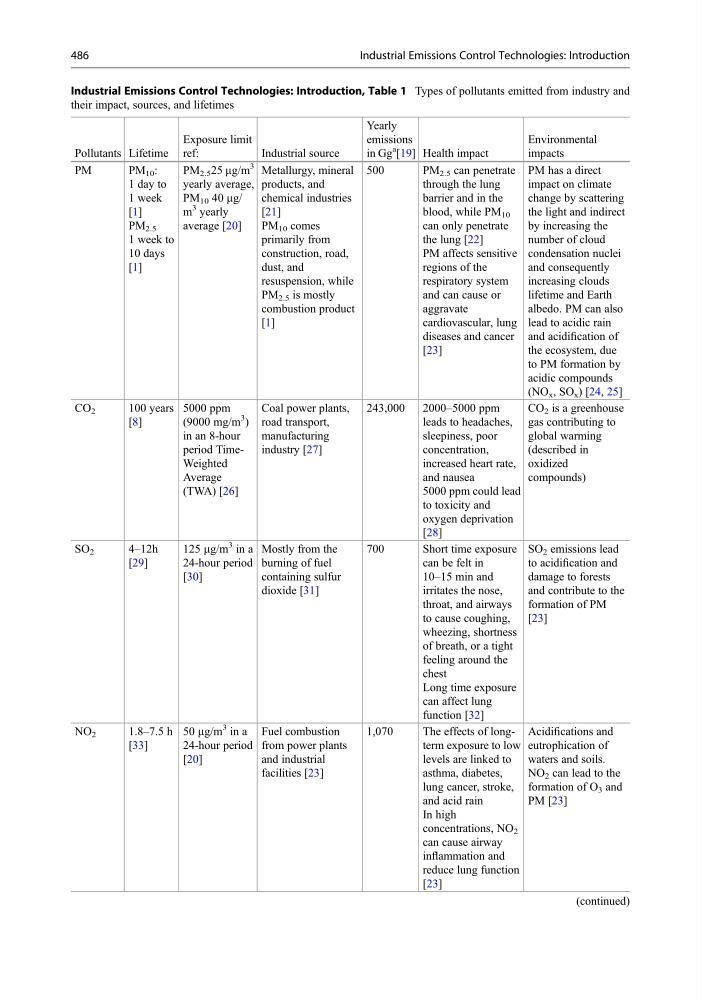
Industrial Emissions Control Technologies: Introduction, Table 1 Types of pollutants emitted from industry and
their impact, sources, and lifetimes
Pollutants Lifetime
Exposure limit
ref:
Industrial source
Yearly
emissions
in Gg
a [19] Health impact
Environmental
impacts
PM
PM 10 :
1 day to
1 week
[1]
PM 2.5
1 week to
10 days
[1]
PM 2.5 25 mg/m
3
yearly average,
PM 10 40 mg/
m
3 yearly
average [20]
Metallurgy, mineral
products, and
chemical industries
[21]
PM 10 comes
primarily from
construction, road,
dust, and
resuspension, while
PM 2.5 is mostly
combustion product
[1]
500
PM 2.5 can penetrate
through the lung
barrier and in the
blood, while PM 10
can only penetrate
the lung [22]
PM affects sensitive
regions of the
respiratory system
and can cause or
aggravate
cardiovascular, lung
diseases and cancer
[23]
PM has a direct
impact on climate
change by scattering
the light and indirect
by increasing the
number of cloud
condensation nuclei
and consequently
increasing clouds
lifetime and Earth
albedo. PM can also
lead to acidic rain
and acidification of
the ecosystem, due
to PM formation by
acidic compounds
(NO x , SO x ) [24, 25]
CO 2
100 years
[8]
5000 ppm
(9000 mg/m
3
)
in an 8-hour
period TimeWeighted
Average
(TWA) [26]
Coal power plants,
road transport,
manufacturing
industry [27]
243,000
2000–5000 ppm
leads to headaches,
sleepiness, poor
concentration,
increased heart rate,
and nausea
5000 ppm could lead
to toxicity and
oxygen deprivation
[28]
CO 2 is a greenhouse
gas contributing to
global warming
(described in
oxidized
compounds)
SO 2
4–12h
[29]
125 mg/m
3 in a
24-hour period
[30]
Mostly from the
burning of fuel
containing sulfur
dioxide [31]
700
Short time exposure
can be felt in
10–15 min and
irritates the nose,
throat, and airways
to cause coughing,
wheezing, shortness
of breath, or a tight
feeling around the
chest
Long time exposure
can affect lung
function [32]
SO 2 emissions lead
to acidification and
damage to forests
and contribute to the
formation of PM
[23]
NO 2
1.8–7.5 h
[33]
50 mg/m
3 in a
24-hour period
[20]
Fuel combustion
from power plants
and industrial
facilities [23]
1,070
The effects of longterm exposure to low
levels are linked to
asthma, diabetes,
lung cancer, stroke,
and acid rain
In high
concentrations, NO 2
can cause airway
inflammation and
reduce lung function
[23]
Acidifications and
eutrophication of
waters and soils.
NO 2 can lead to the
formation of O 3 and
PM [23]
(continued)
486
Industrial Emissions Control Technologies: Introduction
their impact, sources, and lifetimes
Pollutants Lifetime
Exposure limit
ref:
Industrial source
Yearly
emissions
in Gg
a [19] Health impact
Environmental
impacts
PM
PM 10 :
1 day to
1 week
[1]
PM 2.5
1 week to
10 days
[1]
PM 2.5 25 mg/m
3
yearly average,
PM 10 40 mg/
m
3 yearly
average [20]
Metallurgy, mineral
products, and
chemical industries
[21]
PM 10 comes
primarily from
construction, road,
dust, and
resuspension, while
PM 2.5 is mostly
combustion product
[1]
500
PM 2.5 can penetrate
through the lung
barrier and in the
blood, while PM 10
can only penetrate
the lung [22]
PM affects sensitive
regions of the
respiratory system
and can cause or
aggravate
cardiovascular, lung
diseases and cancer
[23]
PM has a direct
impact on climate
change by scattering
the light and indirect
by increasing the
number of cloud
condensation nuclei
and consequently
increasing clouds
lifetime and Earth
albedo. PM can also
lead to acidic rain
and acidification of
the ecosystem, due
to PM formation by
acidic compounds
(NO x , SO x ) [24, 25]
CO 2
100 years
[8]
5000 ppm
(9000 mg/m
3
)
in an 8-hour
period TimeWeighted
Average
(TWA) [26]
Coal power plants,
road transport,
manufacturing
industry [27]
243,000
2000–5000 ppm
leads to headaches,
sleepiness, poor
concentration,
increased heart rate,
and nausea
5000 ppm could lead
to toxicity and
oxygen deprivation
[28]
CO 2 is a greenhouse
gas contributing to
global warming
(described in
oxidized
compounds)
SO 2
4–12h
[29]
125 mg/m
3 in a
24-hour period
[30]
Mostly from the
burning of fuel
containing sulfur
dioxide [31]
700
Short time exposure
can be felt in
10–15 min and
irritates the nose,
throat, and airways
to cause coughing,
wheezing, shortness
of breath, or a tight
feeling around the
chest
Long time exposure
can affect lung
function [32]
SO 2 emissions lead
to acidification and
damage to forests
and contribute to the
formation of PM
[23]
NO 2
1.8–7.5 h
[33]
50 mg/m
3 in a
24-hour period
[20]
Fuel combustion
from power plants
and industrial
facilities [23]
1,070
The effects of longterm exposure to low
levels are linked to
asthma, diabetes,
lung cancer, stroke,
and acid rain
In high
concentrations, NO 2
can cause airway
inflammation and
reduce lung function
[23]
Acidifications and
eutrophication of
waters and soils.
NO 2 can lead to the
formation of O 3 and
PM [23]
(continued)
486
Industrial Emissions Control Technologies: Introduction