

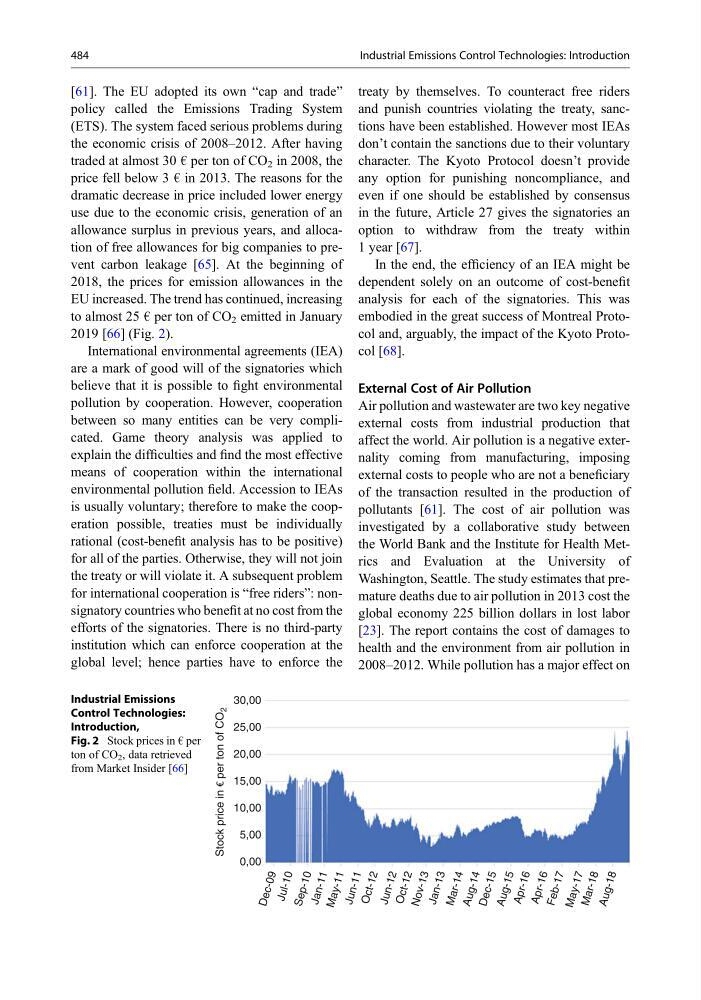
[61]. The EU adopted its own “cap and trade”
policy called the Emissions Trading System
(ETS). The system faced serious problems during
the economic crisis of 2008–2012. After having
traded at almost 30 € per ton of CO 2 in 2008, the
price fell below 3 € in 2013. The reasons for the
dramatic decrease in price included lower energy
use due to the economic crisis, generation of an
allowance surplus in previous years, and allocation of free allowances for big companies to prevent carbon leakage [65]. At the beginning of
2018, the prices for emission allowances in the
EU increased. The trend has continued, increasing
to almost 25 € per ton of CO 2 emitted in January
2019 [66] (Fig. 2).
International environmental agreements (IEA)
are a mark of good will of the signatories which
believe that it is possible to fight environmental
pollution by cooperation. However, cooperation
between so many entities can be very complicated. Game theory analysis was applied to
explain the difficulties and find the most effective
means of cooperation within the international
environmental pollution field. Accession to IEAs
is usually voluntary; therefore to make the cooperation possible, treaties must be individually
rational (cost-benefit analysis has to be positive)
for all of the parties. Otherwise, they will not join
the treaty or will violate it. A subsequent problem
for international cooperation is “free riders”: nonsignatory countries who benefit at no cost from the
efforts of the signatories. There is no third-party
institution which can enforce cooperation at the
global level; hence parties have to enforce the
treaty by themselves. To counteract free riders
and punish countries violating the treaty, sanctions have been established. However most IEAs
don’t contain the sanctions due to their voluntary
character. The Kyoto Protocol doesn’t provide
any option for punishing noncompliance, and
even if one should be established by consensus
in the future, Article 27 gives the signatories an
option to withdraw from the treaty within
1 year [67].
In the end, the efficiency of an IEA might be
dependent solely on an outcome of cost-benefit
analysis for each of the signatories. This was
embodied in the great success of Montreal Protocol and, arguably, the impact of the Kyoto Protocol [68].
External Cost of Air Pollution
Air pollution and wastewater are two key negative
external costs from industrial production that
affect the world. Air pollution is a negative externality coming from manufacturing, imposing
external costs to people who are not a beneficiary
of the transaction resulted in the production of
pollutants [61]. The cost of air pollution was
investigated by a collaborative study between
the World Bank and the Institute for Health Metrics and Evaluation at the University of
Washington, Seattle. The study estimates that premature deaths due to air pollution in 2013 cost the
global economy 225 billion dollars in lost labor
[23]. The report contains the cost of damages to
health and the environment from air pollution in
2008–2012. While pollution has a major effect on
30,00
25,00
20,00
Stock price in Φ
per ton of CO
2
15,00
10,00
5,00
0,00
D e c -0 9
J u l- 1 0
S e p -1 0
J a n -1 1
M a y -1 1
J u n -1 1
O c t- 1 2
J u n -1 2
O c t- 1 2
N o v -1 3
J a n -1 3
M a r- 1 4
A u g -1 4
D e c -1 5
A u g -1 5
A p r- 1 6
A p r- 1 6
F e b -1 7
M a y -1 7
M a r- 1 8
A u g -1 8
Industrial Emissions
Control Technologies:
Introduction,
Fig. 2 Stock prices in € per
ton of CO 2 , data retrieved
from Market Insider [66]
484
Industrial Emissions Control Technologies: Introduction
policy called the Emissions Trading System
(ETS). The system faced serious problems during
the economic crisis of 2008–2012. After having
traded at almost 30 € per ton of CO 2 in 2008, the
price fell below 3 € in 2013. The reasons for the
dramatic decrease in price included lower energy
use due to the economic crisis, generation of an
allowance surplus in previous years, and allocation of free allowances for big companies to prevent carbon leakage [65]. At the beginning of
2018, the prices for emission allowances in the
EU increased. The trend has continued, increasing
to almost 25 € per ton of CO 2 emitted in January
2019 [66] (Fig. 2).
International environmental agreements (IEA)
are a mark of good will of the signatories which
believe that it is possible to fight environmental
pollution by cooperation. However, cooperation
between so many entities can be very complicated. Game theory analysis was applied to
explain the difficulties and find the most effective
means of cooperation within the international
environmental pollution field. Accession to IEAs
is usually voluntary; therefore to make the cooperation possible, treaties must be individually
rational (cost-benefit analysis has to be positive)
for all of the parties. Otherwise, they will not join
the treaty or will violate it. A subsequent problem
for international cooperation is “free riders”: nonsignatory countries who benefit at no cost from the
efforts of the signatories. There is no third-party
institution which can enforce cooperation at the
global level; hence parties have to enforce the
treaty by themselves. To counteract free riders
and punish countries violating the treaty, sanctions have been established. However most IEAs
don’t contain the sanctions due to their voluntary
character. The Kyoto Protocol doesn’t provide
any option for punishing noncompliance, and
even if one should be established by consensus
in the future, Article 27 gives the signatories an
option to withdraw from the treaty within
1 year [67].
In the end, the efficiency of an IEA might be
dependent solely on an outcome of cost-benefit
analysis for each of the signatories. This was
embodied in the great success of Montreal Protocol and, arguably, the impact of the Kyoto Protocol [68].
External Cost of Air Pollution
Air pollution and wastewater are two key negative
external costs from industrial production that
affect the world. Air pollution is a negative externality coming from manufacturing, imposing
external costs to people who are not a beneficiary
of the transaction resulted in the production of
pollutants [61]. The cost of air pollution was
investigated by a collaborative study between
the World Bank and the Institute for Health Metrics and Evaluation at the University of
Washington, Seattle. The study estimates that premature deaths due to air pollution in 2013 cost the
global economy 225 billion dollars in lost labor
[23]. The report contains the cost of damages to
health and the environment from air pollution in
2008–2012. While pollution has a major effect on
30,00
25,00
20,00
Stock price in Φ
per ton of CO
2
15,00
10,00
5,00
0,00
D e c -0 9
J u l- 1 0
S e p -1 0
J a n -1 1
M a y -1 1
J u n -1 1
O c t- 1 2
J u n -1 2
O c t- 1 2
N o v -1 3
J a n -1 3
M a r- 1 4
A u g -1 4
D e c -1 5
A u g -1 5
A p r- 1 6
A p r- 1 6
F e b -1 7
M a y -1 7
M a r- 1 8
A u g -1 8
Industrial Emissions
Control Technologies:
Introduction,
Fig. 2 Stock prices in € per
ton of CO 2 , data retrieved
from Market Insider [66]
484
Industrial Emissions Control Technologies: Introduction