

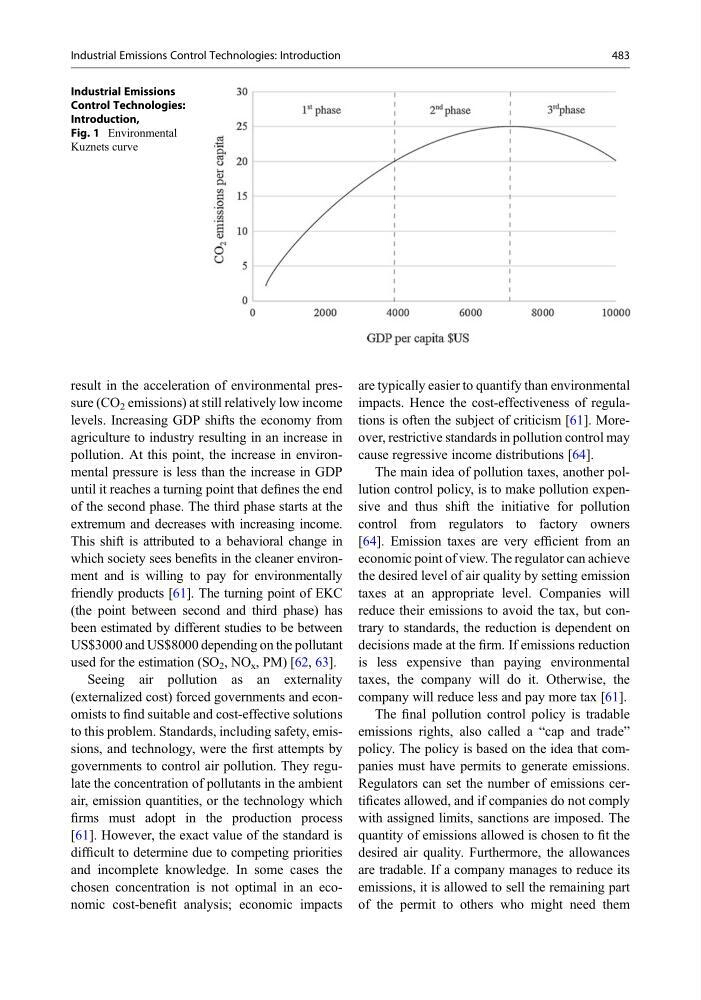
result in the acceleration of environmental pressure (CO 2 emissions) at still relatively low income
levels. Increasing GDP shifts the economy from
agriculture to industry resulting in an increase in
pollution. At this point, the increase in environmental pressure is less than the increase in GDP
until it reaches a turning point that defines the end
of the second phase. The third phase starts at the
extremum and decreases with increasing income.
This shift is attributed to a behavioral change in
which society sees benefits in the cleaner environment and is willing to pay for environmentally
friendly products [61]. The turning point of EKC
(the point between second and third phase) has
been estimated by different studies to be between
US$3000 and US$8000 depending on the pollutant
used for the estimation (SO 2 , NO x , PM) [62, 63].
Seeing air pollution as an externality
(externalized cost) forced governments and economists to find suitable and cost-effective solutions
to this problem. Standards, including safety, emissions, and technology, were the first attempts by
governments to control air pollution. They regulate the concentration of pollutants in the ambient
air, emission quantities, or the technology which
firms must adopt in the production process
[61]. However, the exact value of the standard is
difficult to determine due to competing priorities
and incomplete knowledge. In some cases the
chosen concentration is not optimal in an economic cost-benefit analysis; economic impacts
are typically easier to quantify than environmental
impacts. Hence the cost-effectiveness of regulations is often the subject of criticism [61]. Moreover, restrictive standards in pollution control may
cause regressive income distributions [64].
The main idea of pollution taxes, another pollution control policy, is to make pollution expensive and thus shift the initiative for pollution
control from regulators to factory owners
[64]. Emission taxes are very efficient from an
economic point of view. The regulator can achieve
the desired level of air quality by setting emission
taxes at an appropriate level. Companies will
reduce their emissions to avoid the tax, but contrary to standards, the reduction is dependent on
decisions made at the firm. If emissions reduction
is less expensive than paying environmental
taxes, the company will do it. Otherwise, the
company will reduce less and pay more tax [61].
The final pollution control policy is tradable
emissions rights, also called a “cap and trade”
policy. The policy is based on the idea that companies must have permits to generate emissions.
Regulators can set the number of emissions certificates allowed, and if companies do not comply
with assigned limits, sanctions are imposed. The
quantity of emissions allowed is chosen to fit the
desired air quality. Furthermore, the allowances
are tradable. If a company manages to reduce its
emissions, it is allowed to sell the remaining part
of the permit to others who might need them
Industrial Emissions
Control Technologies:
Introduction,
Fig. 1 Environmental
Kuznets curve
Industrial Emissions Control Technologies: Introduction
483
levels. Increasing GDP shifts the economy from
agriculture to industry resulting in an increase in
pollution. At this point, the increase in environmental pressure is less than the increase in GDP
until it reaches a turning point that defines the end
of the second phase. The third phase starts at the
extremum and decreases with increasing income.
This shift is attributed to a behavioral change in
which society sees benefits in the cleaner environment and is willing to pay for environmentally
friendly products [61]. The turning point of EKC
(the point between second and third phase) has
been estimated by different studies to be between
US$3000 and US$8000 depending on the pollutant
used for the estimation (SO 2 , NO x , PM) [62, 63].
Seeing air pollution as an externality
(externalized cost) forced governments and economists to find suitable and cost-effective solutions
to this problem. Standards, including safety, emissions, and technology, were the first attempts by
governments to control air pollution. They regulate the concentration of pollutants in the ambient
air, emission quantities, or the technology which
firms must adopt in the production process
[61]. However, the exact value of the standard is
difficult to determine due to competing priorities
and incomplete knowledge. In some cases the
chosen concentration is not optimal in an economic cost-benefit analysis; economic impacts
are typically easier to quantify than environmental
impacts. Hence the cost-effectiveness of regulations is often the subject of criticism [61]. Moreover, restrictive standards in pollution control may
cause regressive income distributions [64].
The main idea of pollution taxes, another pollution control policy, is to make pollution expensive and thus shift the initiative for pollution
control from regulators to factory owners
[64]. Emission taxes are very efficient from an
economic point of view. The regulator can achieve
the desired level of air quality by setting emission
taxes at an appropriate level. Companies will
reduce their emissions to avoid the tax, but contrary to standards, the reduction is dependent on
decisions made at the firm. If emissions reduction
is less expensive than paying environmental
taxes, the company will do it. Otherwise, the
company will reduce less and pay more tax [61].
The final pollution control policy is tradable
emissions rights, also called a “cap and trade”
policy. The policy is based on the idea that companies must have permits to generate emissions.
Regulators can set the number of emissions certificates allowed, and if companies do not comply
with assigned limits, sanctions are imposed. The
quantity of emissions allowed is chosen to fit the
desired air quality. Furthermore, the allowances
are tradable. If a company manages to reduce its
emissions, it is allowed to sell the remaining part
of the permit to others who might need them
Industrial Emissions
Control Technologies:
Introduction,
Fig. 1 Environmental
Kuznets curve
Industrial Emissions Control Technologies: Introduction
483