

been observed as a result of heatwaves in Chicago
[35], Melbourne [1], Southeastern Australia [2],
and others [53]. High nighttime temperatures also
increase the vulnerability of electricity transmission systems to failure, as systems cannot shed
excess heat [2].
Significant energy loss in transmission and
distribution systems result from heatwave events,
due to both higher conductor resistivity, higher
ambient temperatures reducing the effectiveness
of heat-dissipating transducers, and higher
demand [53, 54]. Aivalioti [52] describes how
network losses in distribution and transmission
systems increase by 1% for every increase of
3 degrees Celsius in ambient temperatures, in
systems with already existing losses of 8%.
Various modes of renewable energy generation
are negatively affected by extreme heat events.
Solar power cells see lower efficiency under conditions of increased temperature, with increases in
soil temperatures of solar PV power plants also
lowering capacity of underground conductors
[9]. Hydropower generation output is decreased
due to increased evaporation in reservoirs, and
snow-covered regions face reductions in output
due to reductions in stream flows [9].
A report from the Grattan Institute [55] establishes that distribution outages are more than three
times as likely on days hotter than 35 degrees
(an average daily outage per customer of approximately 2.6 min over the 2009–2018 period) as
compared to days below 35 degrees (0.7 min per
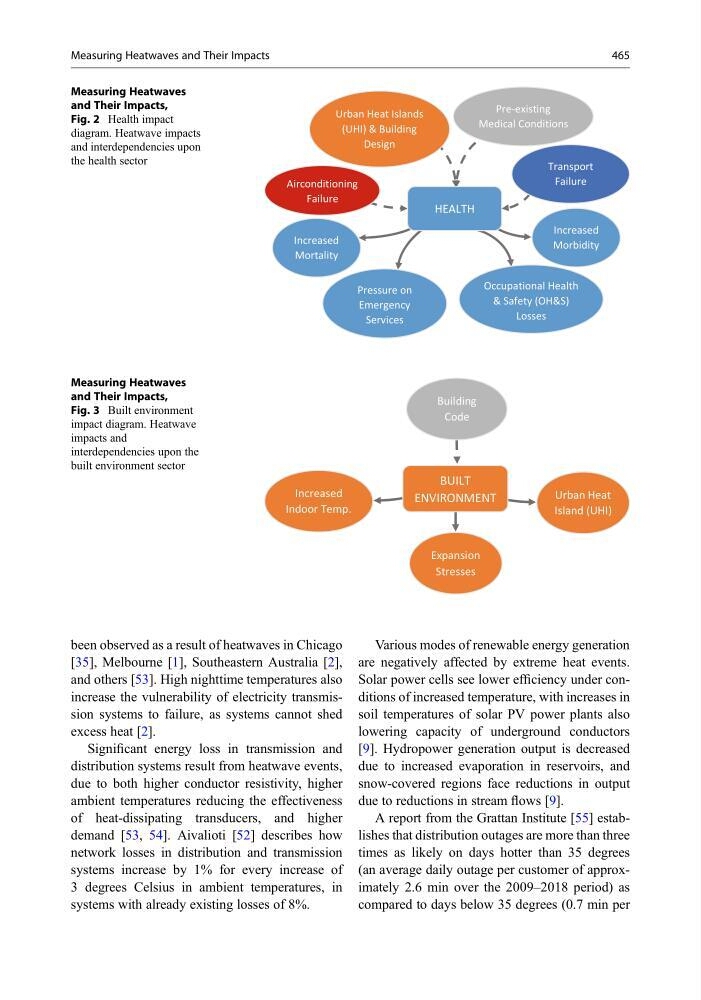
HEALTH
Increased
Mortality
Pressure on
Emergency
Services
Increased
Morbidity
Airconditioning
Failure
Occupational Health
& Safety (OH&S)
Losses
Transport
Failure
Urban Heat Islands
(UHI) & Building
Design
Pre-existing
Medical Conditions
Measuring Heatwaves
and Their Impacts,
Fig. 2 Health impact
diagram. Heatwave impacts
and interdependencies upon
the health sector
BUILT
ENVIRONMENT
Increased
Indoor Temp.
Urban Heat
Island (UHI)
Expansion
Stresses
Building
Code
Measuring Heatwaves
and Their Impacts,
Fig. 3 Built environment
impact diagram. Heatwave
impacts and
interdependencies upon the
built environment sector
Measuring Heatwaves and Their Impacts
465
[35], Melbourne [1], Southeastern Australia [2],
and others [53]. High nighttime temperatures also
increase the vulnerability of electricity transmission systems to failure, as systems cannot shed
excess heat [2].
Significant energy loss in transmission and
distribution systems result from heatwave events,
due to both higher conductor resistivity, higher
ambient temperatures reducing the effectiveness
of heat-dissipating transducers, and higher
demand [53, 54]. Aivalioti [52] describes how
network losses in distribution and transmission
systems increase by 1% for every increase of
3 degrees Celsius in ambient temperatures, in
systems with already existing losses of 8%.
Various modes of renewable energy generation
are negatively affected by extreme heat events.
Solar power cells see lower efficiency under conditions of increased temperature, with increases in
soil temperatures of solar PV power plants also
lowering capacity of underground conductors
[9]. Hydropower generation output is decreased
due to increased evaporation in reservoirs, and
snow-covered regions face reductions in output
due to reductions in stream flows [9].
A report from the Grattan Institute [55] establishes that distribution outages are more than three
times as likely on days hotter than 35 degrees
(an average daily outage per customer of approximately 2.6 min over the 2009–2018 period) as
compared to days below 35 degrees (0.7 min per
HEALTH
Increased
Mortality
Pressure on
Emergency
Services
Increased
Morbidity
Airconditioning
Failure
Occupational Health
& Safety (OH&S)
Losses
Transport
Failure
Urban Heat Islands
(UHI) & Building
Design
Pre-existing
Medical Conditions
Measuring Heatwaves
and Their Impacts,
Fig. 2 Health impact
diagram. Heatwave impacts
and interdependencies upon
the health sector
BUILT
ENVIRONMENT
Increased
Indoor Temp.
Urban Heat
Island (UHI)
Expansion
Stresses
Building
Code
Measuring Heatwaves
and Their Impacts,
Fig. 3 Built environment
impact diagram. Heatwave
impacts and
interdependencies upon the
built environment sector
Measuring Heatwaves and Their Impacts
465