

Conclusion
In this entry, important concepts related to low-cost
sensors are introduced and focus is given to three
main types of low-cost sensors: metal oxide sensors,
optical sensors, and electrochemical sensors, along
with a number of interesting and emerging technologies. MOx sensors are often used because of their
low cost, robustness, and simple structure. One of
the most common MOx sensors is the SnO 2 -based
semiconductor. A comparison of various metal
oxide-based sensors presented some specific metal
oxide sensors with their target pollutants and their
corresponding band gap. Optical sensors rely on the
detection of light. Optical sensors are especially
good at detecting particulate matter and infrared
active gases. Two kinds of optical sensors were
examined; NDIR sensors and PM sensors. The
main electrochemical cells are the amperometric
and the potentiometric sensors. The cells usually
have two or three electrodes, but some have a fourth
electrode. Electrochemical sensors and metal oxide
sensors were described and compared, and although
they showed similar results under laboratory conditions, electrochemical cells are more widely used in
industry and have a better performance record. One
reason for the performance gap between the two
types of sensors could be the algorithms used to
incorporate information from other sensors, in
order to correct for changes in pressure and humidity, the presence of interfering gases, etc.
Low-cost sensors are used for monitoring ambient air quality, IAQ, and to determine personal
exposure. Low-cost portable sensors have a promising future for monitoring personal exposure to
pollution, although they have not reached their full
potential. The future of low-cost sensors may
involve the incorporation of nanowires and metalorganic frameworks. A study showed that a sensor
with MOFs could detect formaldehyde, a compound that is otherwise impossible to detect at
ambient levels in real time with a low-cost system,
with good selectivity and sensitivity. The future of
low-cost sensors is ultimately in smart cities, where
they can contribute with information about pollution levels and provide early warning in cases of
pollution-related disasters. Low-cost sensors have
proven their value, and their accuracy and value are
only expected to increase with time.
Bibliography
1. Atkins P, de Paula J, Friedman R (2009) Quanta,
matter, and change: a molecular approach to physical
chemistry. OUP, Oxford
2. Bochenkov VE, Sergeev GB (2010) Sensitivity,
selectivity, and stability of gas-sensitive metal-oxide
nanostructures. Metal oxide nanostructures and their
applications, vol 3. pp 31–52
3. Guidelines for exposure assessment (1992). Federal
Register 57(104):22888–22938
4. Kemibrug. [Online]. Available: https://kemibrug.dk/.
Accessed 25 Feb 2019
5. Avgelis A, Papadopoulos AM (2004) Indoor air quality guidelines and standards – a state of the art review.
Int J Vent 3(3):267–278
6. Assen AH, Yassine O, Shekhah O, Eddaoudi M,
Salama KN (2017) MOFs for the sensitive detection
of ammonia: deployment of fcu-MOF thin films as
effective chemical capacitive sensors. ACS Sens
2(9):1294–1301
7. Choi Y-J, Hwang I-S, Park J-G, Choi KJ, Park J-H,
Lee J-H (2008) Novel fabrication of an SnO 2 nanowire gas sensor with high sensitivity. Nanotechnology 19(9):095508
8. Peng K-Q, Wang X, Lee S-T (2009) Gas sensing
properties of single crystalline porous silicon nanowires. Appl Phys Lett 95(24):243112
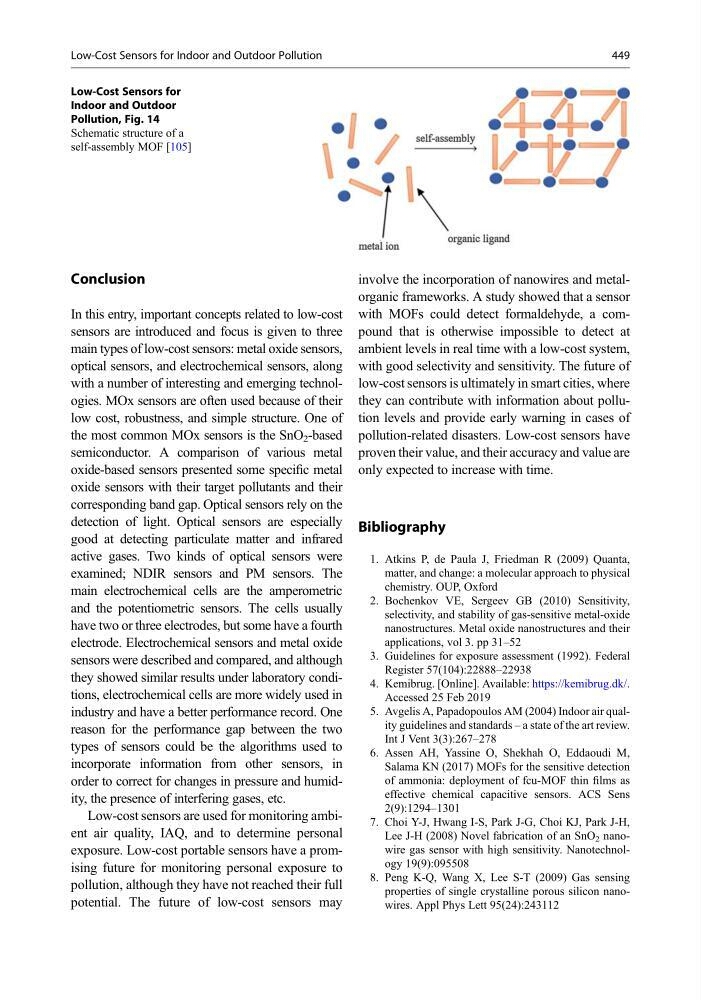
Low-Cost Sensors for
Indoor and Outdoor
Pollution, Fig. 14
Schematic structure of a
self-assembly MOF [105]
Low-Cost Sensors for Indoor and Outdoor Pollution
449
In this entry, important concepts related to low-cost
sensors are introduced and focus is given to three
main types of low-cost sensors: metal oxide sensors,
optical sensors, and electrochemical sensors, along
with a number of interesting and emerging technologies. MOx sensors are often used because of their
low cost, robustness, and simple structure. One of
the most common MOx sensors is the SnO 2 -based
semiconductor. A comparison of various metal
oxide-based sensors presented some specific metal
oxide sensors with their target pollutants and their
corresponding band gap. Optical sensors rely on the
detection of light. Optical sensors are especially
good at detecting particulate matter and infrared
active gases. Two kinds of optical sensors were
examined; NDIR sensors and PM sensors. The
main electrochemical cells are the amperometric
and the potentiometric sensors. The cells usually
have two or three electrodes, but some have a fourth
electrode. Electrochemical sensors and metal oxide
sensors were described and compared, and although
they showed similar results under laboratory conditions, electrochemical cells are more widely used in
industry and have a better performance record. One
reason for the performance gap between the two
types of sensors could be the algorithms used to
incorporate information from other sensors, in
order to correct for changes in pressure and humidity, the presence of interfering gases, etc.
Low-cost sensors are used for monitoring ambient air quality, IAQ, and to determine personal
exposure. Low-cost portable sensors have a promising future for monitoring personal exposure to
pollution, although they have not reached their full
potential. The future of low-cost sensors may
involve the incorporation of nanowires and metalorganic frameworks. A study showed that a sensor
with MOFs could detect formaldehyde, a compound that is otherwise impossible to detect at
ambient levels in real time with a low-cost system,
with good selectivity and sensitivity. The future of
low-cost sensors is ultimately in smart cities, where
they can contribute with information about pollution levels and provide early warning in cases of
pollution-related disasters. Low-cost sensors have
proven their value, and their accuracy and value are
only expected to increase with time.
Bibliography
1. Atkins P, de Paula J, Friedman R (2009) Quanta,
matter, and change: a molecular approach to physical
chemistry. OUP, Oxford
2. Bochenkov VE, Sergeev GB (2010) Sensitivity,
selectivity, and stability of gas-sensitive metal-oxide
nanostructures. Metal oxide nanostructures and their
applications, vol 3. pp 31–52
3. Guidelines for exposure assessment (1992). Federal
Register 57(104):22888–22938
4. Kemibrug. [Online]. Available: https://kemibrug.dk/.
Accessed 25 Feb 2019
5. Avgelis A, Papadopoulos AM (2004) Indoor air quality guidelines and standards – a state of the art review.
Int J Vent 3(3):267–278
6. Assen AH, Yassine O, Shekhah O, Eddaoudi M,
Salama KN (2017) MOFs for the sensitive detection
of ammonia: deployment of fcu-MOF thin films as
effective chemical capacitive sensors. ACS Sens
2(9):1294–1301
7. Choi Y-J, Hwang I-S, Park J-G, Choi KJ, Park J-H,
Lee J-H (2008) Novel fabrication of an SnO 2 nanowire gas sensor with high sensitivity. Nanotechnology 19(9):095508
8. Peng K-Q, Wang X, Lee S-T (2009) Gas sensing
properties of single crystalline porous silicon nanowires. Appl Phys Lett 95(24):243112
Low-Cost Sensors for
Indoor and Outdoor
Pollution, Fig. 14
Schematic structure of a
self-assembly MOF [105]
Low-Cost Sensors for Indoor and Outdoor Pollution
449