

Another approach for measuring NO x gases is
porous silicon nanowires. A study examined Si
nanowires made by metal-assisted chemical etching, which increases the sensitivity of the electrical properties for towards NO x gases. The
nanowires had a swift response, which is associated with the high surface area. The method can be
applied to larger scale semiconductors for monitoring air quality at room temperature [8].
Nanowire fabrication is typically both expensive and time-consuming, a drawback towards
implementing the otherwise promising nanowire
sensors. One study investigates nanowires that
avoid this problem because they are selfassembling. In this study, the nanowires are
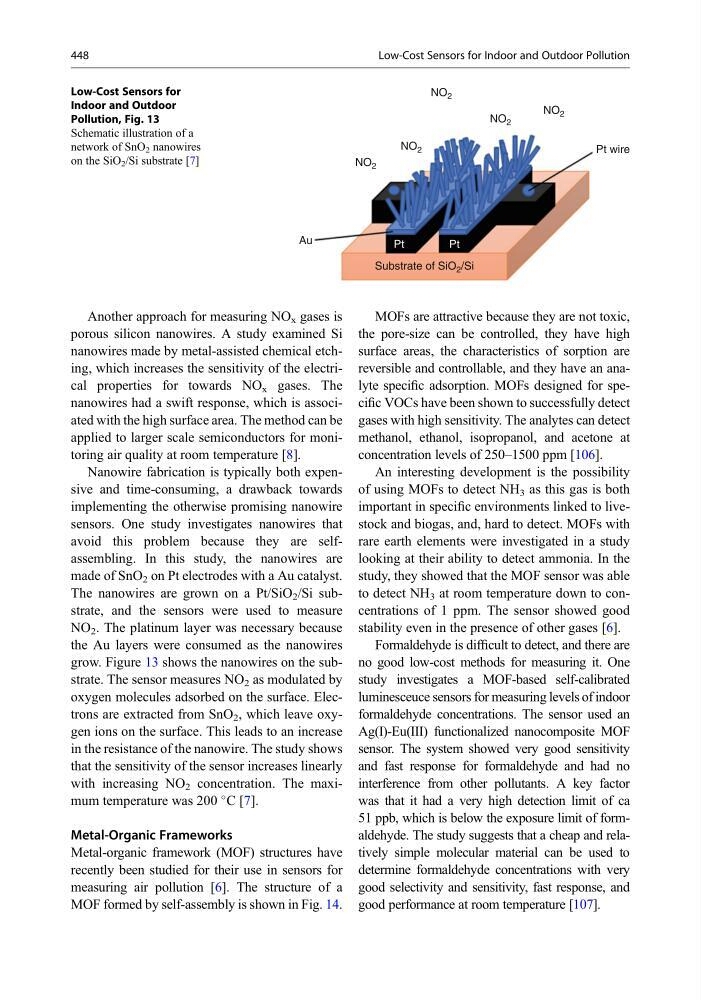
made of SnO 2 on Pt electrodes with a Au catalyst.
The nanowires are grown on a Pt/SiO 2 /Si substrate, and the sensors were used to measure
NO 2 . The platinum layer was necessary because
the Au layers were consumed as the nanowires
grow. Figure 13 shows the nanowires on the substrate. The sensor measures NO 2 as modulated by
oxygen molecules adsorbed on the surface. Electrons are extracted from SnO 2 , which leave oxygen ions on the surface. This leads to an increase
in the resistance of the nanowire. The study shows
that the sensitivity of the sensor increases linearly
with increasing NO 2 concentration. The maximum temperature was 200
C [7].
Metal-Organic Frameworks
Metal-organic framework (MOF) structures have
recently been studied for their use in sensors for
measuring air pollution [6]. The structure of a
MOF formed by self-assembly is shown in Fig. 14.
MOFs are attractive because they are not toxic,
the pore-size can be controlled, they have high
surface areas, the characteristics of sorption are
reversible and controllable, and they have an analyte specific adsorption. MOFs designed for specific VOCs have been shown to successfully detect
gases with high sensitivity. The analytes can detect
methanol, ethanol, isopropanol, and acetone at
concentration levels of 250–1500 ppm [106].
An interesting development is the possibility
of using MOFs to detect NH 3 as this gas is both
important in specific environments linked to livestock and biogas, and, hard to detect. MOFs with
rare earth elements were investigated in a study
looking at their ability to detect ammonia. In the
study, they showed that the MOF sensor was able
to detect NH 3 at room temperature down to concentrations of 1 ppm. The sensor showed good
stability even in the presence of other gases [6].
Formaldehyde is difficult to detect, and there are
no good low-cost methods for measuring it. One
study investigates a MOF-based self-calibrated
luminesceuce sensors for measuring levels of indoor
formaldehyde concentrations. The sensor used an
Ag(I)-Eu(III) functionalized nanocomposite MOF
sensor. The system showed very good sensitivity
and fast response for formaldehyde and had no
interference from other pollutants. A key factor
was that it had a very high detection limit of ca
51 ppb, which is below the exposure limit of formaldehyde. The study suggests that a cheap and relatively simple molecular material can be used to
determine formaldehyde concentrations with very
good selectivity and sensitivity, fast response, and
good performance at room temperature [107].
Au
NO 2
Pt
Substrate of SiO 2 /Si
Pt
NO 2
NO 2
NO 2
NO 2
Pt wire
Low-Cost Sensors for
Indoor and Outdoor
Pollution, Fig. 13
Schematic illustration of a
network of SnO 2 nanowires
on the SiO 2 /Si substrate [7]
448
Low-Cost Sensors for Indoor and Outdoor Pollution
porous silicon nanowires. A study examined Si
nanowires made by metal-assisted chemical etching, which increases the sensitivity of the electrical properties for towards NO x gases. The
nanowires had a swift response, which is associated with the high surface area. The method can be
applied to larger scale semiconductors for monitoring air quality at room temperature [8].
Nanowire fabrication is typically both expensive and time-consuming, a drawback towards
implementing the otherwise promising nanowire
sensors. One study investigates nanowires that
avoid this problem because they are selfassembling. In this study, the nanowires are
made of SnO 2 on Pt electrodes with a Au catalyst.
The nanowires are grown on a Pt/SiO 2 /Si substrate, and the sensors were used to measure
NO 2 . The platinum layer was necessary because
the Au layers were consumed as the nanowires
grow. Figure 13 shows the nanowires on the substrate. The sensor measures NO 2 as modulated by
oxygen molecules adsorbed on the surface. Electrons are extracted from SnO 2 , which leave oxygen ions on the surface. This leads to an increase
in the resistance of the nanowire. The study shows
that the sensitivity of the sensor increases linearly
with increasing NO 2 concentration. The maximum temperature was 200
C [7].
Metal-Organic Frameworks
Metal-organic framework (MOF) structures have
recently been studied for their use in sensors for
measuring air pollution [6]. The structure of a
MOF formed by self-assembly is shown in Fig. 14.
MOFs are attractive because they are not toxic,
the pore-size can be controlled, they have high
surface areas, the characteristics of sorption are
reversible and controllable, and they have an analyte specific adsorption. MOFs designed for specific VOCs have been shown to successfully detect
gases with high sensitivity. The analytes can detect
methanol, ethanol, isopropanol, and acetone at
concentration levels of 250–1500 ppm [106].
An interesting development is the possibility
of using MOFs to detect NH 3 as this gas is both
important in specific environments linked to livestock and biogas, and, hard to detect. MOFs with
rare earth elements were investigated in a study
looking at their ability to detect ammonia. In the
study, they showed that the MOF sensor was able
to detect NH 3 at room temperature down to concentrations of 1 ppm. The sensor showed good
stability even in the presence of other gases [6].
Formaldehyde is difficult to detect, and there are
no good low-cost methods for measuring it. One
study investigates a MOF-based self-calibrated
luminesceuce sensors for measuring levels of indoor
formaldehyde concentrations. The sensor used an
Ag(I)-Eu(III) functionalized nanocomposite MOF
sensor. The system showed very good sensitivity
and fast response for formaldehyde and had no
interference from other pollutants. A key factor
was that it had a very high detection limit of ca
51 ppb, which is below the exposure limit of formaldehyde. The study suggests that a cheap and relatively simple molecular material can be used to
determine formaldehyde concentrations with very
good selectivity and sensitivity, fast response, and
good performance at room temperature [107].
Au
NO 2
Pt
Substrate of SiO 2 /Si
Pt
NO 2
NO 2
NO 2
NO 2
Pt wire
Low-Cost Sensors for
Indoor and Outdoor
Pollution, Fig. 13
Schematic illustration of a
network of SnO 2 nanowires
on the SiO 2 /Si substrate [7]
448
Low-Cost Sensors for Indoor and Outdoor Pollution