

Electrochemical Cells and Metal Oxide
Sensors
An increasing number of air quality
(AQ) monitoring networks based on low-cost sensors have been deployed. Electrochemical
(EC) and metal oxide (MOx) sensors are the two
most common low-cost gas sensors currently used
in AQ measuring products. Both types of sensors
have good sensitivity, fast response time, a wide
range of detectable pollutants, and portable size
[86, 87]. However, for a new technology and
deployment, the data quality of the network must
be validated. Historically, both EC sensors and
MOx sensors have a reputation to overcome, and
their precision and accuracy should be verified in
real-world situations [88].
A number of field campaigns have been undertaken to assess the performance of low-cost AQ
sensors in the real world [83, 84, 89]. Typically,
these campaigns pair a cluster of commercial nodes
with an established monitoring station using calibrated instruments with a known track record. The
station is typically equipped with standard equipment providing reference measurements of NOx,
O 3 , CO, CO 2 , and SO 2 . Temperature, relative
humidity (RH), pressure, and wind speed are also
recorded by the station [90, 91]. The performance
of the low-cost sensors is evaluated by comparing
their output with the reference data. The Data
Quality Objective (DQO), defined by the
European Air Quality Directive, is a measure of
the acceptable uncertainty of the indicative measurements. The allowed uncertainties are 50% for
PM 10 , 30% for O 3 , and 25% for CO, NO x , and SO 2
[70]. In this section, NO 2 and O 3 are selected as
representative and illustrative target gases to compare the performance of different sensor nodes.
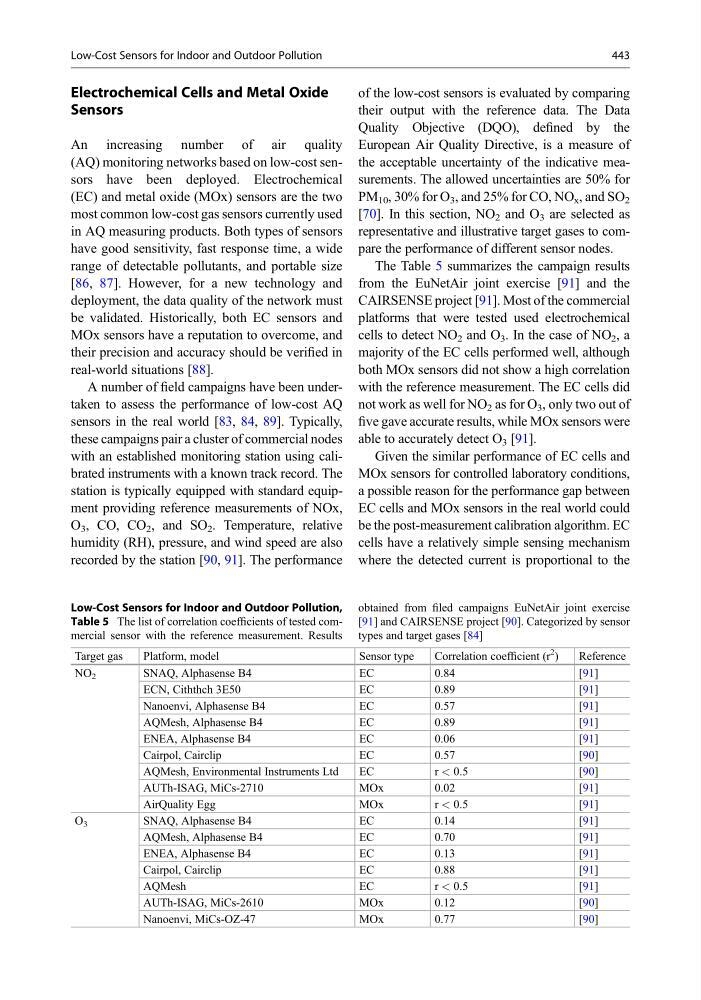
The Table 5 summarizes the campaign results
from the EuNetAir joint exercise [91] and the
CAIRSENSE project [91]. Most of the commercial
platforms that were tested used electrochemical
cells to detect NO 2 and O 3 . In the case of NO 2 , a
majority of the EC cells performed well, although
both MOx sensors did not show a high correlation
with the reference measurement. The EC cells did
not work as well for NO 2 as for O 3 , only two out of
five gave accurate results, while MOx sensors were
able to accurately detect O 3 [91].
Given the similar performance of EC cells and
MOx sensors for controlled laboratory conditions,
a possible reason for the performance gap between
EC cells and MOx sensors in the real world could
be the post-measurement calibration algorithm. EC
cells have a relatively simple sensing mechanism
where the detected current is proportional to the
Low-Cost Sensors for Indoor and Outdoor Pollution,
Table 5 The list of correlation coefficients of tested commercial sensor with the reference measurement. Results
obtained from filed campaigns EuNetAir joint exercise
[91] and CAIRSENSE project [90]. Categorized by sensor
types and target gases [84]
Target gas
Platform, model
Sensor type
Correlation coefficient (r
2
)
Reference
NO 2
SNAQ, Alphasense B4
EC
0.84
[91]
ECN, Ciththch 3E50
EC
0.89
[91]
Nanoenvi, Alphasense B4
EC
0.57
[91]
AQMesh, Alphasense B4
EC
0.89
[91]
ENEA, Alphasense B4
EC
0.06
[91]
Cairpol, Cairclip
EC
0.57
[90]
AQMesh, Environmental Instruments Ltd
EC
r < 0.5
[90]
AUTh-ISAG, MiCs-2710
MOx
0.02
[91]
AirQuality Egg
MOx
r < 0.5
[91]
O 3
SNAQ, Alphasense B4
EC
0.14
[91]
AQMesh, Alphasense B4
EC
0.70
[91]
ENEA, Alphasense B4
EC
0.13
[91]
Cairpol, Cairclip
EC
0.88
[91]
AQMesh
EC
r < 0.5
[91]
AUTh-ISAG, MiCs-2610
MOx
0.12
[90]
Nanoenvi, MiCs-OZ-47
MOx
0.77
[90]
Low-Cost Sensors for Indoor and Outdoor Pollution
443
Sensors
An increasing number of air quality
(AQ) monitoring networks based on low-cost sensors have been deployed. Electrochemical
(EC) and metal oxide (MOx) sensors are the two
most common low-cost gas sensors currently used
in AQ measuring products. Both types of sensors
have good sensitivity, fast response time, a wide
range of detectable pollutants, and portable size
[86, 87]. However, for a new technology and
deployment, the data quality of the network must
be validated. Historically, both EC sensors and
MOx sensors have a reputation to overcome, and
their precision and accuracy should be verified in
real-world situations [88].
A number of field campaigns have been undertaken to assess the performance of low-cost AQ
sensors in the real world [83, 84, 89]. Typically,
these campaigns pair a cluster of commercial nodes
with an established monitoring station using calibrated instruments with a known track record. The
station is typically equipped with standard equipment providing reference measurements of NOx,
O 3 , CO, CO 2 , and SO 2 . Temperature, relative
humidity (RH), pressure, and wind speed are also
recorded by the station [90, 91]. The performance
of the low-cost sensors is evaluated by comparing
their output with the reference data. The Data
Quality Objective (DQO), defined by the
European Air Quality Directive, is a measure of
the acceptable uncertainty of the indicative measurements. The allowed uncertainties are 50% for
PM 10 , 30% for O 3 , and 25% for CO, NO x , and SO 2
[70]. In this section, NO 2 and O 3 are selected as
representative and illustrative target gases to compare the performance of different sensor nodes.
The Table 5 summarizes the campaign results
from the EuNetAir joint exercise [91] and the
CAIRSENSE project [91]. Most of the commercial
platforms that were tested used electrochemical
cells to detect NO 2 and O 3 . In the case of NO 2 , a
majority of the EC cells performed well, although
both MOx sensors did not show a high correlation
with the reference measurement. The EC cells did
not work as well for NO 2 as for O 3 , only two out of
five gave accurate results, while MOx sensors were
able to accurately detect O 3 [91].
Given the similar performance of EC cells and
MOx sensors for controlled laboratory conditions,
a possible reason for the performance gap between
EC cells and MOx sensors in the real world could
be the post-measurement calibration algorithm. EC
cells have a relatively simple sensing mechanism
where the detected current is proportional to the
Low-Cost Sensors for Indoor and Outdoor Pollution,
Table 5 The list of correlation coefficients of tested commercial sensor with the reference measurement. Results
obtained from filed campaigns EuNetAir joint exercise
[91] and CAIRSENSE project [90]. Categorized by sensor
types and target gases [84]
Target gas
Platform, model
Sensor type
Correlation coefficient (r
2
)
Reference
NO 2
SNAQ, Alphasense B4
EC
0.84
[91]
ECN, Ciththch 3E50
EC
0.89
[91]
Nanoenvi, Alphasense B4
EC
0.57
[91]
AQMesh, Alphasense B4
EC
0.89
[91]
ENEA, Alphasense B4
EC
0.06
[91]
Cairpol, Cairclip
EC
0.57
[90]
AQMesh, Environmental Instruments Ltd
EC
r < 0.5
[90]
AUTh-ISAG, MiCs-2710
MOx
0.02
[91]
AirQuality Egg
MOx
r < 0.5
[91]
O 3
SNAQ, Alphasense B4
EC
0.14
[91]
AQMesh, Alphasense B4
EC
0.70
[91]
ENEA, Alphasense B4
EC
0.13
[91]
Cairpol, Cairclip
EC
0.88
[91]
AQMesh
EC
r < 0.5
[91]
AUTh-ISAG, MiCs-2610
MOx
0.12
[90]
Nanoenvi, MiCs-OZ-47
MOx
0.77
[90]
Low-Cost Sensors for Indoor and Outdoor Pollution
443