

gas concentration. However, there is no simple
model that can transform the MOx signal
(normally resistance) into a concentration. Taking
metrological variables (temperature, pressure, etc.)
into account is complicated. It should also be noted
that the same model of EC cells can behave differently in different systems, e.g., AQMesh
Alphasense B4 vs. ENEA Alphasense B4. This
could be due to different applied algorithms, the
design of the electronics, or the sampling method.
In addition, the same platform can perform differently in different situations, for example, the
AQMesh systems as used in Ref. [91] vs. Ref. [90].
In conclusion, the data quality generated by
low-cost sensor platforms has room for improvement, but certainly, they are able to provide low
cost and high time resolution with the trade-off of
somewhat compromised data quality. The EC cells
are more widely applied in commercial products
and at the present time appear to have a better
performance record than MOx sensors; however,
MOx sensors also have good potential for realworld applications if the right algorithm is applied.
Comparison Between MOx,
Electrochemical, and Optical Sensors
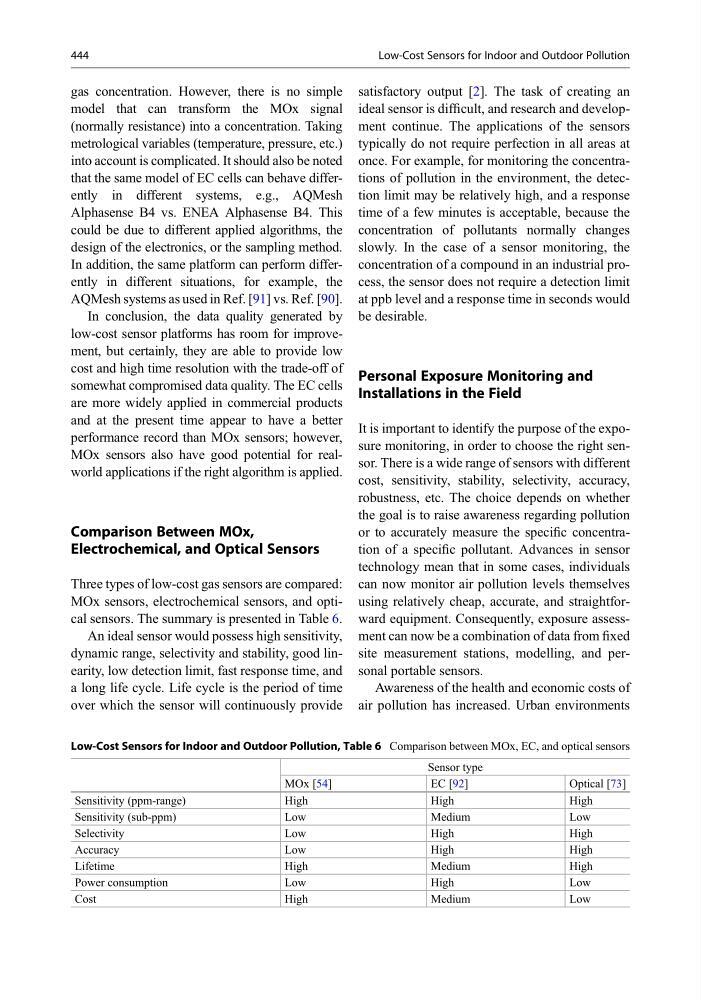
Three types of low-cost gas sensors are compared:
MOx sensors, electrochemical sensors, and optical sensors. The summary is presented in Table 6.
An ideal sensor would possess high sensitivity,
dynamic range, selectivity and stability, good linearity, low detection limit, fast response time, and
a long life cycle. Life cycle is the period of time
over which the sensor will continuously provide
satisfactory output [2]. The task of creating an
ideal sensor is difficult, and research and development continue. The applications of the sensors
typically do not require perfection in all areas at
once. For example, for monitoring the concentrations of pollution in the environment, the detection limit may be relatively high, and a response
time of a few minutes is acceptable, because the
concentration of pollutants normally changes
slowly. In the case of a sensor monitoring, the
concentration of a compound in an industrial process, the sensor does not require a detection limit
at ppb level and a response time in seconds would
be desirable.
Personal Exposure Monitoring and
Installations in the Field
It is important to identify the purpose of the exposure monitoring, in order to choose the right sensor. There is a wide range of sensors with different
cost, sensitivity, stability, selectivity, accuracy,
robustness, etc. The choice depends on whether
the goal is to raise awareness regarding pollution
or to accurately measure the specific concentration of a specific pollutant. Advances in sensor
technology mean that in some cases, individuals
can now monitor air pollution levels themselves
using relatively cheap, accurate, and straightforward equipment. Consequently, exposure assessment can now be a combination of data from fixed
site measurement stations, modelling, and personal portable sensors.
Awareness of the health and economic costs of
air pollution has increased. Urban environments
Low-Cost Sensors for Indoor and Outdoor Pollution, Table 6 Comparison between MOx, EC, and optical sensors
Sensor type
MOx [54]
E C [ 92]
Optical [73]
Sensitivity (ppm-range)
High
High
High
Sensitivity (sub-ppm)
Low
Medium
Low
Selectivity
Low
High
High
Accuracy
Low
High
High
Lifetime
High
Medium
High
Power consumption
Low
High
Low
Cost
High
Medium
Low
444
Low-Cost Sensors for Indoor and Outdoor Pollution
model that can transform the MOx signal
(normally resistance) into a concentration. Taking
metrological variables (temperature, pressure, etc.)
into account is complicated. It should also be noted
that the same model of EC cells can behave differently in different systems, e.g., AQMesh
Alphasense B4 vs. ENEA Alphasense B4. This
could be due to different applied algorithms, the
design of the electronics, or the sampling method.
In addition, the same platform can perform differently in different situations, for example, the
AQMesh systems as used in Ref. [91] vs. Ref. [90].
In conclusion, the data quality generated by
low-cost sensor platforms has room for improvement, but certainly, they are able to provide low
cost and high time resolution with the trade-off of
somewhat compromised data quality. The EC cells
are more widely applied in commercial products
and at the present time appear to have a better
performance record than MOx sensors; however,
MOx sensors also have good potential for realworld applications if the right algorithm is applied.
Comparison Between MOx,
Electrochemical, and Optical Sensors
Three types of low-cost gas sensors are compared:
MOx sensors, electrochemical sensors, and optical sensors. The summary is presented in Table 6.
An ideal sensor would possess high sensitivity,
dynamic range, selectivity and stability, good linearity, low detection limit, fast response time, and
a long life cycle. Life cycle is the period of time
over which the sensor will continuously provide
satisfactory output [2]. The task of creating an
ideal sensor is difficult, and research and development continue. The applications of the sensors
typically do not require perfection in all areas at
once. For example, for monitoring the concentrations of pollution in the environment, the detection limit may be relatively high, and a response
time of a few minutes is acceptable, because the
concentration of pollutants normally changes
slowly. In the case of a sensor monitoring, the
concentration of a compound in an industrial process, the sensor does not require a detection limit
at ppb level and a response time in seconds would
be desirable.
Personal Exposure Monitoring and
Installations in the Field
It is important to identify the purpose of the exposure monitoring, in order to choose the right sensor. There is a wide range of sensors with different
cost, sensitivity, stability, selectivity, accuracy,
robustness, etc. The choice depends on whether
the goal is to raise awareness regarding pollution
or to accurately measure the specific concentration of a specific pollutant. Advances in sensor
technology mean that in some cases, individuals
can now monitor air pollution levels themselves
using relatively cheap, accurate, and straightforward equipment. Consequently, exposure assessment can now be a combination of data from fixed
site measurement stations, modelling, and personal portable sensors.
Awareness of the health and economic costs of
air pollution has increased. Urban environments
Low-Cost Sensors for Indoor and Outdoor Pollution, Table 6 Comparison between MOx, EC, and optical sensors
Sensor type
MOx [54]
E C [ 92]
Optical [73]
Sensitivity (ppm-range)
High
High
High
Sensitivity (sub-ppm)
Low
Medium
Low
Selectivity
Low
High
High
Accuracy
Low
High
High
Lifetime
High
Medium
High
Power consumption
Low
High
Low
Cost
High
Medium
Low
444
Low-Cost Sensors for Indoor and Outdoor Pollution