

by using filters to separate the gases [79]. Other
challenges in using electrochemical sensors
include calibration of the sensitivity to the target
gas, and cross-sensitivity for mixtures of gases,
which depend on temperature, humidity, and
pressure [80].
Potentiometric Sensors
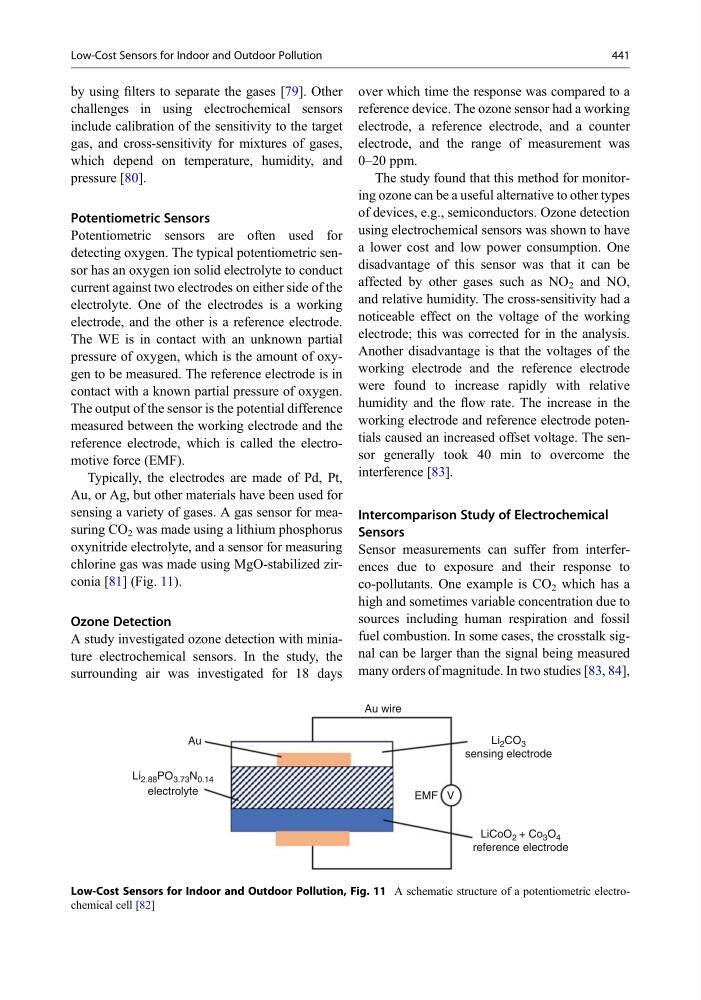
Potentiometric sensors are often used for
detecting oxygen. The typical potentiometric sensor has an oxygen ion solid electrolyte to conduct
current against two electrodes on either side of the
electrolyte. One of the electrodes is a working
electrode, and the other is a reference electrode.
The WE is in contact with an unknown partial
pressure of oxygen, which is the amount of oxygen to be measured. The reference electrode is in
contact with a known partial pressure of oxygen.
The output of the sensor is the potential difference
measured between the working electrode and the
reference electrode, which is called the electromotive force (EMF).
Typically, the electrodes are made of Pd, Pt,
Au, or Ag, but other materials have been used for
sensing a variety of gases. A gas sensor for measuring CO 2 was made using a lithium phosphorus
oxynitride electrolyte, and a sensor for measuring
chlorine gas was made using MgO-stabilized zirconia [81] (Fig. 11).
Ozone Detection
A study investigated ozone detection with miniature electrochemical sensors. In the study, the
surrounding air was investigated for 18 days
over which time the response was compared to a
reference device. The ozone sensor had a working
electrode, a reference electrode, and a counter
electrode, and the range of measurement was
0–20 ppm.
The study found that this method for monitoring ozone can be a useful alternative to other types
of devices, e.g., semiconductors. Ozone detection
using electrochemical sensors was shown to have
a lower cost and low power consumption. One
disadvantage of this sensor was that it can be
affected by other gases such as NO 2 and NO,
and relative humidity. The cross-sensitivity had a
noticeable effect on the voltage of the working
electrode; this was corrected for in the analysis.
Another disadvantage is that the voltages of the
working electrode and the reference electrode
were found to increase rapidly with relative
humidity and the flow rate. The increase in the
working electrode and reference electrode potentials caused an increased offset voltage. The sensor generally took 40 min to overcome the
interference [83].
Intercomparison Study of Electrochemical
Sensors
Sensor measurements can suffer from interferences due to exposure and their response to
co-pollutants. One example is CO 2 which has a
high and sometimes variable concentration due to
sources including human respiration and fossil
fuel combustion. In some cases, the crosstalk signal can be larger than the signal being measured
many orders of magnitude. In two studies [83, 84],
Au wire
Au
EMF
Li 2 CO 3
sensing electrode
LiCoO 2 + Co 3 O 4
reference electrode
Li 2.88 PO 3.73 N 0.14
electrolyte
V
Low-Cost Sensors for Indoor and Outdoor Pollution, Fig. 11 A schematic structure of a potentiometric electrochemical cell [82]
Low-Cost Sensors for Indoor and Outdoor Pollution
441
challenges in using electrochemical sensors
include calibration of the sensitivity to the target
gas, and cross-sensitivity for mixtures of gases,
which depend on temperature, humidity, and
pressure [80].
Potentiometric Sensors
Potentiometric sensors are often used for
detecting oxygen. The typical potentiometric sensor has an oxygen ion solid electrolyte to conduct
current against two electrodes on either side of the
electrolyte. One of the electrodes is a working
electrode, and the other is a reference electrode.
The WE is in contact with an unknown partial
pressure of oxygen, which is the amount of oxygen to be measured. The reference electrode is in
contact with a known partial pressure of oxygen.
The output of the sensor is the potential difference
measured between the working electrode and the
reference electrode, which is called the electromotive force (EMF).
Typically, the electrodes are made of Pd, Pt,
Au, or Ag, but other materials have been used for
sensing a variety of gases. A gas sensor for measuring CO 2 was made using a lithium phosphorus
oxynitride electrolyte, and a sensor for measuring
chlorine gas was made using MgO-stabilized zirconia [81] (Fig. 11).
Ozone Detection
A study investigated ozone detection with miniature electrochemical sensors. In the study, the
surrounding air was investigated for 18 days
over which time the response was compared to a
reference device. The ozone sensor had a working
electrode, a reference electrode, and a counter
electrode, and the range of measurement was
0–20 ppm.
The study found that this method for monitoring ozone can be a useful alternative to other types
of devices, e.g., semiconductors. Ozone detection
using electrochemical sensors was shown to have
a lower cost and low power consumption. One
disadvantage of this sensor was that it can be
affected by other gases such as NO 2 and NO,
and relative humidity. The cross-sensitivity had a
noticeable effect on the voltage of the working
electrode; this was corrected for in the analysis.
Another disadvantage is that the voltages of the
working electrode and the reference electrode
were found to increase rapidly with relative
humidity and the flow rate. The increase in the
working electrode and reference electrode potentials caused an increased offset voltage. The sensor generally took 40 min to overcome the
interference [83].
Intercomparison Study of Electrochemical
Sensors
Sensor measurements can suffer from interferences due to exposure and their response to
co-pollutants. One example is CO 2 which has a
high and sometimes variable concentration due to
sources including human respiration and fossil
fuel combustion. In some cases, the crosstalk signal can be larger than the signal being measured
many orders of magnitude. In two studies [83, 84],
Au wire
Au
EMF
Li 2 CO 3
sensing electrode
LiCoO 2 + Co 3 O 4
reference electrode
Li 2.88 PO 3.73 N 0.14
electrolyte
V
Low-Cost Sensors for Indoor and Outdoor Pollution, Fig. 11 A schematic structure of a potentiometric electrochemical cell [82]
Low-Cost Sensors for Indoor and Outdoor Pollution
441