

of the gas occurs, and typically, the WE is coated
with a catalyst. The catalyst is chosen for a specific gas, which enters through diffusion to give a
high surface area and promote the reaction [48].
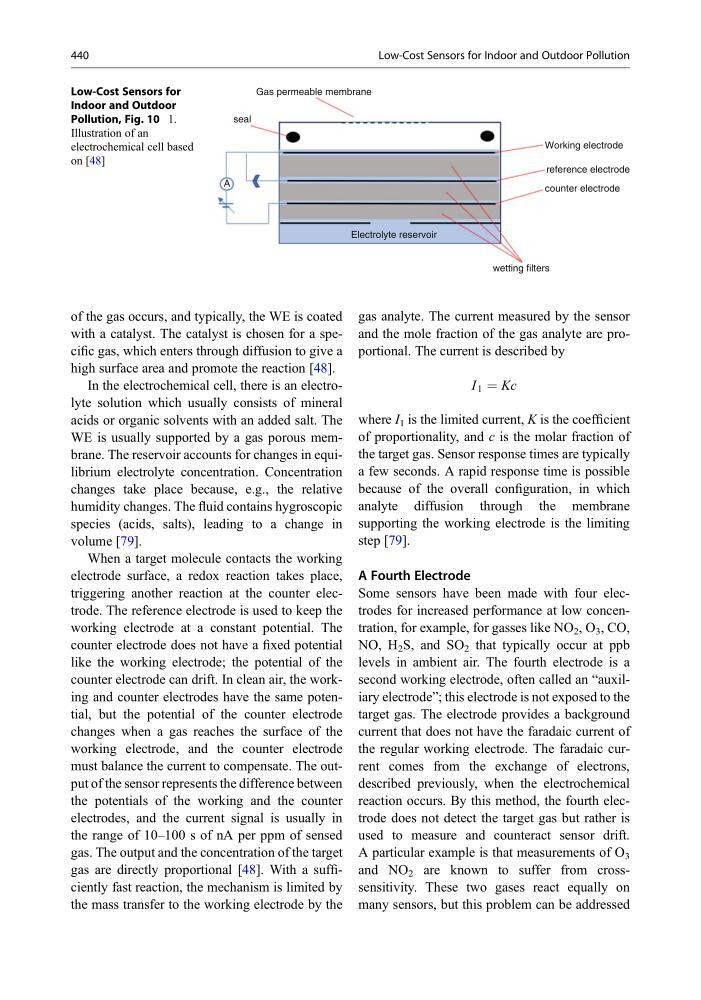
In the electrochemical cell, there is an electrolyte solution which usually consists of mineral
acids or organic solvents with an added salt. The
WE is usually supported by a gas porous membrane. The reservoir accounts for changes in equilibrium electrolyte concentration. Concentration
changes take place because, e.g., the relative
humidity changes. The fluid contains hygroscopic
species (acids, salts), leading to a change in
volume [79].
When a target molecule contacts the working
electrode surface, a redox reaction takes place,
triggering another reaction at the counter electrode. The reference electrode is used to keep the
working electrode at a constant potential. The
counter electrode does not have a fixed potential
like the working electrode; the potential of the
counter electrode can drift. In clean air, the working and counter electrodes have the same potential, but the potential of the counter electrode
changes when a gas reaches the surface of the
working electrode, and the counter electrode
must balance the current to compensate. The output of the sensor represents the difference between
the potentials of the working and the counter
electrodes, and the current signal is usually in
the range of 10–100 s of nA per ppm of sensed
gas. The output and the concentration of the target
gas are directly proportional [48]. With a sufficiently fast reaction, the mechanism is limited by
the mass transfer to the working electrode by the
gas analyte. The current measured by the sensor
and the mole fraction of the gas analyte are proportional. The current is described by
I 1 ¼ Kc
where I 1 is the limited current, K is the coefficient
of proportionality, and c is the molar fraction of
the target gas. Sensor response times are typically
a few seconds. A rapid response time is possible
because of the overall configuration, in which
analyte diffusion through the membrane
supporting the working electrode is the limiting
step [79].
A Fourth Electrode
Some sensors have been made with four electrodes for increased performance at low concentration, for example, for gasses like NO 2 , O 3 , CO,
NO, H 2 S, and SO 2 that typically occur at ppb
levels in ambient air. The fourth electrode is a
second working electrode, often called an “auxiliary electrode”; this electrode is not exposed to the
target gas. The electrode provides a background
current that does not have the faradaic current of
the regular working electrode. The faradaic current comes from the exchange of electrons,
described previously, when the electrochemical
reaction occurs. By this method, the fourth electrode does not detect the target gas but rather is
used to measure and counteract sensor drift.
A particular example is that measurements of O 3
and NO 2 are known to suffer from crosssensitivity. These two gases react equally on
many sensors, but this problem can be addressed
seal
A
Gas permeable membrane
Electrolyte reservoir
Working electrode
reference electrode
counter electrode
wetting filters
Low-Cost Sensors for
Indoor and Outdoor
Pollution, Fig. 10 1.
Illustration of an
electrochemical cell based
on [48]
440
Low-Cost Sensors for Indoor and Outdoor Pollution
with a catalyst. The catalyst is chosen for a specific gas, which enters through diffusion to give a
high surface area and promote the reaction [48].
In the electrochemical cell, there is an electrolyte solution which usually consists of mineral
acids or organic solvents with an added salt. The
WE is usually supported by a gas porous membrane. The reservoir accounts for changes in equilibrium electrolyte concentration. Concentration
changes take place because, e.g., the relative
humidity changes. The fluid contains hygroscopic
species (acids, salts), leading to a change in
volume [79].
When a target molecule contacts the working
electrode surface, a redox reaction takes place,
triggering another reaction at the counter electrode. The reference electrode is used to keep the
working electrode at a constant potential. The
counter electrode does not have a fixed potential
like the working electrode; the potential of the
counter electrode can drift. In clean air, the working and counter electrodes have the same potential, but the potential of the counter electrode
changes when a gas reaches the surface of the
working electrode, and the counter electrode
must balance the current to compensate. The output of the sensor represents the difference between
the potentials of the working and the counter
electrodes, and the current signal is usually in
the range of 10–100 s of nA per ppm of sensed
gas. The output and the concentration of the target
gas are directly proportional [48]. With a sufficiently fast reaction, the mechanism is limited by
the mass transfer to the working electrode by the
gas analyte. The current measured by the sensor
and the mole fraction of the gas analyte are proportional. The current is described by
I 1 ¼ Kc
where I 1 is the limited current, K is the coefficient
of proportionality, and c is the molar fraction of
the target gas. Sensor response times are typically
a few seconds. A rapid response time is possible
because of the overall configuration, in which
analyte diffusion through the membrane
supporting the working electrode is the limiting
step [79].
A Fourth Electrode
Some sensors have been made with four electrodes for increased performance at low concentration, for example, for gasses like NO 2 , O 3 , CO,
NO, H 2 S, and SO 2 that typically occur at ppb
levels in ambient air. The fourth electrode is a
second working electrode, often called an “auxiliary electrode”; this electrode is not exposed to the
target gas. The electrode provides a background
current that does not have the faradaic current of
the regular working electrode. The faradaic current comes from the exchange of electrons,
described previously, when the electrochemical
reaction occurs. By this method, the fourth electrode does not detect the target gas but rather is
used to measure and counteract sensor drift.
A particular example is that measurements of O 3
and NO 2 are known to suffer from crosssensitivity. These two gases react equally on
many sensors, but this problem can be addressed
seal
A
Gas permeable membrane
Electrolyte reservoir
Working electrode
reference electrode
counter electrode
wetting filters
Low-Cost Sensors for
Indoor and Outdoor
Pollution, Fig. 10 1.
Illustration of an
electrochemical cell based
on [48]
440
Low-Cost Sensors for Indoor and Outdoor Pollution