

For the three sensors, the standard deviation was
used to measure the reproducibility. The standard
deviation for a concentration range of 0–100 mg/m
3
varied from 15 to 90 mg/m
3
. The DSM sensor was
the one with the lowest standard deviation, with
relatively constant and small values. The PPD and
the GP2Y sensors had higher standard deviations at
higher particle concentrations, although the relative
standard deviation of all the sensors decreased
when the particle concentration increased. This
implies that the sensors were not very accurate
when measuring low concentrations (<200 mg/
m
3
). The sensor which gave the highest LOD
value, 30.2 mg/m
3
, was the GP2Y. The PPD had
the lowest value of 6.44 mg/m
3
.
Effect of Relative Humidity, Temperature, Particle
Size, and Composition
When tested for particle size dependence, it was
shown that for the same mass concentration, the
sensors’ output increased with decreasing particle
size. The PPD and DSM sensors were shown to be
more sensitive to larger particles, and the GP2Y
sensor was shown to be more sensitive to smaller
particles. Water is effective at absorbing infrared
light, which can lead to an overestimation of the
particle mass concentration because of reduced
light intensity. Water vapor may cause failure in
the circuits and hereby give false results. Overall,
relative humidity has a large effect on the sensors’
output. The temperature was shown to have very
little effect on the three PM sensors in the range of
5–32
C [77].
Particle mass concentrations are calculated
from the size distributions of the particles, and
this depends on the composition and size of the
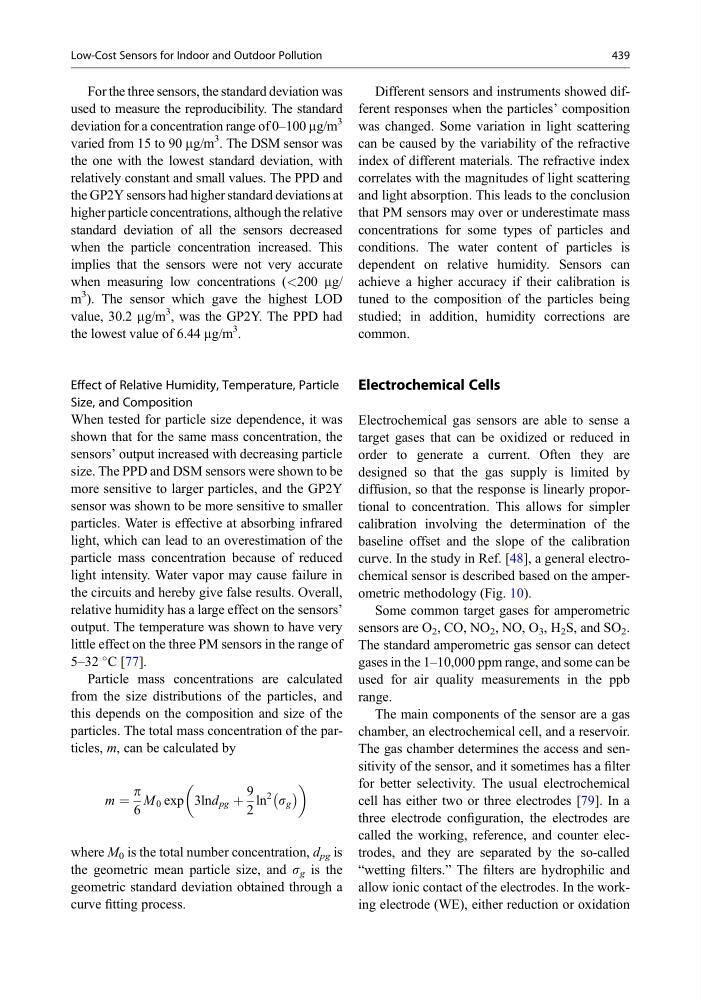
particles. The total mass concentration of the particles, m, can be calculated by
m ¼
p
6
M 0 exp 3lnd pg þ
9
2
ln
2
s g
À Á
where M 0 is the total number concentration, d pg is
the geometric mean particle size, and s g is the
geometric standard deviation obtained through a
curve fitting process.
Different sensors and instruments showed different responses when the particles’ composition
was changed. Some variation in light scattering
can be caused by the variability of the refractive
index of different materials. The refractive index
correlates with the magnitudes of light scattering
and light absorption. This leads to the conclusion
that PM sensors may over or underestimate mass
concentrations for some types of particles and
conditions. The water content of particles is
dependent on relative humidity. Sensors can
achieve a higher accuracy if their calibration is
tuned to the composition of the particles being
studied; in addition, humidity corrections are
common.
Electrochemical Cells
Electrochemical gas sensors are able to sense a
target gases that can be oxidized or reduced in
order to generate a current. Often they are
designed so that the gas supply is limited by
diffusion, so that the response is linearly proportional to concentration. This allows for simpler
calibration involving the determination of the
baseline offset and the slope of the calibration
curve. In the study in Ref. [48], a general electrochemical sensor is described based on the amperometric methodology (Fig. 10).
Some common target gases for amperometric
sensors are O 2 , CO, NO 2 , NO, O 3 , H 2 S, and SO 2 .
The standard amperometric gas sensor can detect
gases in the 1–10,000 ppm range, and some can be
used for air quality measurements in the ppb
range.
The main components of the sensor are a gas
chamber, an electrochemical cell, and a reservoir.
The gas chamber determines the access and sensitivity of the sensor, and it sometimes has a filter
for better selectivity. The usual electrochemical
cell has either two or three electrodes [79]. In a
three electrode configuration, the electrodes are
called the working, reference, and counter electrodes, and they are separated by the so-called
“wetting filters.” The filters are hydrophilic and
allow ionic contact of the electrodes. In the working electrode (WE), either reduction or oxidation
Low-Cost Sensors for Indoor and Outdoor Pollution
439
used to measure the reproducibility. The standard
deviation for a concentration range of 0–100 mg/m
3
varied from 15 to 90 mg/m
3
. The DSM sensor was
the one with the lowest standard deviation, with
relatively constant and small values. The PPD and
the GP2Y sensors had higher standard deviations at
higher particle concentrations, although the relative
standard deviation of all the sensors decreased
when the particle concentration increased. This
implies that the sensors were not very accurate
when measuring low concentrations (<200 mg/
m
3
). The sensor which gave the highest LOD
value, 30.2 mg/m
3
, was the GP2Y. The PPD had
the lowest value of 6.44 mg/m
3
.
Effect of Relative Humidity, Temperature, Particle
Size, and Composition
When tested for particle size dependence, it was
shown that for the same mass concentration, the
sensors’ output increased with decreasing particle
size. The PPD and DSM sensors were shown to be
more sensitive to larger particles, and the GP2Y
sensor was shown to be more sensitive to smaller
particles. Water is effective at absorbing infrared
light, which can lead to an overestimation of the
particle mass concentration because of reduced
light intensity. Water vapor may cause failure in
the circuits and hereby give false results. Overall,
relative humidity has a large effect on the sensors’
output. The temperature was shown to have very
little effect on the three PM sensors in the range of
5–32
C [77].
Particle mass concentrations are calculated
from the size distributions of the particles, and
this depends on the composition and size of the
particles. The total mass concentration of the particles, m, can be calculated by
m ¼
p
6
M 0 exp 3lnd pg þ
9
2
ln
2
s g
À Á
where M 0 is the total number concentration, d pg is
the geometric mean particle size, and s g is the
geometric standard deviation obtained through a
curve fitting process.
Different sensors and instruments showed different responses when the particles’ composition
was changed. Some variation in light scattering
can be caused by the variability of the refractive
index of different materials. The refractive index
correlates with the magnitudes of light scattering
and light absorption. This leads to the conclusion
that PM sensors may over or underestimate mass
concentrations for some types of particles and
conditions. The water content of particles is
dependent on relative humidity. Sensors can
achieve a higher accuracy if their calibration is
tuned to the composition of the particles being
studied; in addition, humidity corrections are
common.
Electrochemical Cells
Electrochemical gas sensors are able to sense a
target gases that can be oxidized or reduced in
order to generate a current. Often they are
designed so that the gas supply is limited by
diffusion, so that the response is linearly proportional to concentration. This allows for simpler
calibration involving the determination of the
baseline offset and the slope of the calibration
curve. In the study in Ref. [48], a general electrochemical sensor is described based on the amperometric methodology (Fig. 10).
Some common target gases for amperometric
sensors are O 2 , CO, NO 2 , NO, O 3 , H 2 S, and SO 2 .
The standard amperometric gas sensor can detect
gases in the 1–10,000 ppm range, and some can be
used for air quality measurements in the ppb
range.
The main components of the sensor are a gas
chamber, an electrochemical cell, and a reservoir.
The gas chamber determines the access and sensitivity of the sensor, and it sometimes has a filter
for better selectivity. The usual electrochemical
cell has either two or three electrodes [79]. In a
three electrode configuration, the electrodes are
called the working, reference, and counter electrodes, and they are separated by the so-called
“wetting filters.” The filters are hydrophilic and
allow ionic contact of the electrodes. In the working electrode (WE), either reduction or oxidation
Low-Cost Sensors for Indoor and Outdoor Pollution
439