

In the context of optical detection of particles,
it is important to note that the sizes of aerosol
particles are similar to optical wavelengths.
A practical implication of the scattering of light
is that if the particle is larger than the wavelength,
light could be absorbed. If the sizes are similar,
light may be scattered in a complex way, and if the
particle is much smaller than the wavelength,
there is no interaction. Since visible light is in
the wavelength range of 380–700 nm, optical
particle counters often have extreme difficulty
measuring ultrafine particles; in contrast, optical
particle counters that measure PM 10 , PM 2.5 , and
PM 1 are commonly available.
In one study [77], three low-cost PM sensors
were tested and compared to three reference instruments. The sensors used were the Shinyei
PPD42NS, in the study called “PPD,” the
Samyoung DSM501A, called “DSM,” and the
Sharp GP2Y1010AU0F, called “GP2Y.” The PPD
and DSM were quite similar in their setup, while the
GP2Y was smaller in geometry. Furthermore, the
GP2Y has a different orientation than the other two
sensors. All three sensors use IREDs (infrared light
emitting diodes) to generate light. The PM sensors
were tested for the linearity of their response, precision, limit of detection, particle composition, size
dependence, and the relative humidity and influence
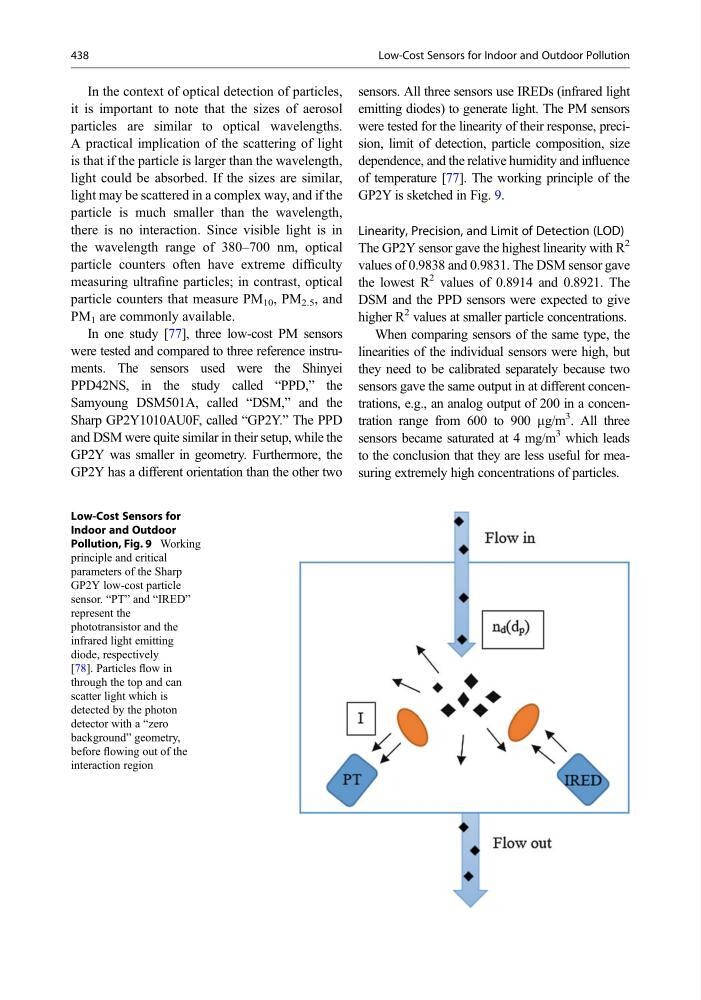
of temperature [77]. The working principle of the
GP2Y is sketched in Fig. 9.
Linearity, Precision, and Limit of Detection (LOD)
The GP2Y sensor gave the highest linearity with R
2
values of 0.9838 and 0.9831. The DSM sensor gave
the lowest R
2 values of 0.8914 and 0.8921. The
DSM and the PPD sensors were expected to give
higher R
2 values at smaller particle concentrations.
When comparing sensors of the same type, the
linearities of the individual sensors were high, but
they need to be calibrated separately because two
sensors gave the same output in at different concentrations, e.g., an analog output of 200 in a concentration range from 600 to 900 mg/m
3
. All three
sensors became saturated at 4 mg/m
3 which leads
to the conclusion that they are less useful for measuring extremely high concentrations of particles.
Low-Cost Sensors for
Indoor and Outdoor
Pollution, Fig. 9 Working
principle and critical
parameters of the Sharp
GP2Y low-cost particle
sensor. “PT” and “IRED”
represent the
phototransistor and the
infrared light emitting
diode, respectively
[78]. Particles flow in
through the top and can
scatter light which is
detected by the photon
detector with a “zero
background” geometry,
before flowing out of the
interaction region
438
Low-Cost Sensors for Indoor and Outdoor Pollution
it is important to note that the sizes of aerosol
particles are similar to optical wavelengths.
A practical implication of the scattering of light
is that if the particle is larger than the wavelength,
light could be absorbed. If the sizes are similar,
light may be scattered in a complex way, and if the
particle is much smaller than the wavelength,
there is no interaction. Since visible light is in
the wavelength range of 380–700 nm, optical
particle counters often have extreme difficulty
measuring ultrafine particles; in contrast, optical
particle counters that measure PM 10 , PM 2.5 , and
PM 1 are commonly available.
In one study [77], three low-cost PM sensors
were tested and compared to three reference instruments. The sensors used were the Shinyei
PPD42NS, in the study called “PPD,” the
Samyoung DSM501A, called “DSM,” and the
Sharp GP2Y1010AU0F, called “GP2Y.” The PPD
and DSM were quite similar in their setup, while the
GP2Y was smaller in geometry. Furthermore, the
GP2Y has a different orientation than the other two
sensors. All three sensors use IREDs (infrared light
emitting diodes) to generate light. The PM sensors
were tested for the linearity of their response, precision, limit of detection, particle composition, size
dependence, and the relative humidity and influence
of temperature [77]. The working principle of the
GP2Y is sketched in Fig. 9.
Linearity, Precision, and Limit of Detection (LOD)
The GP2Y sensor gave the highest linearity with R
2
values of 0.9838 and 0.9831. The DSM sensor gave
the lowest R
2 values of 0.8914 and 0.8921. The
DSM and the PPD sensors were expected to give
higher R
2 values at smaller particle concentrations.
When comparing sensors of the same type, the
linearities of the individual sensors were high, but
they need to be calibrated separately because two
sensors gave the same output in at different concentrations, e.g., an analog output of 200 in a concentration range from 600 to 900 mg/m
3
. All three
sensors became saturated at 4 mg/m
3 which leads
to the conclusion that they are less useful for measuring extremely high concentrations of particles.
Low-Cost Sensors for
Indoor and Outdoor
Pollution, Fig. 9 Working
principle and critical
parameters of the Sharp
GP2Y low-cost particle
sensor. “PT” and “IRED”
represent the
phototransistor and the
infrared light emitting
diode, respectively
[78]. Particles flow in
through the top and can
scatter light which is
detected by the photon
detector with a “zero
background” geometry,
before flowing out of the
interaction region
438
Low-Cost Sensors for Indoor and Outdoor Pollution