

it is larger than the intrinsic noise of the detector
and amplifier.
NDIR has an advantage compared with other
spectroscopic techniques in the area of energy
consumption, since its IR source produces light
at wavelengths in the range of 1–15 mm and thus
can operate at lower temperatures than systems
that use near infrared (NIR) or visible light. Disadvantages of NDIR sensors include spectral
interference (crosstalk from other molecules),
and for some gases, a detection limit above ambient concentrations. NDIR systems perform well
for CO 2 though as it is present at concentrations of
hundreds of ppm and has strong infrared absorptions. NDIR sensitivity depends on the detector
signal per unit of IR intensity, and the detection
limit is a function of both sensitivity and signal-tonoise ratio.
In one study [72], five different NDIR sensors
were used to monitor CO 2 in a barn of dairy cows.
The NDIR sensors are compared with two commonly applied methods: photo-acoustic spectroscopy (PAS) and an open-path laser (OP-laser).
Every sensor was calibrated, tested for linearity,
and sensitivity to static pressure. After the calibration, the NDIR sensors were exposed to CO 2 in
the barn together with PAS analyzers and an
OP-laser for comparison. The tested NDIR sensors showed a small variability of 5%, and they
were sensitive to a static pressure sensitivity of
0.08% of the readings per 1 hPa. It was concluded
that the NDIR CO 2 sensors are appropriate for
multipoint monitoring of CO 2 concentrations in
livestock barns, and that they are a practical alternative to the OP-laser and PAS methods for monitoring averaged spatial or single-point CO 2
concentrations [72].
Particulate Matter
Particulate matter can be characterized by its total
mass per unit volume, for example, as mg/m
3 . The
size distribution of particles is extremely important with implications for the health impact of
particles and their atmospheric lifetime and role,
but it is harder to determine than the number
density of particles. A useful classification is
often made by looking at the total mass density
of particles smaller than a certain threshold, for
example, PM 10 (particles with an aerodynamic
diameter below 10 mm). Similarly, the terms
PM 2.5 , PM 1 , and PM 0.1 are also used. Particles
with an aerodynamic diameter larger than 2.5 mm
are called “coarse” and could include dust and
pollen. Those smaller than 2.5 mm, measured as
PM 2.5 , are “fine” particles and have been associated with a significantly elevated health risk.
There is increased attention on “ultrafine” nanoparticles, with a size smaller than 0.1 mm, measured as PM 0.1 . These particles may be made, e.g.,
as brake dust or diesel soot.
There are both high cost and low-cost devices
for measuring particle mass number concentration. While PM can be measured by many
methods, only the method based on light scattering, called an optical particle counter (OPC), can
be produced at a low cost [76]. We can quickly
note the success of a low-cost particle counter
based on components from a smoke detector. The
system employs two chambers: one for ionization using the active element of a smoke detector
and the second using photoionization. Because
the two chambers have different sensitivities to
fine and ultrafine particles, it is able to discriminate the two size modes with high
accuracy [110].
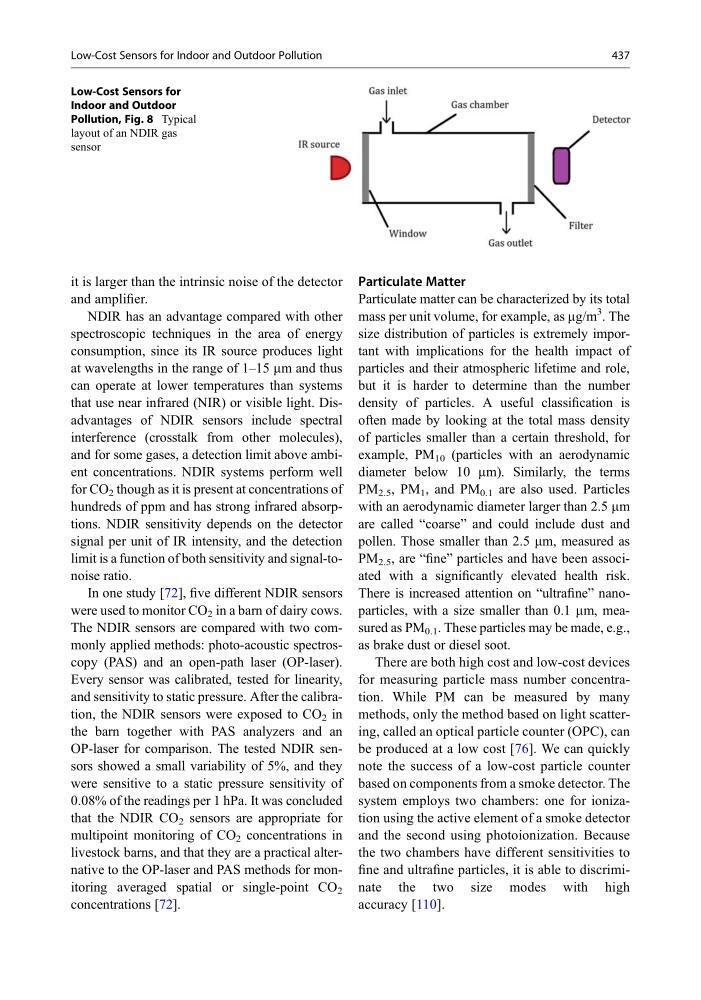
Low-Cost Sensors for
Indoor and Outdoor
Pollution, Fig. 8 Typical
layout of an NDIR gas
sensor
Low-Cost Sensors for Indoor and Outdoor Pollution
437
and amplifier.
NDIR has an advantage compared with other
spectroscopic techniques in the area of energy
consumption, since its IR source produces light
at wavelengths in the range of 1–15 mm and thus
can operate at lower temperatures than systems
that use near infrared (NIR) or visible light. Disadvantages of NDIR sensors include spectral
interference (crosstalk from other molecules),
and for some gases, a detection limit above ambient concentrations. NDIR systems perform well
for CO 2 though as it is present at concentrations of
hundreds of ppm and has strong infrared absorptions. NDIR sensitivity depends on the detector
signal per unit of IR intensity, and the detection
limit is a function of both sensitivity and signal-tonoise ratio.
In one study [72], five different NDIR sensors
were used to monitor CO 2 in a barn of dairy cows.
The NDIR sensors are compared with two commonly applied methods: photo-acoustic spectroscopy (PAS) and an open-path laser (OP-laser).
Every sensor was calibrated, tested for linearity,
and sensitivity to static pressure. After the calibration, the NDIR sensors were exposed to CO 2 in
the barn together with PAS analyzers and an
OP-laser for comparison. The tested NDIR sensors showed a small variability of 5%, and they
were sensitive to a static pressure sensitivity of
0.08% of the readings per 1 hPa. It was concluded
that the NDIR CO 2 sensors are appropriate for
multipoint monitoring of CO 2 concentrations in
livestock barns, and that they are a practical alternative to the OP-laser and PAS methods for monitoring averaged spatial or single-point CO 2
concentrations [72].
Particulate Matter
Particulate matter can be characterized by its total
mass per unit volume, for example, as mg/m
3 . The
size distribution of particles is extremely important with implications for the health impact of
particles and their atmospheric lifetime and role,
but it is harder to determine than the number
density of particles. A useful classification is
often made by looking at the total mass density
of particles smaller than a certain threshold, for
example, PM 10 (particles with an aerodynamic
diameter below 10 mm). Similarly, the terms
PM 2.5 , PM 1 , and PM 0.1 are also used. Particles
with an aerodynamic diameter larger than 2.5 mm
are called “coarse” and could include dust and
pollen. Those smaller than 2.5 mm, measured as
PM 2.5 , are “fine” particles and have been associated with a significantly elevated health risk.
There is increased attention on “ultrafine” nanoparticles, with a size smaller than 0.1 mm, measured as PM 0.1 . These particles may be made, e.g.,
as brake dust or diesel soot.
There are both high cost and low-cost devices
for measuring particle mass number concentration. While PM can be measured by many
methods, only the method based on light scattering, called an optical particle counter (OPC), can
be produced at a low cost [76]. We can quickly
note the success of a low-cost particle counter
based on components from a smoke detector. The
system employs two chambers: one for ionization using the active element of a smoke detector
and the second using photoionization. Because
the two chambers have different sensitivities to
fine and ultrafine particles, it is able to discriminate the two size modes with high
accuracy [110].
Low-Cost Sensors for
Indoor and Outdoor
Pollution, Fig. 8 Typical
layout of an NDIR gas
sensor
Low-Cost Sensors for Indoor and Outdoor Pollution
437