

cycles. If the gas concentration changes quickly, it
may lead to false results. Another disadvantage is
that signal rates higher than 1 per minute cannot
be performed without modelling [69].
Optical Sensors
Optical sensors are a broad class of devices that
use scattering or absorption of light. They range
from simple components that detect when light
levels are above or below a specific level to highly
sensitive devices for detecting single photons.
Sensors are combined with wavelength filters or
dispersion elements in order to perform spectroscopic measurements of single components; the
spectroscopy may be refined further by introducing systems such as atomic emission lamps that
produce a single wavelength and resonant absorption/fluorescence for further increased specificity
and sensitivity. However, one quickly exits the
realm of low-cost sensors to which this entry is
confined. Most optical sensors produce an electrical signal (voltage or current) that is digitized.
Optical techniques are widely applied in atmospheric pollutant monitoring, especially for particulate matter (PM) detection but also for many
trace gases [70].
Gases can be selectively detected based on
their infrared (IR) spectra. Each molecule has a
unique set of vibrational frequencies based on the
masses of the atomic nuclei involved and the force
constants of its chemical bonds, which can be
used as a specific “fingerprint” for that molecule.
A molecule absorbs light at a unique set of energies, determined by these vibrational frequencies.
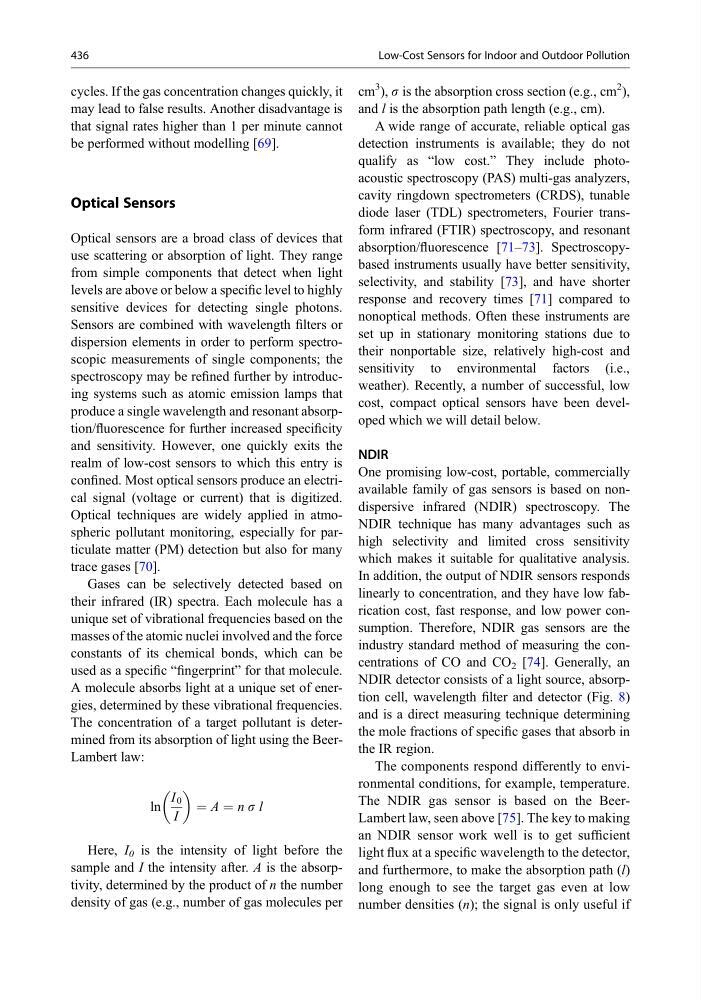
The concentration of a target pollutant is determined from its absorption of light using the BeerLambert law:
ln
I 0
I
¼ A ¼ n s l
Here, I 0 is the intensity of light before the
sample and I the intensity after. A is the absorptivity, determined by the product of n the number
density of gas (e.g., number of gas molecules per
cm
3 ), s is the absorption cross section (e.g., cm
2 ),
and l is the absorption path length (e.g., cm).
A wide range of accurate, reliable optical gas
detection instruments is available; they do not
qualify as “low cost.” They include photoacoustic spectroscopy (PAS) multi-gas analyzers,
cavity ringdown spectrometers (CRDS), tunable
diode laser (TDL) spectrometers, Fourier transform infrared (FTIR) spectroscopy, and resonant
absorption/fluorescence [71–73]. Spectroscopybased instruments usually have better sensitivity,
selectivity, and stability [73], and have shorter
response and recovery times [71] compared to
nonoptical methods. Often these instruments are
set up in stationary monitoring stations due to
their nonportable size, relatively high-cost and
sensitivity to environmental factors (i.e.,
weather). Recently, a number of successful, low
cost, compact optical sensors have been developed which we will detail below.
NDIR
One promising low-cost, portable, commercially
available family of gas sensors is based on nondispersive infrared (NDIR) spectroscopy. The
NDIR technique has many advantages such as
high selectivity and limited cross sensitivity
which makes it suitable for qualitative analysis.
In addition, the output of NDIR sensors responds
linearly to concentration, and they have low fabrication cost, fast response, and low power consumption. Therefore, NDIR gas sensors are the
industry standard method of measuring the concentrations of CO and CO 2 [74]. Generally, an
NDIR detector consists of a light source, absorption cell, wavelength filter and detector (Fig. 8)
and is a direct measuring technique determining
the mole fractions of specific gases that absorb in
the IR region.
The components respond differently to environmental conditions, for example, temperature.
The NDIR gas sensor is based on the BeerLambert law, seen above [75]. The key to making
an NDIR sensor work well is to get sufficient
light flux at a specific wavelength to the detector,
and furthermore, to make the absorption path (l)
long enough to see the target gas even at low
number densities (n); the signal is only useful if
436
Low-Cost Sensors for Indoor and Outdoor Pollution
may lead to false results. Another disadvantage is
that signal rates higher than 1 per minute cannot
be performed without modelling [69].
Optical Sensors
Optical sensors are a broad class of devices that
use scattering or absorption of light. They range
from simple components that detect when light
levels are above or below a specific level to highly
sensitive devices for detecting single photons.
Sensors are combined with wavelength filters or
dispersion elements in order to perform spectroscopic measurements of single components; the
spectroscopy may be refined further by introducing systems such as atomic emission lamps that
produce a single wavelength and resonant absorption/fluorescence for further increased specificity
and sensitivity. However, one quickly exits the
realm of low-cost sensors to which this entry is
confined. Most optical sensors produce an electrical signal (voltage or current) that is digitized.
Optical techniques are widely applied in atmospheric pollutant monitoring, especially for particulate matter (PM) detection but also for many
trace gases [70].
Gases can be selectively detected based on
their infrared (IR) spectra. Each molecule has a
unique set of vibrational frequencies based on the
masses of the atomic nuclei involved and the force
constants of its chemical bonds, which can be
used as a specific “fingerprint” for that molecule.
A molecule absorbs light at a unique set of energies, determined by these vibrational frequencies.
The concentration of a target pollutant is determined from its absorption of light using the BeerLambert law:
ln
I 0
I
¼ A ¼ n s l
Here, I 0 is the intensity of light before the
sample and I the intensity after. A is the absorptivity, determined by the product of n the number
density of gas (e.g., number of gas molecules per
cm
3 ), s is the absorption cross section (e.g., cm
2 ),
and l is the absorption path length (e.g., cm).
A wide range of accurate, reliable optical gas
detection instruments is available; they do not
qualify as “low cost.” They include photoacoustic spectroscopy (PAS) multi-gas analyzers,
cavity ringdown spectrometers (CRDS), tunable
diode laser (TDL) spectrometers, Fourier transform infrared (FTIR) spectroscopy, and resonant
absorption/fluorescence [71–73]. Spectroscopybased instruments usually have better sensitivity,
selectivity, and stability [73], and have shorter
response and recovery times [71] compared to
nonoptical methods. Often these instruments are
set up in stationary monitoring stations due to
their nonportable size, relatively high-cost and
sensitivity to environmental factors (i.e.,
weather). Recently, a number of successful, low
cost, compact optical sensors have been developed which we will detail below.
NDIR
One promising low-cost, portable, commercially
available family of gas sensors is based on nondispersive infrared (NDIR) spectroscopy. The
NDIR technique has many advantages such as
high selectivity and limited cross sensitivity
which makes it suitable for qualitative analysis.
In addition, the output of NDIR sensors responds
linearly to concentration, and they have low fabrication cost, fast response, and low power consumption. Therefore, NDIR gas sensors are the
industry standard method of measuring the concentrations of CO and CO 2 [74]. Generally, an
NDIR detector consists of a light source, absorption cell, wavelength filter and detector (Fig. 8)
and is a direct measuring technique determining
the mole fractions of specific gases that absorb in
the IR region.
The components respond differently to environmental conditions, for example, temperature.
The NDIR gas sensor is based on the BeerLambert law, seen above [75]. The key to making
an NDIR sensor work well is to get sufficient
light flux at a specific wavelength to the detector,
and furthermore, to make the absorption path (l)
long enough to see the target gas even at low
number densities (n); the signal is only useful if
436
Low-Cost Sensors for Indoor and Outdoor Pollution