

Ozone Recovery and Chemistry–Climate
Interactions
Surface observations of halocarbon source gases
from global networks have confirmed the success
of the Montreal Protocol and Amendments in
delaying, and reversing, the increase in atmospheric chlorine concentrations. The abundance
of the shorter-lived source gases (e.g., CH 3 CCl 3 ,
lifetime 6 years) has peaked and these species are
now showing a decline. Longer-lived species
(e.g., CFC-12, lifetime 100 years) have shown a
slowing down in growth and leveling off in abundance. This is consistent with the behavior
expected under regulations imposed by the
Montreal Protocol and Amendments. The protocol allows for some continued production of
HCFCs until 2030.
Overall, we expect the levels of atmospheric
halogens (chlorine and bromine) to return to values
when the Antarctic Ozone hole first appeared
(1980) by about 2050. This date therefore sets the
reference point for the disappearance of the Antarctic Ozone hole if the other atmospheric conditions remain constant. However, because of
increases in greenhouse gases (GHGs), and associated climate change, the atmosphere in 2050 will
be markedly different to 1980. The main radiative
impact of GHG increases is a cooling of the stratosphere (accompanied by the well-known warming
of the surface). This cooling of the stratosphere will
impact the temperature-dependent ozone chemistry. Colder temperatures in the lower stratosphere
will cause more PSCs and so while the halogen
loading remains high this could lead to increased
ozone loss. On the other hand, colder temperatures
will tend to slow down the rate of the gas-phase
reactions which destroy ozone (from all cycles).
This will lead to more stratospheric ozone. Other
climate change feedbacks might occur, e.g., a
strengthening of the stratospheric meridional circulation [19], which will transport more ozone to
higher latitudes. State-of-the-art predictions [20]
for the future of the ozone layer are shown in
Fig. 5. These CCM results show that rate of
ozone layer recovery will vary with region. The
model experiments also clearly show that climate
change (stratospheric cooling) acts to speed up the
future increase in ozone.
The gray shaded line included both changes.
The blue shaded line shows the effect of ODS
changes only. The orange shaded line shows the
effect of GHG increases only. The pink line shows
the change in ODS concentrations in the models
(right hand axis). (From [20]).
Future Directions
An important current stratospheric science topic
concerns the rate of ozone recovery and the interactions between this and climate change (see section “Ozone Recovery and Chemistry–Climate
Interactions”). While the expected decrease in
15000
10000
5000
0
500
400
300
200
100
Cases per million people per year
Predicted abundance (parts per trillion)
0
1980 2000 2020 2040
Year
Copenhagen
1992
London
1990
London
1990
Montreal
1987
Montreal
1987
Excess skin
cancer cases
Effective
stratospheric
chlorine
No protocol
No protocol
Zero emissions
Beijing
1999
Copenhagen
1992
2060 2080 2100
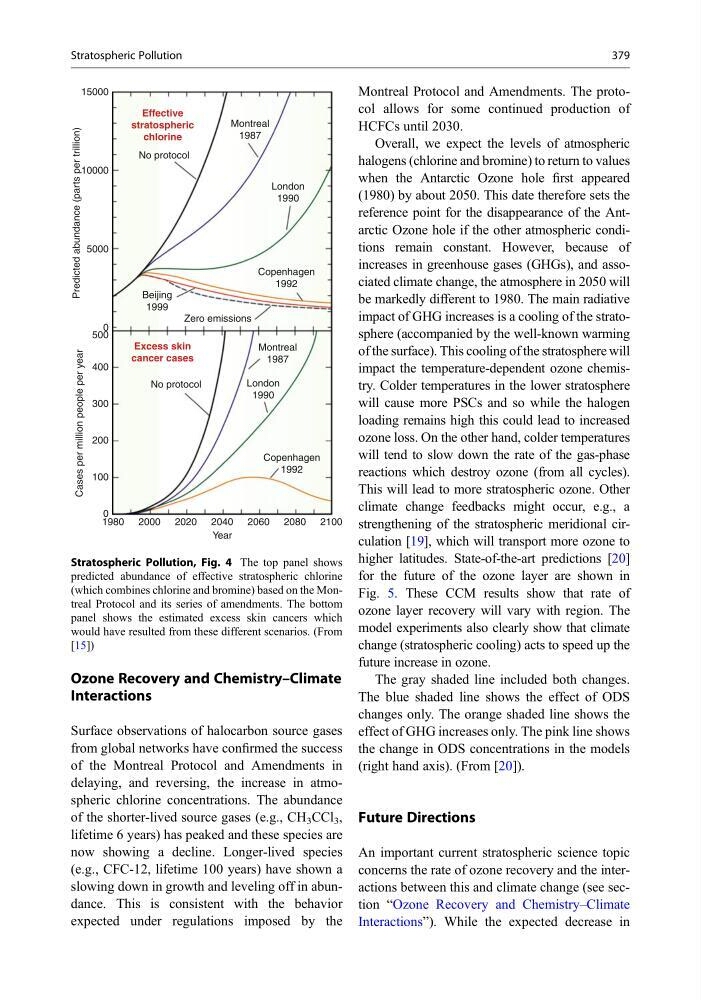
Stratospheric Pollution, Fig. 4 The top panel shows
predicted abundance of effective stratospheric chlorine
(which combines chlorine and bromine) based on the Montreal Protocol and its series of amendments. The bottom
panel shows the estimated excess skin cancers which
would have resulted from these different scenarios. (From
[15])
Stratospheric Pollution
379
Interactions
Surface observations of halocarbon source gases
from global networks have confirmed the success
of the Montreal Protocol and Amendments in
delaying, and reversing, the increase in atmospheric chlorine concentrations. The abundance
of the shorter-lived source gases (e.g., CH 3 CCl 3 ,
lifetime 6 years) has peaked and these species are
now showing a decline. Longer-lived species
(e.g., CFC-12, lifetime 100 years) have shown a
slowing down in growth and leveling off in abundance. This is consistent with the behavior
expected under regulations imposed by the
Montreal Protocol and Amendments. The protocol allows for some continued production of
HCFCs until 2030.
Overall, we expect the levels of atmospheric
halogens (chlorine and bromine) to return to values
when the Antarctic Ozone hole first appeared
(1980) by about 2050. This date therefore sets the
reference point for the disappearance of the Antarctic Ozone hole if the other atmospheric conditions remain constant. However, because of
increases in greenhouse gases (GHGs), and associated climate change, the atmosphere in 2050 will
be markedly different to 1980. The main radiative
impact of GHG increases is a cooling of the stratosphere (accompanied by the well-known warming
of the surface). This cooling of the stratosphere will
impact the temperature-dependent ozone chemistry. Colder temperatures in the lower stratosphere
will cause more PSCs and so while the halogen
loading remains high this could lead to increased
ozone loss. On the other hand, colder temperatures
will tend to slow down the rate of the gas-phase
reactions which destroy ozone (from all cycles).
This will lead to more stratospheric ozone. Other
climate change feedbacks might occur, e.g., a
strengthening of the stratospheric meridional circulation [19], which will transport more ozone to
higher latitudes. State-of-the-art predictions [20]
for the future of the ozone layer are shown in
Fig. 5. These CCM results show that rate of
ozone layer recovery will vary with region. The
model experiments also clearly show that climate
change (stratospheric cooling) acts to speed up the
future increase in ozone.
The gray shaded line included both changes.
The blue shaded line shows the effect of ODS
changes only. The orange shaded line shows the
effect of GHG increases only. The pink line shows
the change in ODS concentrations in the models
(right hand axis). (From [20]).
Future Directions
An important current stratospheric science topic
concerns the rate of ozone recovery and the interactions between this and climate change (see section “Ozone Recovery and Chemistry–Climate
Interactions”). While the expected decrease in
15000
10000
5000
0
500
400
300
200
100
Cases per million people per year
Predicted abundance (parts per trillion)
0
1980 2000 2020 2040
Year
Copenhagen
1992
London
1990
London
1990
Montreal
1987
Montreal
1987
Excess skin
cancer cases
Effective
stratospheric
chlorine
No protocol
No protocol
Zero emissions
Beijing
1999
Copenhagen
1992
2060 2080 2100
Stratospheric Pollution, Fig. 4 The top panel shows
predicted abundance of effective stratospheric chlorine
(which combines chlorine and bromine) based on the Montreal Protocol and its series of amendments. The bottom
panel shows the estimated excess skin cancers which
would have resulted from these different scenarios. (From
[15])
Stratospheric Pollution
379