

CFCs; the models were wrong because they did
not contain a description of the role of PSCs and
heterogeneous chemistry.
The first significant attempt at international
regulation was the Vienna Convention for the
Protection of the Ozone Layer in March 1985.
This resulted in 22 countries agreeing to reduce
CFC emissions and to study the impact of CFCs
on ozone further. In September 1987, the Montreal Protocol was signed, initially by 27 countries,
leading to some limits in the production of CFCs
and halons. There were two key elements to the
Montreal Protocol which contributed to its ultimate success. First, a Multilateral Fund was set up
to help developing countries phase out the use of
ozone-depleting substances. Second, the protocol
allowed for strengthening of the regulations
should stronger scientific evidence linking CFCs
to ozone loss emerge. Following intense scientific
research in the late 1980s and 1990s to determine
the cause of polar and global ozone depletion,
such unequivocal evidence was found. The Montreal Protocol was strengthened in a series of
amendments: London (1990), Copenhagen
(1992), Montreal (1997), and Beijing (1999).
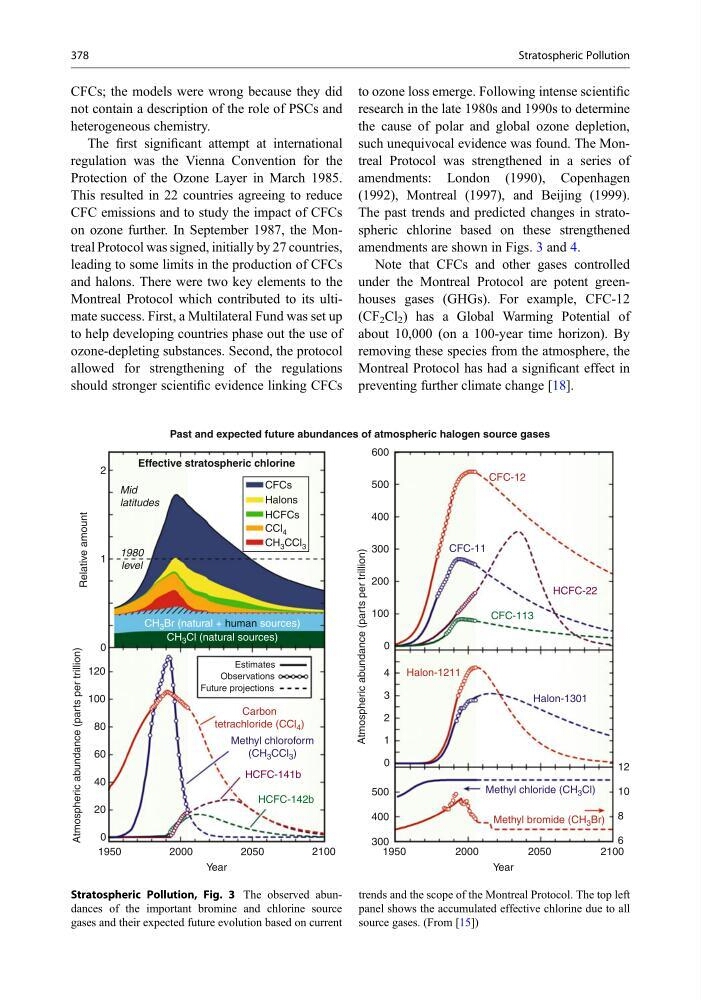
The past trends and predicted changes in stratospheric chlorine based on these strengthened
amendments are shown in Figs. 3 and 4.
Note that CFCs and other gases controlled
under the Montreal Protocol are potent greenhouses gases (GHGs). For example, CFC-12
(CF 2 Cl 2 ) has a Global Warming Potential of
about 10,000 (on a 100-year time horizon). By
removing these species from the atmosphere, the
Montreal Protocol has had a significant effect in
preventing further climate change [18].
2
1
0
120
100
80
60
40
20
0
1950
2000
2050
HCFC-142b
HCFC-141b
Methyl chloroform
(CH 3 CCl 3 )
Carbon
tetrachloride (CCl 4 )
CH 3 Br (natural + human sources)
CH 3 Cl (natural sources)
Effective stratospheric chlorine
Past and expected future abundances of atmospheric halogen source gases
Estimates
CFCs
Halons
HCFCs
CCl 4
CH 3 CCl 3
Observations
1980
level
Mid
latitudes
Future projections
CFC-12
CFC-11
HCFC-22
CFC-113
Halon-1211
Halon-1301
Methyl chloride (CH 3 Cl)
Methyl bromide (CH 3 Br)
Year
2100
600
300
400
500
100
200
0
3
4
2
1
0
500
400
300
1950
2000
2050
Year
2100
Atmospheric abundance (parts per trillion)
Atmospheric abundance (parts per trillion)
Relative amount
6
8
10
12
Stratospheric Pollution, Fig. 3 The observed abundances of the important bromine and chlorine source
gases and their expected future evolution based on current
trends and the scope of the Montreal Protocol. The top left
panel shows the accumulated effective chlorine due to all
source gases. (From [15])
378
Stratospheric Pollution
not contain a description of the role of PSCs and
heterogeneous chemistry.
The first significant attempt at international
regulation was the Vienna Convention for the
Protection of the Ozone Layer in March 1985.
This resulted in 22 countries agreeing to reduce
CFC emissions and to study the impact of CFCs
on ozone further. In September 1987, the Montreal Protocol was signed, initially by 27 countries,
leading to some limits in the production of CFCs
and halons. There were two key elements to the
Montreal Protocol which contributed to its ultimate success. First, a Multilateral Fund was set up
to help developing countries phase out the use of
ozone-depleting substances. Second, the protocol
allowed for strengthening of the regulations
should stronger scientific evidence linking CFCs
to ozone loss emerge. Following intense scientific
research in the late 1980s and 1990s to determine
the cause of polar and global ozone depletion,
such unequivocal evidence was found. The Montreal Protocol was strengthened in a series of
amendments: London (1990), Copenhagen
(1992), Montreal (1997), and Beijing (1999).
The past trends and predicted changes in stratospheric chlorine based on these strengthened
amendments are shown in Figs. 3 and 4.
Note that CFCs and other gases controlled
under the Montreal Protocol are potent greenhouses gases (GHGs). For example, CFC-12
(CF 2 Cl 2 ) has a Global Warming Potential of
about 10,000 (on a 100-year time horizon). By
removing these species from the atmosphere, the
Montreal Protocol has had a significant effect in
preventing further climate change [18].
2
1
0
120
100
80
60
40
20
0
1950
2000
2050
HCFC-142b
HCFC-141b
Methyl chloroform
(CH 3 CCl 3 )
Carbon
tetrachloride (CCl 4 )
CH 3 Br (natural + human sources)
CH 3 Cl (natural sources)
Effective stratospheric chlorine
Past and expected future abundances of atmospheric halogen source gases
Estimates
CFCs
Halons
HCFCs
CCl 4
CH 3 CCl 3
Observations
1980
level
Mid
latitudes
Future projections
CFC-12
CFC-11
HCFC-22
CFC-113
Halon-1211
Halon-1301
Methyl chloride (CH 3 Cl)
Methyl bromide (CH 3 Br)
Year
2100
600
300
400
500
100
200
0
3
4
2
1
0
500
400
300
1950
2000
2050
Year
2100
Atmospheric abundance (parts per trillion)
Atmospheric abundance (parts per trillion)
Relative amount
6
8
10
12
Stratospheric Pollution, Fig. 3 The observed abundances of the important bromine and chlorine source
gases and their expected future evolution based on current
trends and the scope of the Montreal Protocol. The top left
panel shows the accumulated effective chlorine due to all
source gases. (From [15])
378
Stratospheric Pollution