

reservoir species. Concern about the increasing
levels of chlorine in the atmosphere started in
1974 when Molina and Rowland [5] suggested
that the only atmospheric sink for the stable,
inert CFC molecules was transport to the stratosphere where they would be broken down by short
wavelength UV radiation to release chlorine,
which could catalytically destroy ozone.
Ozone Depletion
Polar Ozone Loss
The most dramatic manifestation of humaninduced ozone depletion has occurred over the
Antarctic in springtime, the so-called Antarctic
Ozone Hole. Reductions in the stratospheric
ozone column over Antarctica were first detected
by Farman et al. [6] in the early to mid-1980s.
Observations of ozone loss in this region were a
complete surprise to the scientific community as it
was believed that in the cold Antarctic lower
stratosphere, ozone should be very stable and
long-lived. The publication of the observed
decrease initiated an intense period of scientific
study with field campaigns to Antarctica, analysis
of satellite data and numerical modeling. It was
rapidly established that the cause of the ozone loss
was high levels of “active chlorine” [7], i.e., chlorine present as ozone-destroying radicals (ClO)
rather than in the reservoir form. A new catalytic
cycle involving the dimer of ClO (catalyzing 2O 3
! 3O 2 ) was proposed to explain how ClO could
destroy ozone in the cold polar lower stratosphere
when sunlight returns in spring [8]. Temperatures
in the Antarctic lower stratosphere in winter, when
there is 24-h darkness, can reach as low as
185–190 K. Strong westerly winds form a polar
vortex which isolates the stratosphere over Antarctica from middle latitudes. A key step to
explaining polar ozone depletion was the discovery that polar stratospheric clouds (PSCs), which
form at around 20 km in the polar regions despite
the low pressures and dry stratosphere, could initiate heterogeneous reactions [9], which convert
the normally stable reservoir HCl and ClONO 2 to
the active radical form. Thus, it is the cold isolated
conditions of the Antarctic lower stratosphere in
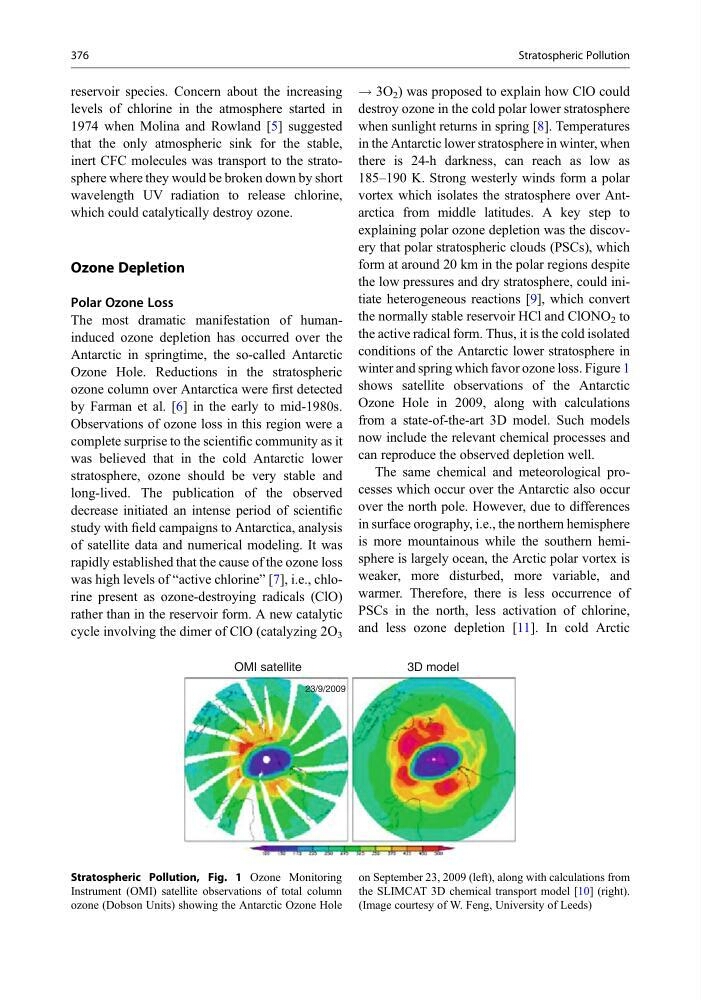
winter and spring which favor ozone loss. Figure 1
shows satellite observations of the Antarctic
Ozone Hole in 2009, along with calculations
from a state-of-the-art 3D model. Such models
now include the relevant chemical processes and
can reproduce the observed depletion well.
The same chemical and meteorological processes which occur over the Antarctic also occur
over the north pole. However, due to differences
in surface orography, i.e., the northern hemisphere
is more mountainous while the southern hemisphere is largely ocean, the Arctic polar vortex is
weaker, more disturbed, more variable, and
warmer. Therefore, there is less occurrence of
PSCs in the north, less activation of chlorine,
and less ozone depletion [11]. In cold Arctic
OMI satellite
23/9/2009
3D model
Stratospheric Pollution, Fig. 1 Ozone Monitoring
Instrument (OMI) satellite observations of total column
ozone (Dobson Units) showing the Antarctic Ozone Hole
on September 23, 2009 (left), along with calculations from
the SLIMCAT 3D chemical transport model [10] (right).
(Image courtesy of W. Feng, University of Leeds)
376
Stratospheric Pollution
levels of chlorine in the atmosphere started in
1974 when Molina and Rowland [5] suggested
that the only atmospheric sink for the stable,
inert CFC molecules was transport to the stratosphere where they would be broken down by short
wavelength UV radiation to release chlorine,
which could catalytically destroy ozone.
Ozone Depletion
Polar Ozone Loss
The most dramatic manifestation of humaninduced ozone depletion has occurred over the
Antarctic in springtime, the so-called Antarctic
Ozone Hole. Reductions in the stratospheric
ozone column over Antarctica were first detected
by Farman et al. [6] in the early to mid-1980s.
Observations of ozone loss in this region were a
complete surprise to the scientific community as it
was believed that in the cold Antarctic lower
stratosphere, ozone should be very stable and
long-lived. The publication of the observed
decrease initiated an intense period of scientific
study with field campaigns to Antarctica, analysis
of satellite data and numerical modeling. It was
rapidly established that the cause of the ozone loss
was high levels of “active chlorine” [7], i.e., chlorine present as ozone-destroying radicals (ClO)
rather than in the reservoir form. A new catalytic
cycle involving the dimer of ClO (catalyzing 2O 3
! 3O 2 ) was proposed to explain how ClO could
destroy ozone in the cold polar lower stratosphere
when sunlight returns in spring [8]. Temperatures
in the Antarctic lower stratosphere in winter, when
there is 24-h darkness, can reach as low as
185–190 K. Strong westerly winds form a polar
vortex which isolates the stratosphere over Antarctica from middle latitudes. A key step to
explaining polar ozone depletion was the discovery that polar stratospheric clouds (PSCs), which
form at around 20 km in the polar regions despite
the low pressures and dry stratosphere, could initiate heterogeneous reactions [9], which convert
the normally stable reservoir HCl and ClONO 2 to
the active radical form. Thus, it is the cold isolated
conditions of the Antarctic lower stratosphere in
winter and spring which favor ozone loss. Figure 1
shows satellite observations of the Antarctic
Ozone Hole in 2009, along with calculations
from a state-of-the-art 3D model. Such models
now include the relevant chemical processes and
can reproduce the observed depletion well.
The same chemical and meteorological processes which occur over the Antarctic also occur
over the north pole. However, due to differences
in surface orography, i.e., the northern hemisphere
is more mountainous while the southern hemisphere is largely ocean, the Arctic polar vortex is
weaker, more disturbed, more variable, and
warmer. Therefore, there is less occurrence of
PSCs in the north, less activation of chlorine,
and less ozone depletion [11]. In cold Arctic
OMI satellite
23/9/2009
3D model
Stratospheric Pollution, Fig. 1 Ozone Monitoring
Instrument (OMI) satellite observations of total column
ozone (Dobson Units) showing the Antarctic Ozone Hole
on September 23, 2009 (left), along with calculations from
the SLIMCAT 3D chemical transport model [10] (right).
(Image courtesy of W. Feng, University of Leeds)
376
Stratospheric Pollution