

level can affect ozone that is present in the part per
million (1 in 10
6 ) level in the stratosphere. Concern over stratospheric ozone depletion really
started in the early 1970s with the realization
that O 3 could be destroyed catalytically by NOx
(NO + NO 2 ) [2], and that large fleets of proposed
supersonic aircraft, flying near 18 km, could
directly inject NOx into the stratosphere [3]. As
it turned out, very few supersonic passenger aircraft (i.e., Concorde) were built so the impact on
the ozone layer was small. In 1974, attention
turned to chlorine when it was proposed that this
family could catalytically destroy ozone [4].
Catalytic cycles can also be based on:
X þ O 3 ! XO þ O 2
Y þ O 3 ! YO þ O 2
XO þ YO ! XY þ O 2
ð5Þ
XY þ hv ! X þ Y
Net : 2O 3 ! 3O 2
ð6Þ
The details of steps (5) and (6) vary between
different cycles (i.e., different species X and Y),
though all such cycles catalyze 2O 3 ! 3O 2 . As
these cycles do not depend on the concentration of
atomic oxygen they are more efficient in the lower
stratosphere.
Stratospheric Chemistry
There are a number of important chemical families whose species can lead to stratospheric ozone
destruction. For each of these families there are
one or more source gases, reservoirs, and radicals.
Source gases are the long-lived species (lifetime
many years) which can be transported from the
surface to the stratosphere. Once in the stratosphere these source gases decompose to release
radicals. These are the species which can catalytically destroy ozone in cycles described in section
“Catalytic Ozone Loss”. However, the radicals
can also become temporarily tied up in reservoir
species; these species do not destroy ozone and,
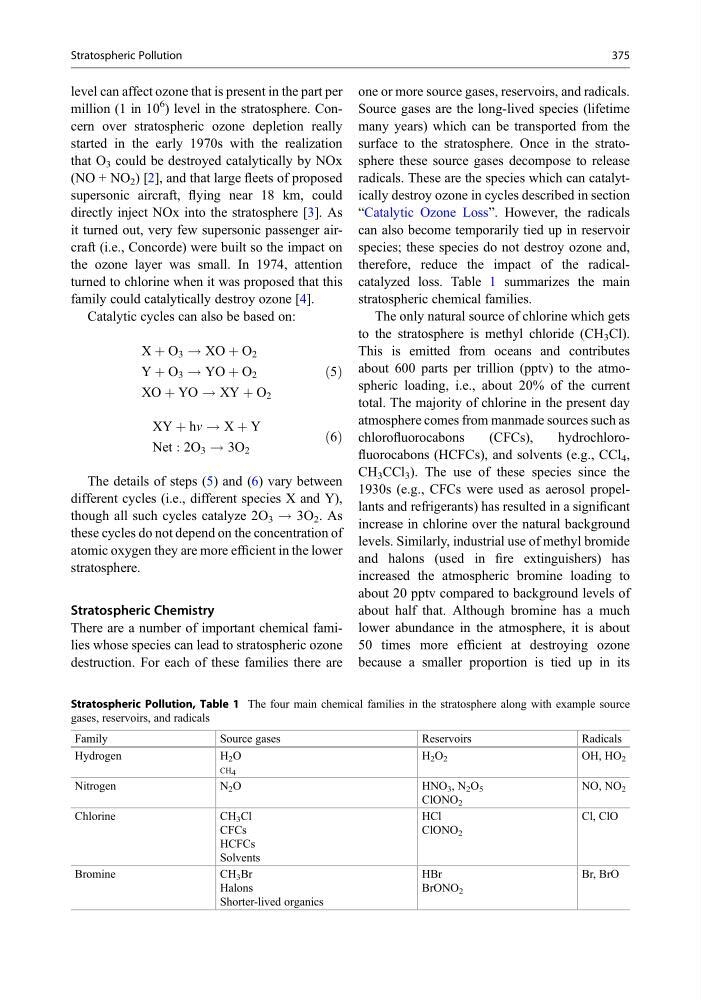
therefore, reduce the impact of the radicalcatalyzed loss. Table 1 summarizes the main
stratospheric chemical families.
The only natural source of chlorine which gets
to the stratosphere is methyl chloride (CH 3 Cl).
This is emitted from oceans and contributes
about 600 parts per trillion (pptv) to the atmospheric loading, i.e., about 20% of the current
total. The majority of chlorine in the present day
atmosphere comes from manmade sources such as
chlorofluorocabons
(CFCs),
hydrochlorofluorocabons (HCFCs), and solvents (e.g., CCl 4 ,
CH 3 CCl 3 ). The use of these species since the
1930s (e.g., CFCs were used as aerosol propellants and refrigerants) has resulted in a significant
increase in chlorine over the natural background
levels. Similarly, industrial use of methyl bromide
and halons (used in fire extinguishers) has
increased the atmospheric bromine loading to
about 20 pptv compared to background levels of
about half that. Although bromine has a much
lower abundance in the atmosphere, it is about
50 times more efficient at destroying ozone
because a smaller proportion is tied up in its
Stratospheric Pollution, Table 1 The four main chemical families in the stratosphere along with example source
gases, reservoirs, and radicals
Family
Source gases
Reservoirs
Radicals
Hydrogen
H 2 O
CH 4
H 2 O 2
OH, HO 2
Nitrogen
N 2 O
HNO 3 , N 2 O 5
ClONO 2
NO, NO 2
Chlorine
CH 3 Cl
CFCs
HCFCs
Solvents
HCl
ClONO 2
Cl, ClO
Bromine
CH 3 Br
Halons
Shorter-lived organics
HBr
BrONO 2
Br, BrO
Stratospheric Pollution
375
million (1 in 10
6 ) level in the stratosphere. Concern over stratospheric ozone depletion really
started in the early 1970s with the realization
that O 3 could be destroyed catalytically by NOx
(NO + NO 2 ) [2], and that large fleets of proposed
supersonic aircraft, flying near 18 km, could
directly inject NOx into the stratosphere [3]. As
it turned out, very few supersonic passenger aircraft (i.e., Concorde) were built so the impact on
the ozone layer was small. In 1974, attention
turned to chlorine when it was proposed that this
family could catalytically destroy ozone [4].
Catalytic cycles can also be based on:
X þ O 3 ! XO þ O 2
Y þ O 3 ! YO þ O 2
XO þ YO ! XY þ O 2
ð5Þ
XY þ hv ! X þ Y
Net : 2O 3 ! 3O 2
ð6Þ
The details of steps (5) and (6) vary between
different cycles (i.e., different species X and Y),
though all such cycles catalyze 2O 3 ! 3O 2 . As
these cycles do not depend on the concentration of
atomic oxygen they are more efficient in the lower
stratosphere.
Stratospheric Chemistry
There are a number of important chemical families whose species can lead to stratospheric ozone
destruction. For each of these families there are
one or more source gases, reservoirs, and radicals.
Source gases are the long-lived species (lifetime
many years) which can be transported from the
surface to the stratosphere. Once in the stratosphere these source gases decompose to release
radicals. These are the species which can catalytically destroy ozone in cycles described in section
“Catalytic Ozone Loss”. However, the radicals
can also become temporarily tied up in reservoir
species; these species do not destroy ozone and,
therefore, reduce the impact of the radicalcatalyzed loss. Table 1 summarizes the main
stratospheric chemical families.
The only natural source of chlorine which gets
to the stratosphere is methyl chloride (CH 3 Cl).
This is emitted from oceans and contributes
about 600 parts per trillion (pptv) to the atmospheric loading, i.e., about 20% of the current
total. The majority of chlorine in the present day
atmosphere comes from manmade sources such as
chlorofluorocabons
(CFCs),
hydrochlorofluorocabons (HCFCs), and solvents (e.g., CCl 4 ,
CH 3 CCl 3 ). The use of these species since the
1930s (e.g., CFCs were used as aerosol propellants and refrigerants) has resulted in a significant
increase in chlorine over the natural background
levels. Similarly, industrial use of methyl bromide
and halons (used in fire extinguishers) has
increased the atmospheric bromine loading to
about 20 pptv compared to background levels of
about half that. Although bromine has a much
lower abundance in the atmosphere, it is about
50 times more efficient at destroying ozone
because a smaller proportion is tied up in its
Stratospheric Pollution, Table 1 The four main chemical families in the stratosphere along with example source
gases, reservoirs, and radicals
Family
Source gases
Reservoirs
Radicals
Hydrogen
H 2 O
CH 4
H 2 O 2
OH, HO 2
Nitrogen
N 2 O
HNO 3 , N 2 O 5
ClONO 2
NO, NO 2
Chlorine
CH 3 Cl
CFCs
HCFCs
Solvents
HCl
ClONO 2
Cl, ClO
Bromine
CH 3 Br
Halons
Shorter-lived organics
HBr
BrONO 2
Br, BrO
Stratospheric Pollution
375