

summertime ozone concentrations and the severity of summer smogs over the coming decades,
with the largest effects in polluted, urban areas
[75–77]. The potential impact of climate change
on PM is much less certain. Important factors in
changes in PM owing to climate change include
precipitation frequency and mixing depth, as well
as wildfire frequencies [75, 76]. In addition to the
uncertainty of the impact of climate change on PM
emissions, the uncertainty of the reverse, the
impact of PM on climate change, is also large.
Part of this uncertainty arises from the differences
in aerosol types and their climate properties. Sulfates and nitrates have an overall cooling
(negative radiative forcing) effect, whereas black
carbon has an overall warming effect [36]. Therefore, while the reduction of PM improves air
quality, it may result in further atmospheric
warming in terms of climate change. In addition
to direct forcing, aerosols can also act as cloud
condensation nuclei (CCN) and exert an indirect
effect on climate. The abundance of CCN affects
cloud formation and cloud lifetime, which in turn
affects the scattering and absorption of radiation
and therefore climate. Preliminary model results
show a range of increases and decreases in PM
concentrations for different regions in response to
climate change [75, 76].
While controls of CO 2 emissions should
remain a priority for mitigation of global climate
change, reductions in emissions of air pollutants
could have a faster impact on slowing warming
trends in the short term (10–30 years). Raes and
Seinfeld [78] have pointed out that we maybe on a
“bumpy road” to recovery with larger short-term
increases in temperature, owing partly to the fact
that significant amounts of long-lived GHGs are
already in the atmosphere but also because reductions in atmospheric aerosols in the next decade or
so will add to the positive radiative forcing of the
Earth’s climate.
Mitigation of short-lived agents with high radiative forcing may reduce the possibility of catastrophic climate change in particularly sensitive
regions such as the Arctic. However, mitigation
decisions must be based on sound science and
Atmospheric concentrations
Atmospheric
concentrations
Climate
Nitrogen cycle
Pollutant emissions
• Fossil fuel combustion
• Biomass burning
• Industrial emissions
• Emissions relating to land-use change
Ecosystem nutrients
Æ Biogenic emissions
Temperature,
humidity,
dynamics
CH 4 , VOC
emissions
rates
RF (IR)
N 2 O, RF
RF (UV + IR)
Carbon
oxidation
(via OH)
O 3 production
NO x , HNO 3
lifetimes
O 3 production
Lightning,
precipitation,
temperature
emissions
environmental
concentrations
CH 4
VOCs
CO
O 3
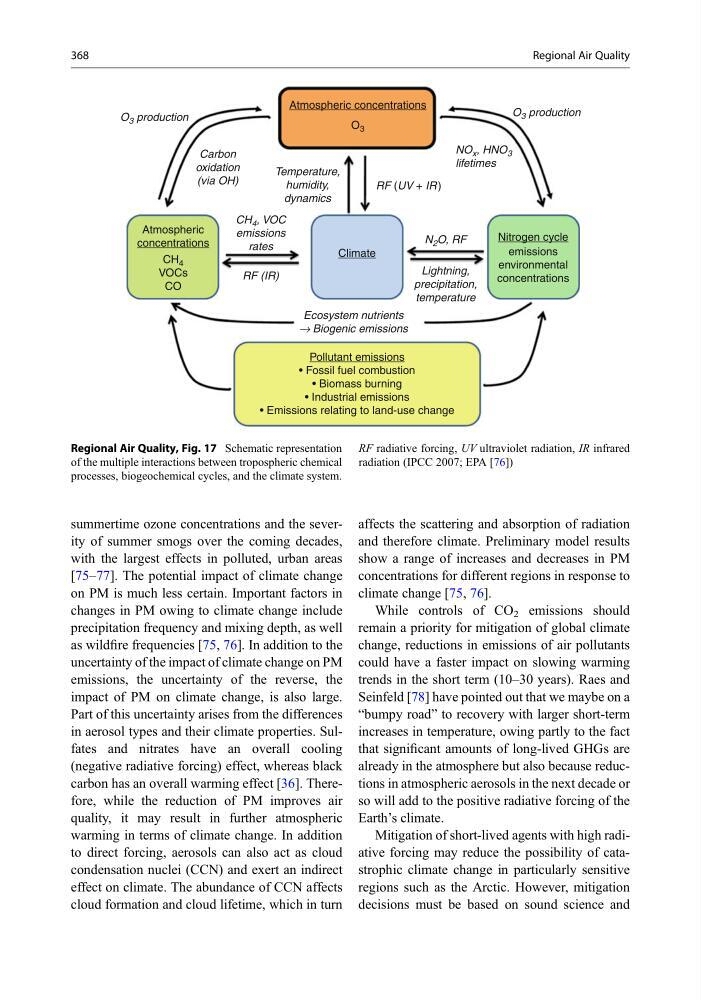
Regional Air Quality, Fig. 17 Schematic representation
of the multiple interactions between tropospheric chemical
processes, biogeochemical cycles, and the climate system.
RF radiative forcing, UV ultraviolet radiation, IR infrared
radiation (IPCC 2007; EPA [76])
368
Regional Air Quality
with the largest effects in polluted, urban areas
[75–77]. The potential impact of climate change
on PM is much less certain. Important factors in
changes in PM owing to climate change include
precipitation frequency and mixing depth, as well
as wildfire frequencies [75, 76]. In addition to the
uncertainty of the impact of climate change on PM
emissions, the uncertainty of the reverse, the
impact of PM on climate change, is also large.
Part of this uncertainty arises from the differences
in aerosol types and their climate properties. Sulfates and nitrates have an overall cooling
(negative radiative forcing) effect, whereas black
carbon has an overall warming effect [36]. Therefore, while the reduction of PM improves air
quality, it may result in further atmospheric
warming in terms of climate change. In addition
to direct forcing, aerosols can also act as cloud
condensation nuclei (CCN) and exert an indirect
effect on climate. The abundance of CCN affects
cloud formation and cloud lifetime, which in turn
affects the scattering and absorption of radiation
and therefore climate. Preliminary model results
show a range of increases and decreases in PM
concentrations for different regions in response to
climate change [75, 76].
While controls of CO 2 emissions should
remain a priority for mitigation of global climate
change, reductions in emissions of air pollutants
could have a faster impact on slowing warming
trends in the short term (10–30 years). Raes and
Seinfeld [78] have pointed out that we maybe on a
“bumpy road” to recovery with larger short-term
increases in temperature, owing partly to the fact
that significant amounts of long-lived GHGs are
already in the atmosphere but also because reductions in atmospheric aerosols in the next decade or
so will add to the positive radiative forcing of the
Earth’s climate.
Mitigation of short-lived agents with high radiative forcing may reduce the possibility of catastrophic climate change in particularly sensitive
regions such as the Arctic. However, mitigation
decisions must be based on sound science and
Atmospheric concentrations
Atmospheric
concentrations
Climate
Nitrogen cycle
Pollutant emissions
• Fossil fuel combustion
• Biomass burning
• Industrial emissions
• Emissions relating to land-use change
Ecosystem nutrients
Æ Biogenic emissions
Temperature,
humidity,
dynamics
CH 4 , VOC
emissions
rates
RF (IR)
N 2 O, RF
RF (UV + IR)
Carbon
oxidation
(via OH)
O 3 production
NO x , HNO 3
lifetimes
O 3 production
Lightning,
precipitation,
temperature
emissions
environmental
concentrations
CH 4
VOCs
CO
O 3
Regional Air Quality, Fig. 17 Schematic representation
of the multiple interactions between tropospheric chemical
processes, biogeochemical cycles, and the climate system.
RF radiative forcing, UV ultraviolet radiation, IR infrared
radiation (IPCC 2007; EPA [76])
368
Regional Air Quality