

extensive amount of research available
concerning air pollution and health effects at the
time of regulation.
The guidelines set by the WHO exist for the
most common air pollutants: size-resolved particulate matter, ozone, nitrogen dioxide, and sulfur
dioxide [1]. These were most recently updated in
2005. While the WHO has set guidelines for all
countries to use as a basis for regulation if they
choose to do so, most national air monitoring
authorities have a list of “air quality pollutants”
that are monitored and regulated. In the USA,
these are the “criteria pollutants” that are regulated under the National Ambient Air Quality
Standards (NAAQS) by the US Environmental
Protection Agency (EPA) and include carbon
monoxide, lead, nitrogen dioxide, particulate
matter of two-size fraction, ozone, and sulfur
dioxide, similar to those pollutants for which the
WHO has established guidelines [37]. European
Union air quality pollutants include particulate
matter, sulfur dioxide, nitrogen dioxide, lead, carbon monoxide, benzene, ozone, arsenic, cadmium, nickel, and PAHs and are regulated under
the air quality standards which were simplified in
2008 by combining all existing legislation on air
quality under one directive known as the ambient
air quality and Clean Air for Europe (CAFE)
directive [69]. As is apparent here, all air quality
pollutant regulation tends to contain a similar set
of air pollutants with some countries/regulating
bodies selecting additional species, such as trace
metals, to be included. Regulatory standards and
WHO guidelines are listed in Table 1.
Vegetative detritus
8
(a) West Jerusalem
7
6
Source contribution (μg C m −3
)
5
4
3
2
1
0
JAN
FEB
MAR APR
MAY
JUN
JUL
AUG
SEP
OCT NOV DEC
Biomass burning
Diesel vehicles
Gasoline vehicles
Residual fuel oil
Soil/Dust
LT coal comb.
SOA isoprene
SOA pinene
SOA caryophyllene
SOA toluene
Other
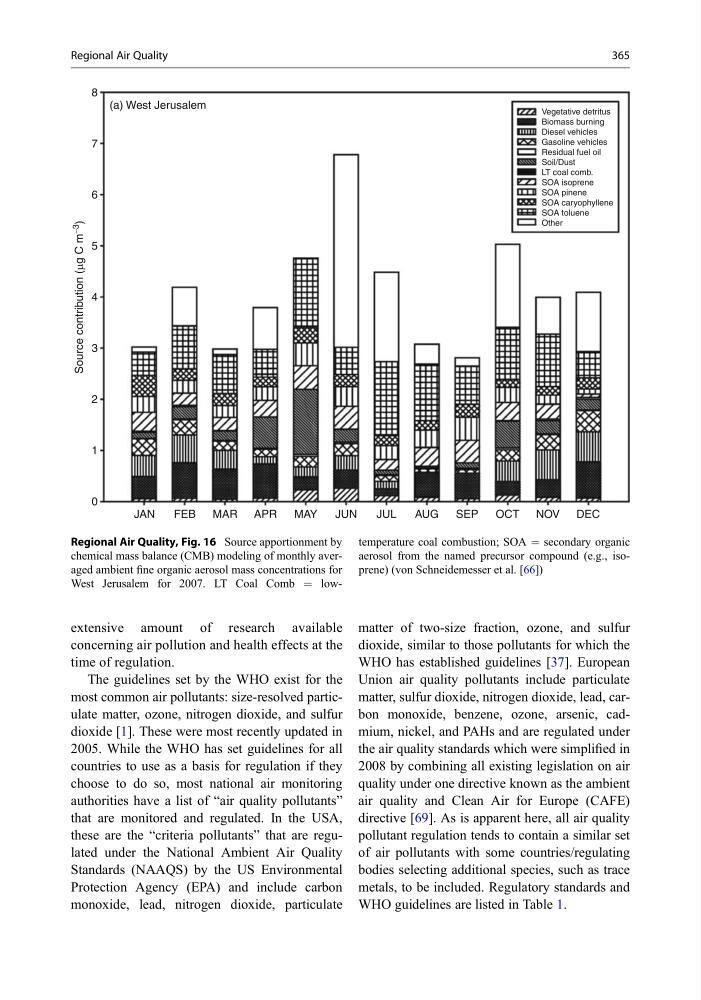
Regional Air Quality, Fig. 16 Source apportionment by
chemical mass balance (CMB) modeling of monthly averaged ambient fine organic aerosol mass concentrations for
West Jerusalem for 2007. LT Coal Comb ¼ lowtemperature coal combustion; SOA ¼ secondary organic
aerosol from the named precursor compound (e.g., isoprene) (von Schneidemesser et al. [66])
Regional Air Quality
365
concerning air pollution and health effects at the
time of regulation.
The guidelines set by the WHO exist for the
most common air pollutants: size-resolved particulate matter, ozone, nitrogen dioxide, and sulfur
dioxide [1]. These were most recently updated in
2005. While the WHO has set guidelines for all
countries to use as a basis for regulation if they
choose to do so, most national air monitoring
authorities have a list of “air quality pollutants”
that are monitored and regulated. In the USA,
these are the “criteria pollutants” that are regulated under the National Ambient Air Quality
Standards (NAAQS) by the US Environmental
Protection Agency (EPA) and include carbon
monoxide, lead, nitrogen dioxide, particulate
matter of two-size fraction, ozone, and sulfur
dioxide, similar to those pollutants for which the
WHO has established guidelines [37]. European
Union air quality pollutants include particulate
matter, sulfur dioxide, nitrogen dioxide, lead, carbon monoxide, benzene, ozone, arsenic, cadmium, nickel, and PAHs and are regulated under
the air quality standards which were simplified in
2008 by combining all existing legislation on air
quality under one directive known as the ambient
air quality and Clean Air for Europe (CAFE)
directive [69]. As is apparent here, all air quality
pollutant regulation tends to contain a similar set
of air pollutants with some countries/regulating
bodies selecting additional species, such as trace
metals, to be included. Regulatory standards and
WHO guidelines are listed in Table 1.
Vegetative detritus
8
(a) West Jerusalem
7
6
Source contribution (μg C m −3
)
5
4
3
2
1
0
JAN
FEB
MAR APR
MAY
JUN
JUL
AUG
SEP
OCT NOV DEC
Biomass burning
Diesel vehicles
Gasoline vehicles
Residual fuel oil
Soil/Dust
LT coal comb.
SOA isoprene
SOA pinene
SOA caryophyllene
SOA toluene
Other
Regional Air Quality, Fig. 16 Source apportionment by
chemical mass balance (CMB) modeling of monthly averaged ambient fine organic aerosol mass concentrations for
West Jerusalem for 2007. LT Coal Comb ¼ lowtemperature coal combustion; SOA ¼ secondary organic
aerosol from the named precursor compound (e.g., isoprene) (von Schneidemesser et al. [66])
Regional Air Quality
365