

In addition to receptor models, other types of
statistical models are also frequently used in atmospheric chemistry, such as simple regression analysis, land use regression models, and neural
network models. Land use regression models
have been used in atmospheric chemistry to characterize air pollution exposure and health effects
for people residing in urban areas, integrating
traffic and geographic information into the models
[67]. To learn about neural network models and
their uses in the air pollution modeling field the
reader is referred to Boznar and Mlakar [68].
Current Air Quality Legislation and
Metrics
Air quality guidelines are established to protect
human health and the environment. The World
Health Organization (WHO) has established air
quality guidelines for use worldwide that are
focused on protecting human health. Air quality
guidelines in the USA and Europe are intended to
protect human health, including sensitive
populations (e.g., elderly, asthmatics), with secondary limits set for the protection of public
welfare (e.g., visibility, animals, crops, buildings) [37]. The standards are set based on the
0 – 0.05
0.05 – 0.1
0.1 – 0.5
0.5 – 1
1 – 2
2 – 4
4 – 2.186
UK Emissions Map of
Ammonia 2005 kg /1×1km
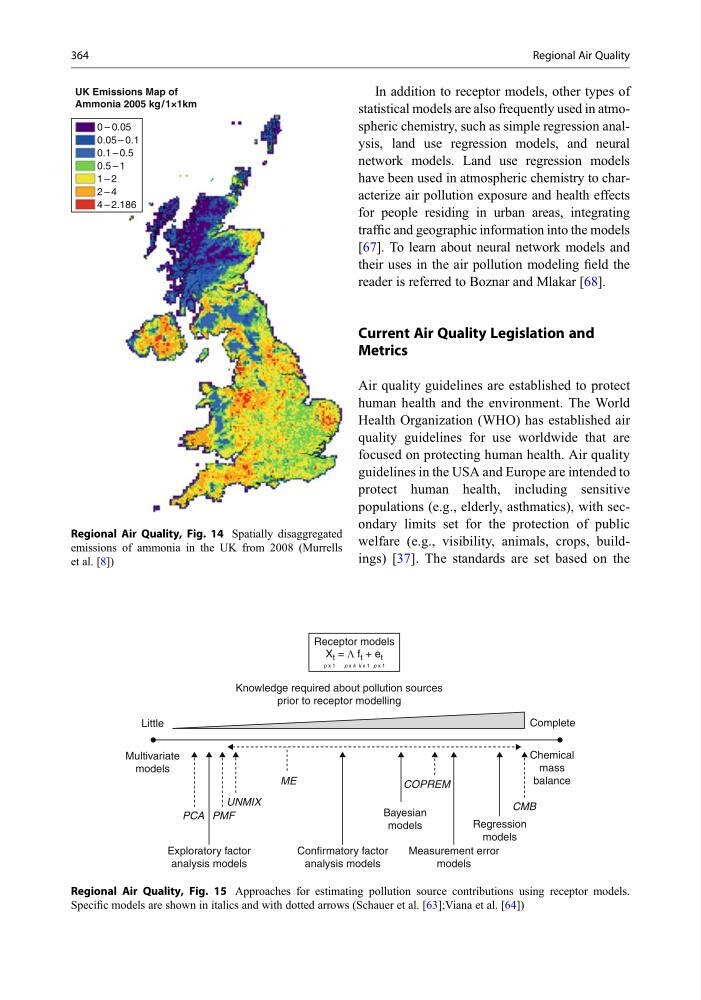
Regional Air Quality, Fig. 14 Spatially disaggregated
emissions of ammonia in the UK from 2008 (Murrells
et al. [8])
Confirmatory factor
analysis models
Exploratory factor
analysis models
Multivariate
models
Little
Knowledge required about pollution sources
prior to receptor modelling
Receptor models
p x 1
p x 1
k x 1
p x k
X t = Λ f t + e t
Measurement error
models
Regression
models
Bayesian
models
COPREM
ME
UNMIX
PMF
PCA
CMB
Chemical
mass
balance
Complete
Regional Air Quality, Fig. 15 Approaches for estimating pollution source contributions using receptor models.
Specific models are shown in italics and with dotted arrows (Schauer et al. [63];Viana et al. [64])
364
Regional Air Quality
statistical models are also frequently used in atmospheric chemistry, such as simple regression analysis, land use regression models, and neural
network models. Land use regression models
have been used in atmospheric chemistry to characterize air pollution exposure and health effects
for people residing in urban areas, integrating
traffic and geographic information into the models
[67]. To learn about neural network models and
their uses in the air pollution modeling field the
reader is referred to Boznar and Mlakar [68].
Current Air Quality Legislation and
Metrics
Air quality guidelines are established to protect
human health and the environment. The World
Health Organization (WHO) has established air
quality guidelines for use worldwide that are
focused on protecting human health. Air quality
guidelines in the USA and Europe are intended to
protect human health, including sensitive
populations (e.g., elderly, asthmatics), with secondary limits set for the protection of public
welfare (e.g., visibility, animals, crops, buildings) [37]. The standards are set based on the
0 – 0.05
0.05 – 0.1
0.1 – 0.5
0.5 – 1
1 – 2
2 – 4
4 – 2.186
UK Emissions Map of
Ammonia 2005 kg /1×1km
Regional Air Quality, Fig. 14 Spatially disaggregated
emissions of ammonia in the UK from 2008 (Murrells
et al. [8])
Confirmatory factor
analysis models
Exploratory factor
analysis models
Multivariate
models
Little
Knowledge required about pollution sources
prior to receptor modelling
Receptor models
p x 1
p x 1
k x 1
p x k
X t = Λ f t + e t
Measurement error
models
Regression
models
Bayesian
models
COPREM
ME
UNMIX
PMF
PCA
CMB
Chemical
mass
balance
Complete
Regional Air Quality, Fig. 15 Approaches for estimating pollution source contributions using receptor models.
Specific models are shown in italics and with dotted arrows (Schauer et al. [63];Viana et al. [64])
364
Regional Air Quality