

comply with design and quality assurance requirements, as well as using monitoring techniques
based on federal reference methods. The results
from these monitoring networks are then reported
to the US EPA annually [18]. There are different
levels of monitoring networks in the USA, including the National Air Monitoring Stations (NAMS),
the State and Local Air Monitoring Stations
(SLAMS), and the Photochemical Assessment
Monitoring Stations (PAMS). The national network is for long-term monitoring to provide a
systematic, consistent database for comparison
with other air quality data and trend analysis. The
state and local network is for determining compliance with air quality standards, while the PAMS
network is designed for monitoring ozone in areas
of persistently high ozone concentrations
[18]. More information on monitoring and the federal reference methods used in the US air quality
networks is available on the US EPA Web site and
in Godish (2004) [18].
The overarching air monitoring network for all
of Europe, which focuses on transboundary air
pollution, was established as part of the Convention on Long-Range Transboundary Air Pollution
(LRTAP). Within that convention, the EMEP programme (Co-operative Programme for Monitoring
and Evaluation of the Long-range Transmission of
Air Pollutants in Europe) was tasked to “regularly
provide governments and subsidiary bodies under
the LRTAP Convention with qualified scientific
information to support the development and further
evaluation of the international protocols on emission reductions negotiated within the Convention”
[53]. At this point, data are collected for the following areas of interest: acidification and eutrophication, ground-level ozone, persistent organic
pollutants (POPs), heavy metals, and particulate
matter. These are monitored using air and precipitation sampling methods. In addition to measurements (monitoring), EMEP also collects emissions
data, and uses modeling to look at atmospheric
transport and deposition of air pollutants
[53]. The focus here will be on the established
monitoring network. There are over 300 sites in
the monitoring network in 37 countries, and more
than 20 participating institutions. There are three
different levels of monitoring stations within the
EMEP network depending on the number and type
of measurements being conducted, but all EMEP
stations are located in areas classified as measuring
regional or global background. Many of the EMEP
stations are also part of or working in cooperation
with other European monitoring framework initiatives, such as the World Meteorological
Organization-Global Atmospheric Watch programme (WMO-GAW), national monitoring networks that report to the European Commission
under the European Union Air Quality Directives,
and other national and local monitoring networks
Cloud processing
Secondary
formation
Physical & chemical
Transformation (Aging)
t
e
W
c
i
n
e
g
o
p
o
r
h
t
n
A
D r y
Natural
n
o
i
t
i
s
o
p
e
D
n
o
i
s
s
i
m
e
y
r
a
m
i
r
P
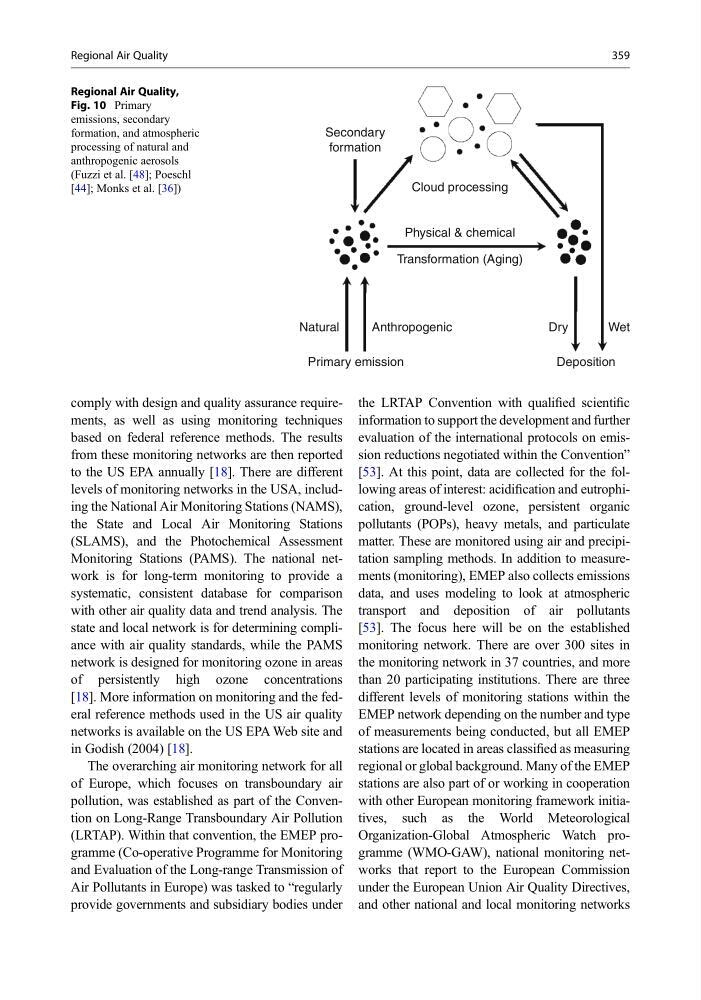
Regional Air Quality,
Fig. 10 Primary
emissions, secondary
formation, and atmospheric
processing of natural and
anthropogenic aerosols
(Fuzzi et al. [48]; Poeschl
[44]; Monks et al. [36])
Regional Air Quality
359
based on federal reference methods. The results
from these monitoring networks are then reported
to the US EPA annually [18]. There are different
levels of monitoring networks in the USA, including the National Air Monitoring Stations (NAMS),
the State and Local Air Monitoring Stations
(SLAMS), and the Photochemical Assessment
Monitoring Stations (PAMS). The national network is for long-term monitoring to provide a
systematic, consistent database for comparison
with other air quality data and trend analysis. The
state and local network is for determining compliance with air quality standards, while the PAMS
network is designed for monitoring ozone in areas
of persistently high ozone concentrations
[18]. More information on monitoring and the federal reference methods used in the US air quality
networks is available on the US EPA Web site and
in Godish (2004) [18].
The overarching air monitoring network for all
of Europe, which focuses on transboundary air
pollution, was established as part of the Convention on Long-Range Transboundary Air Pollution
(LRTAP). Within that convention, the EMEP programme (Co-operative Programme for Monitoring
and Evaluation of the Long-range Transmission of
Air Pollutants in Europe) was tasked to “regularly
provide governments and subsidiary bodies under
the LRTAP Convention with qualified scientific
information to support the development and further
evaluation of the international protocols on emission reductions negotiated within the Convention”
[53]. At this point, data are collected for the following areas of interest: acidification and eutrophication, ground-level ozone, persistent organic
pollutants (POPs), heavy metals, and particulate
matter. These are monitored using air and precipitation sampling methods. In addition to measurements (monitoring), EMEP also collects emissions
data, and uses modeling to look at atmospheric
transport and deposition of air pollutants
[53]. The focus here will be on the established
monitoring network. There are over 300 sites in
the monitoring network in 37 countries, and more
than 20 participating institutions. There are three
different levels of monitoring stations within the
EMEP network depending on the number and type
of measurements being conducted, but all EMEP
stations are located in areas classified as measuring
regional or global background. Many of the EMEP
stations are also part of or working in cooperation
with other European monitoring framework initiatives, such as the World Meteorological
Organization-Global Atmospheric Watch programme (WMO-GAW), national monitoring networks that report to the European Commission
under the European Union Air Quality Directives,
and other national and local monitoring networks
Cloud processing
Secondary
formation
Physical & chemical
Transformation (Aging)
t
e
W
c
i
n
e
g
o
p
o
r
h
t
n
A
D r y
Natural
n
o
i
t
i
s
o
p
e
D
n
o
i
s
s
i
m
e
y
r
a
m
i
r
P
Regional Air Quality,
Fig. 10 Primary
emissions, secondary
formation, and atmospheric
processing of natural and
anthropogenic aerosols
(Fuzzi et al. [48]; Poeschl
[44]; Monks et al. [36])
Regional Air Quality
359