

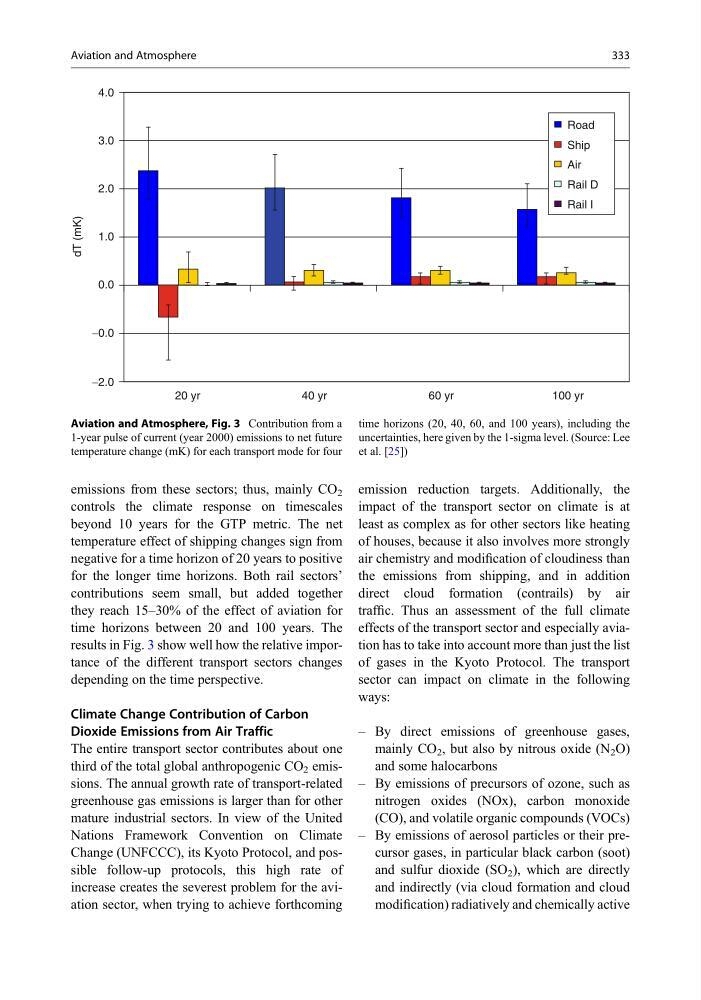
emissions from these sectors; thus, mainly CO 2
controls the climate response on timescales
beyond 10 years for the GTP metric. The net
temperature effect of shipping changes sign from
negative for a time horizon of 20 years to positive
for the longer time horizons. Both rail sectors’
contributions seem small, but added together
they reach 15–30% of the effect of aviation for
time horizons between 20 and 100 years. The
results in Fig. 3 show well how the relative importance of the different transport sectors changes
depending on the time perspective.
Climate Change Contribution of Carbon
Dioxide Emissions from Air Traffic
The entire transport sector contributes about one
third of the total global anthropogenic CO 2 emissions. The annual growth rate of transport-related
greenhouse gas emissions is larger than for other
mature industrial sectors. In view of the United
Nations Framework Convention on Climate
Change (UNFCCC), its Kyoto Protocol, and possible follow-up protocols, this high rate of
increase creates the severest problem for the aviation sector, when trying to achieve forthcoming
emission reduction targets. Additionally, the
impact of the transport sector on climate is at
least as complex as for other sectors like heating
of houses, because it also involves more strongly
air chemistry and modification of cloudiness than
the emissions from shipping, and in addition
direct cloud formation (contrails) by air
traffic. Thus an assessment of the full climate
effects of the transport sector and especially aviation has to take into account more than just the list
of gases in the Kyoto Protocol. The transport
sector can impact on climate in the following
ways:
– By direct emissions of greenhouse gases,
mainly CO 2 , but also by nitrous oxide (N 2 O)
and some halocarbons
– By emissions of precursors of ozone, such as
nitrogen oxides (NOx), carbon monoxide
(CO), and volatile organic compounds (VOCs)
– By emissions of aerosol particles or their precursor gases, in particular black carbon (soot)
and sulfur dioxide (SO 2 ), which are directly
and indirectly (via cloud formation and cloud
modification) radiatively and chemically active
Road
Ship
Air
Rail D
Rail I
dT (mK)
3.0
4.0
2.0
1.0
0.0
−0.0
−2.0
20 yr
40 yr
60 yr
100 yr
Aviation and Atmosphere, Fig. 3 Contribution from a
1-year pulse of current (year 2000) emissions to net future
temperature change (mK) for each transport mode for four
time horizons (20, 40, 60, and 100 years), including the
uncertainties, here given by the 1-sigma level. (Source: Lee
et al. [25])
Aviation and Atmosphere
333
controls the climate response on timescales
beyond 10 years for the GTP metric. The net
temperature effect of shipping changes sign from
negative for a time horizon of 20 years to positive
for the longer time horizons. Both rail sectors’
contributions seem small, but added together
they reach 15–30% of the effect of aviation for
time horizons between 20 and 100 years. The
results in Fig. 3 show well how the relative importance of the different transport sectors changes
depending on the time perspective.
Climate Change Contribution of Carbon
Dioxide Emissions from Air Traffic
The entire transport sector contributes about one
third of the total global anthropogenic CO 2 emissions. The annual growth rate of transport-related
greenhouse gas emissions is larger than for other
mature industrial sectors. In view of the United
Nations Framework Convention on Climate
Change (UNFCCC), its Kyoto Protocol, and possible follow-up protocols, this high rate of
increase creates the severest problem for the aviation sector, when trying to achieve forthcoming
emission reduction targets. Additionally, the
impact of the transport sector on climate is at
least as complex as for other sectors like heating
of houses, because it also involves more strongly
air chemistry and modification of cloudiness than
the emissions from shipping, and in addition
direct cloud formation (contrails) by air
traffic. Thus an assessment of the full climate
effects of the transport sector and especially aviation has to take into account more than just the list
of gases in the Kyoto Protocol. The transport
sector can impact on climate in the following
ways:
– By direct emissions of greenhouse gases,
mainly CO 2 , but also by nitrous oxide (N 2 O)
and some halocarbons
– By emissions of precursors of ozone, such as
nitrogen oxides (NOx), carbon monoxide
(CO), and volatile organic compounds (VOCs)
– By emissions of aerosol particles or their precursor gases, in particular black carbon (soot)
and sulfur dioxide (SO 2 ), which are directly
and indirectly (via cloud formation and cloud
modification) radiatively and chemically active
Road
Ship
Air
Rail D
Rail I
dT (mK)
3.0
4.0
2.0
1.0
0.0
−0.0
−2.0
20 yr
40 yr
60 yr
100 yr
Aviation and Atmosphere, Fig. 3 Contribution from a
1-year pulse of current (year 2000) emissions to net future
temperature change (mK) for each transport mode for four
time horizons (20, 40, 60, and 100 years), including the
uncertainties, here given by the 1-sigma level. (Source: Lee
et al. [25])
Aviation and Atmosphere
333