

Ocean Alkalinity Enhancement
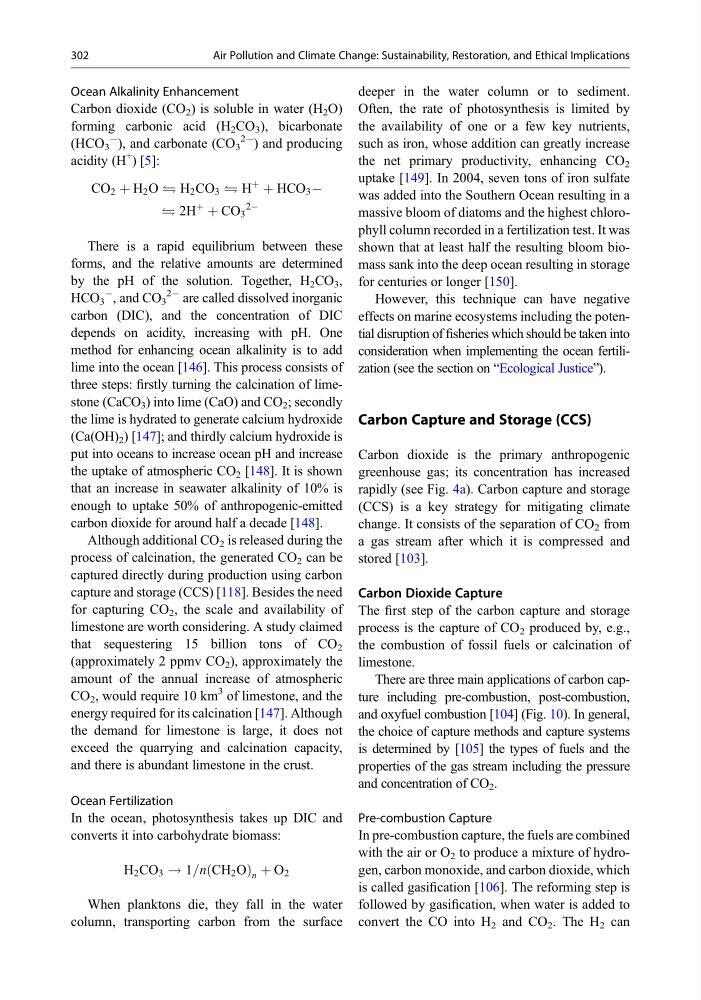
Carbon dioxide (CO 2 ) is soluble in water (H 2 O)
forming carbonic acid (H 2 CO 3 ), bicarbonate
(HCO 3
À ), and carbonate (CO 3
2À
) and producing
acidity (H
+
) [5]:
CO 2 þ H 2 O H 2 CO 3 H
þ
þ HCO 3 À
2H
þ
þ CO 3
2À
There is a rapid equilibrium between these
forms, and the relative amounts are determined
by the pH of the solution. Together, H 2 CO 3 ,
HCO 3
À , and CO 3
2À are called dissolved inorganic
carbon (DIC), and the concentration of DIC
depends on acidity, increasing with pH. One
method for enhancing ocean alkalinity is to add
lime into the ocean [146]. This process consists of
three steps: firstly turning the calcination of limestone (CaCO 3 ) into lime (CaO) and CO 2 ; secondly
the lime is hydrated to generate calcium hydroxide
(Ca(OH) 2 ) [147]; and thirdly calcium hydroxide is
put into oceans to increase ocean pH and increase
the uptake of atmospheric CO 2 [148]. It is shown
that an increase in seawater alkalinity of 10% is
enough to uptake 50% of anthropogenic-emitted
carbon dioxide for around half a decade [148].
Although additional CO 2 is released during the
process of calcination, the generated CO 2 can be
captured directly during production using carbon
capture and storage (CCS) [118]. Besides the need
for capturing CO 2 , the scale and availability of
limestone are worth considering. A study claimed
that sequestering 15 billion tons of CO 2
(approximately 2 ppmv CO 2 ), approximately the
amount of the annual increase of atmospheric
CO 2 , would require 10 km
3 of limestone, and the
energy required for its calcination [147]. Although
the demand for limestone is large, it does not
exceed the quarrying and calcination capacity,
and there is abundant limestone in the crust.
Ocean Fertilization
In the ocean, photosynthesis takes up DIC and
converts it into carbohydrate biomass:
H 2 CO 3 ! 1=n CH 2 O
ð
Þ n þ O 2
When planktons die, they fall in the water
column, transporting carbon from the surface
deeper in the water column or to sediment.
Often, the rate of photosynthesis is limited by
the availability of one or a few key nutrients,
such as iron, whose addition can greatly increase
the net primary productivity, enhancing CO 2
uptake [149]. In 2004, seven tons of iron sulfate
was added into the Southern Ocean resulting in a
massive bloom of diatoms and the highest chlorophyll column recorded in a fertilization test. It was
shown that at least half the resulting bloom biomass sank into the deep ocean resulting in storage
for centuries or longer [150].
However, this technique can have negative
effects on marine ecosystems including the potential disruption of fisheries which should be taken into
consideration when implementing the ocean fertilization (see the section on “Ecological Justice”).
Carbon Capture and Storage (CCS)
Carbon dioxide is the primary anthropogenic
greenhouse gas; its concentration has increased
rapidly (see Fig. 4a). Carbon capture and storage
(CCS) is a key strategy for mitigating climate
change. It consists of the separation of CO 2 from
a gas stream after which it is compressed and
stored [103].
Carbon Dioxide Capture
The first step of the carbon capture and storage
process is the capture of CO 2 produced by, e.g.,
the combustion of fossil fuels or calcination of
limestone.
There are three main applications of carbon capture including pre-combustion, post-combustion,
and oxyfuel combustion [104] (Fig. 10). In general,
the choice of capture methods and capture systems
is determined by [105] the types of fuels and the
properties of the gas stream including the pressure
and concentration of CO 2 .
Pre-combustion Capture
In pre-combustion capture, the fuels are combined
with the air or O 2 to produce a mixture of hydrogen, carbon monoxide, and carbon dioxide, which
is called gasification [106]. The reforming step is
followed by gasification, when water is added to
convert the CO into H 2 and CO 2 . The H 2 can
302
Air Pollution and Climate Change: Sustainability, Restoration, and Ethical Implications
Carbon dioxide (CO 2 ) is soluble in water (H 2 O)
forming carbonic acid (H 2 CO 3 ), bicarbonate
(HCO 3
À ), and carbonate (CO 3
2À
) and producing
acidity (H
+
) [5]:
CO 2 þ H 2 O H 2 CO 3 H
þ
þ HCO 3 À
2H
þ
þ CO 3
2À
There is a rapid equilibrium between these
forms, and the relative amounts are determined
by the pH of the solution. Together, H 2 CO 3 ,
HCO 3
À , and CO 3
2À are called dissolved inorganic
carbon (DIC), and the concentration of DIC
depends on acidity, increasing with pH. One
method for enhancing ocean alkalinity is to add
lime into the ocean [146]. This process consists of
three steps: firstly turning the calcination of limestone (CaCO 3 ) into lime (CaO) and CO 2 ; secondly
the lime is hydrated to generate calcium hydroxide
(Ca(OH) 2 ) [147]; and thirdly calcium hydroxide is
put into oceans to increase ocean pH and increase
the uptake of atmospheric CO 2 [148]. It is shown
that an increase in seawater alkalinity of 10% is
enough to uptake 50% of anthropogenic-emitted
carbon dioxide for around half a decade [148].
Although additional CO 2 is released during the
process of calcination, the generated CO 2 can be
captured directly during production using carbon
capture and storage (CCS) [118]. Besides the need
for capturing CO 2 , the scale and availability of
limestone are worth considering. A study claimed
that sequestering 15 billion tons of CO 2
(approximately 2 ppmv CO 2 ), approximately the
amount of the annual increase of atmospheric
CO 2 , would require 10 km
3 of limestone, and the
energy required for its calcination [147]. Although
the demand for limestone is large, it does not
exceed the quarrying and calcination capacity,
and there is abundant limestone in the crust.
Ocean Fertilization
In the ocean, photosynthesis takes up DIC and
converts it into carbohydrate biomass:
H 2 CO 3 ! 1=n CH 2 O
ð
Þ n þ O 2
When planktons die, they fall in the water
column, transporting carbon from the surface
deeper in the water column or to sediment.
Often, the rate of photosynthesis is limited by
the availability of one or a few key nutrients,
such as iron, whose addition can greatly increase
the net primary productivity, enhancing CO 2
uptake [149]. In 2004, seven tons of iron sulfate
was added into the Southern Ocean resulting in a
massive bloom of diatoms and the highest chlorophyll column recorded in a fertilization test. It was
shown that at least half the resulting bloom biomass sank into the deep ocean resulting in storage
for centuries or longer [150].
However, this technique can have negative
effects on marine ecosystems including the potential disruption of fisheries which should be taken into
consideration when implementing the ocean fertilization (see the section on “Ecological Justice”).
Carbon Capture and Storage (CCS)
Carbon dioxide is the primary anthropogenic
greenhouse gas; its concentration has increased
rapidly (see Fig. 4a). Carbon capture and storage
(CCS) is a key strategy for mitigating climate
change. It consists of the separation of CO 2 from
a gas stream after which it is compressed and
stored [103].
Carbon Dioxide Capture
The first step of the carbon capture and storage
process is the capture of CO 2 produced by, e.g.,
the combustion of fossil fuels or calcination of
limestone.
There are three main applications of carbon capture including pre-combustion, post-combustion,
and oxyfuel combustion [104] (Fig. 10). In general,
the choice of capture methods and capture systems
is determined by [105] the types of fuels and the
properties of the gas stream including the pressure
and concentration of CO 2 .
Pre-combustion Capture
In pre-combustion capture, the fuels are combined
with the air or O 2 to produce a mixture of hydrogen, carbon monoxide, and carbon dioxide, which
is called gasification [106]. The reforming step is
followed by gasification, when water is added to
convert the CO into H 2 and CO 2 . The H 2 can
302
Air Pollution and Climate Change: Sustainability, Restoration, and Ethical Implications