

see below, by heating biomass in the absence of
oxygen [118]. Sources of biochar include pyrolysis
of agricultural, forestry, and urban waste and other
sources of plant waste [118].
Compared to crop wastes and woods, biochar
safely captures and stores carbon for a much longer time as biochar is resistant to biological oxidation, in contrast to plant material including
wood. In addition, mixing biochar with soil
enhances crop yield and shows a strong potential
for reducing emissions of the greenhouse gases
CH 4 and N 2 O by soil, and NH 3 , and improving
soil structures [142].
Bioenergy with Carbon Capture and Storage
(BECCS)
BECCS refers to carbon sink technologies that
extract energy from biomass, for example, by
making ethanol or biogas, and trap and store the
CO 2 that is produced [195]. Photosynthetic
plants and algae (e.g., crops like sugar cane,
corn, rapeseed) take up CO 2 as they grow; the
biomass is then used as food or fuel. The processes of producing biofuel, for example, fermentation to produce ethanol, give CO 2 that is
captured. The carbon in the biofuel came from
the atmosphere and is released back into the
atmosphere when the fuel is used, and in addition, the CO 2 produced in fuel manufacture is
captured and stored. When optimized, BECCS
thus promises to be a carbon-negative technology. However, significant amounts of energy can
be used in producing and processing biomass, for
example, as fertilizer and for tractors and trucks.
It may take decades before their net carbon footprint becomes negative [195]. Further research is
necessary to reduce cost, improve performance,
and scale up BECCS.
Afforestation and Reforestation
Afforestation refers to establishing forests at formerly forested locations that have lost their tree
cover for over half a century, while reforestation
refers to establishing forests at locations that
have lost their trees within the last 50 years
[118]. Afforestation and reforestation are feasible options for increasing land carbon storage in
the form of soil carbon and plant biomass including wood [143]. A study shows that the regrowth
of forests on farms that were abandoned during
the medieval outbreak of bubonic plague in
Europe can account for the CO 2 and temperature
decrease during that period [144]. Storing
11–27 GtC by reforestation was shown to result
in decreases of atmospheric CO 2 of
4–10 ppm [144].
Due to its potential for storing carbon and
improving environmental resilience, several
projects have been launched to address deforestation. One example is the United Nations’ Reducing Emissions from Deforestation and forest
Degradation (REDD+) project, which aims to
support reforestation in developing countries
[196]. Another is the Great Green Wall project to
re-establish a continuous band of trees across
Africa across the Sahel to reduce desertification
[145]. The 8000 km project is already 15% complete. By establishing green belts and trees, the
Great Green Wall will moderate temperature,
reduce wind speed, and enhance humidity of
soil [145].
In addition to storing carbon and providing biodiversity, increasing forest cover can enhance cloud
cover, increasing the albedo, via evapotranspiration,
and providing biogenic precursors of cloud condensation nuclei, helping to counteract the lower albedo
of forest relative to grassland [118].
Ocean Carbon Sink Enhancement
The ocean is a formidable reservoir for carbon that
can absorb over a quarter of anthropogenic carbon
dioxide [118]. There are several ways to improve
the carbon sink capacity of the ocean.
Air Pollution and Climate Change: Sustainability,
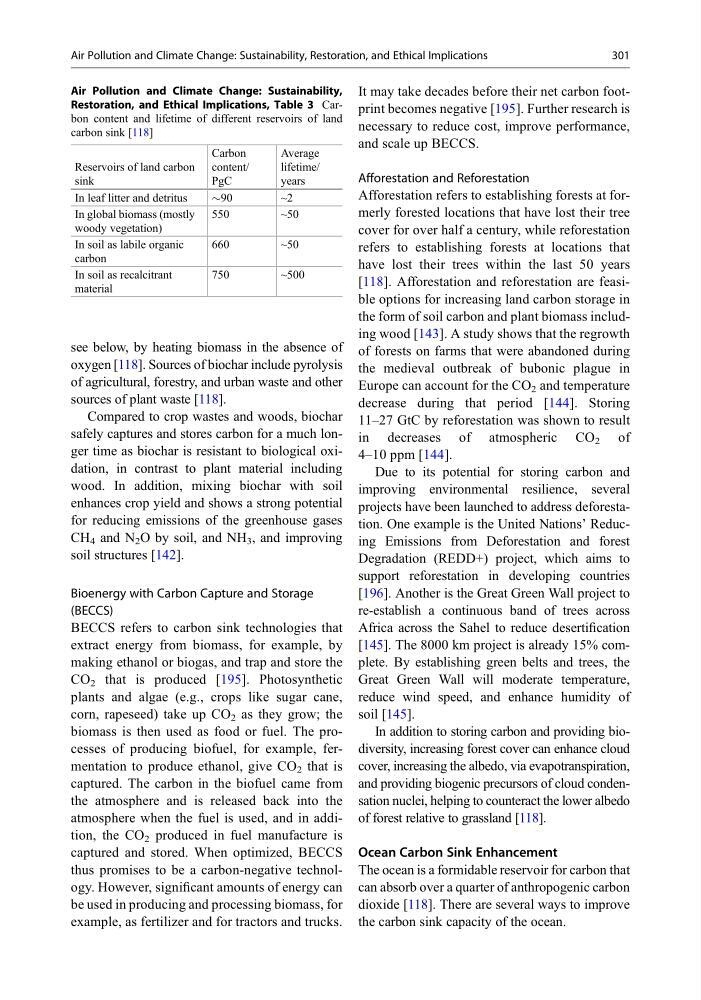
Restoration, and Ethical Implications, Table 3 Carbon content and lifetime of different reservoirs of land
carbon sink [118]
Reservoirs of land carbon
sink
Carbon
content/
PgC
Average
lifetime/
years
In leaf litter and detritus
$90
~2
In global biomass (mostly
woody vegetation)
550
~50
In soil as labile organic
carbon
660
~50
In soil as recalcitrant
material
750
~500
Air Pollution and Climate Change: Sustainability, Restoration, and Ethical Implications
301
oxygen [118]. Sources of biochar include pyrolysis
of agricultural, forestry, and urban waste and other
sources of plant waste [118].
Compared to crop wastes and woods, biochar
safely captures and stores carbon for a much longer time as biochar is resistant to biological oxidation, in contrast to plant material including
wood. In addition, mixing biochar with soil
enhances crop yield and shows a strong potential
for reducing emissions of the greenhouse gases
CH 4 and N 2 O by soil, and NH 3 , and improving
soil structures [142].
Bioenergy with Carbon Capture and Storage
(BECCS)
BECCS refers to carbon sink technologies that
extract energy from biomass, for example, by
making ethanol or biogas, and trap and store the
CO 2 that is produced [195]. Photosynthetic
plants and algae (e.g., crops like sugar cane,
corn, rapeseed) take up CO 2 as they grow; the
biomass is then used as food or fuel. The processes of producing biofuel, for example, fermentation to produce ethanol, give CO 2 that is
captured. The carbon in the biofuel came from
the atmosphere and is released back into the
atmosphere when the fuel is used, and in addition, the CO 2 produced in fuel manufacture is
captured and stored. When optimized, BECCS
thus promises to be a carbon-negative technology. However, significant amounts of energy can
be used in producing and processing biomass, for
example, as fertilizer and for tractors and trucks.
It may take decades before their net carbon footprint becomes negative [195]. Further research is
necessary to reduce cost, improve performance,
and scale up BECCS.
Afforestation and Reforestation
Afforestation refers to establishing forests at formerly forested locations that have lost their tree
cover for over half a century, while reforestation
refers to establishing forests at locations that
have lost their trees within the last 50 years
[118]. Afforestation and reforestation are feasible options for increasing land carbon storage in
the form of soil carbon and plant biomass including wood [143]. A study shows that the regrowth
of forests on farms that were abandoned during
the medieval outbreak of bubonic plague in
Europe can account for the CO 2 and temperature
decrease during that period [144]. Storing
11–27 GtC by reforestation was shown to result
in decreases of atmospheric CO 2 of
4–10 ppm [144].
Due to its potential for storing carbon and
improving environmental resilience, several
projects have been launched to address deforestation. One example is the United Nations’ Reducing Emissions from Deforestation and forest
Degradation (REDD+) project, which aims to
support reforestation in developing countries
[196]. Another is the Great Green Wall project to
re-establish a continuous band of trees across
Africa across the Sahel to reduce desertification
[145]. The 8000 km project is already 15% complete. By establishing green belts and trees, the
Great Green Wall will moderate temperature,
reduce wind speed, and enhance humidity of
soil [145].
In addition to storing carbon and providing biodiversity, increasing forest cover can enhance cloud
cover, increasing the albedo, via evapotranspiration,
and providing biogenic precursors of cloud condensation nuclei, helping to counteract the lower albedo
of forest relative to grassland [118].
Ocean Carbon Sink Enhancement
The ocean is a formidable reservoir for carbon that
can absorb over a quarter of anthropogenic carbon
dioxide [118]. There are several ways to improve
the carbon sink capacity of the ocean.
Air Pollution and Climate Change: Sustainability,
Restoration, and Ethical Implications, Table 3 Carbon content and lifetime of different reservoirs of land
carbon sink [118]
Reservoirs of land carbon
sink
Carbon
content/
PgC
Average
lifetime/
years
In leaf litter and detritus
$90
~2
In global biomass (mostly
woody vegetation)
550
~50
In soil as labile organic
carbon
660
~50
In soil as recalcitrant
material
750
~500
Air Pollution and Climate Change: Sustainability, Restoration, and Ethical Implications
301