

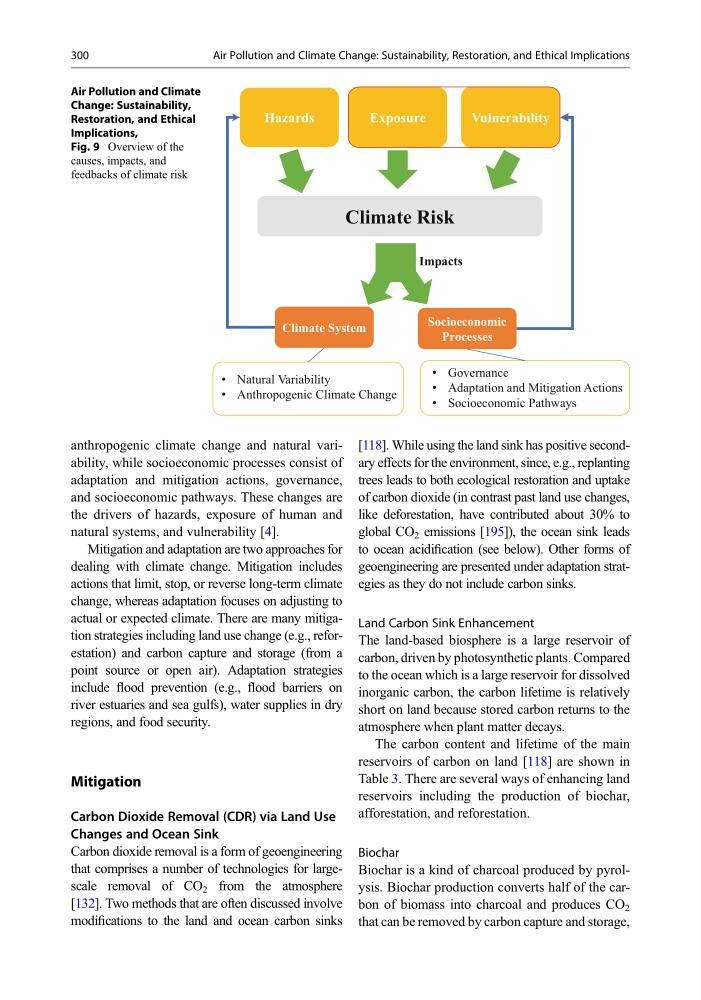
anthropogenic climate change and natural variability, while socioeconomic processes consist of
adaptation and mitigation actions, governance,
and socioeconomic pathways. These changes are
the drivers of hazards, exposure of human and
natural systems, and vulnerability [4].
Mitigation and adaptation are two approaches for
dealing with climate change. Mitigation includes
actions that limit, stop, or reverse long-term climate
change, whereas adaptation focuses on adjusting to
actual or expected climate. There are many mitigation strategies including land use change (e.g., reforestation) and carbon capture and storage (from a
point source or open air). Adaptation strategies
include flood prevention (e.g., flood barriers on
river estuaries and sea gulfs), water supplies in dry
regions, and food security.
Mitigation
Carbon Dioxide Removal (CDR) via Land Use
Changes and Ocean Sink
Carbon dioxide removal is a form of geoengineering
that comprises a number of technologies for largescale removal of CO 2 from the atmosphere
[132]. Two methods that are often discussed involve
modifications to the land and ocean carbon sinks
[118]. While using the land sink has positive secondary effects for the environment, since, e.g., replanting
trees leads to both ecological restoration and uptake
of carbon dioxide (in contrast past land use changes,
like deforestation, have contributed about 30% to
global CO 2 emissions [195]), the ocean sink leads
to ocean acidification (see below). Other forms of
geoengineering are presented under adaptation strategies as they do not include carbon sinks.
Land Carbon Sink Enhancement
The land-based biosphere is a large reservoir of
carbon, driven by photosynthetic plants. Compared
to the ocean which is a large reservoir for dissolved
inorganic carbon, the carbon lifetime is relatively
short on land because stored carbon returns to the
atmosphere when plant matter decays.
The carbon content and lifetime of the main
reservoirs of carbon on land [118] are shown in
Table 3. There are several ways of enhancing land
reservoirs including the production of biochar,
afforestation, and reforestation.
Biochar
Biochar is a kind of charcoal produced by pyrolysis. Biochar production converts half of the carbon of biomass into charcoal and produces CO 2
that can be removed by carbon capture and storage,
Hazards
Exposure
Vulnerability
Climate Risk
Climate System
Socioeconomic
Processes
Impacts
• Governance
• Adaptation and Mitigation Actions
• Socioeconomic Pathways
• Natural Variability
• Anthropogenic Climate Change
Air Pollution and Climate
Change: Sustainability,
Restoration, and Ethical
Implications,
Fig. 9 Overview of the
causes, impacts, and
feedbacks of climate risk
300
Air Pollution and Climate Change: Sustainability, Restoration, and Ethical Implications
adaptation and mitigation actions, governance,
and socioeconomic pathways. These changes are
the drivers of hazards, exposure of human and
natural systems, and vulnerability [4].
Mitigation and adaptation are two approaches for
dealing with climate change. Mitigation includes
actions that limit, stop, or reverse long-term climate
change, whereas adaptation focuses on adjusting to
actual or expected climate. There are many mitigation strategies including land use change (e.g., reforestation) and carbon capture and storage (from a
point source or open air). Adaptation strategies
include flood prevention (e.g., flood barriers on
river estuaries and sea gulfs), water supplies in dry
regions, and food security.
Mitigation
Carbon Dioxide Removal (CDR) via Land Use
Changes and Ocean Sink
Carbon dioxide removal is a form of geoengineering
that comprises a number of technologies for largescale removal of CO 2 from the atmosphere
[132]. Two methods that are often discussed involve
modifications to the land and ocean carbon sinks
[118]. While using the land sink has positive secondary effects for the environment, since, e.g., replanting
trees leads to both ecological restoration and uptake
of carbon dioxide (in contrast past land use changes,
like deforestation, have contributed about 30% to
global CO 2 emissions [195]), the ocean sink leads
to ocean acidification (see below). Other forms of
geoengineering are presented under adaptation strategies as they do not include carbon sinks.
Land Carbon Sink Enhancement
The land-based biosphere is a large reservoir of
carbon, driven by photosynthetic plants. Compared
to the ocean which is a large reservoir for dissolved
inorganic carbon, the carbon lifetime is relatively
short on land because stored carbon returns to the
atmosphere when plant matter decays.
The carbon content and lifetime of the main
reservoirs of carbon on land [118] are shown in
Table 3. There are several ways of enhancing land
reservoirs including the production of biochar,
afforestation, and reforestation.
Biochar
Biochar is a kind of charcoal produced by pyrolysis. Biochar production converts half of the carbon of biomass into charcoal and produces CO 2
that can be removed by carbon capture and storage,
Hazards
Exposure
Vulnerability
Climate Risk
Climate System
Socioeconomic
Processes
Impacts
• Governance
• Adaptation and Mitigation Actions
• Socioeconomic Pathways
• Natural Variability
• Anthropogenic Climate Change
Air Pollution and Climate
Change: Sustainability,
Restoration, and Ethical
Implications,
Fig. 9 Overview of the
causes, impacts, and
feedbacks of climate risk
300
Air Pollution and Climate Change: Sustainability, Restoration, and Ethical Implications