

subsequently be used in power generation, and the
pure CO 2 can be safely captured.
Post-combustion Capture
In post-combustion capture, fossil fuels are
burned, and then the flue gas passes through a
suitable absorber which absorbs the carbon dioxide before it enters the atmosphere. In this way, the
CO 2 is safely captured. Stripping carbon dioxide
from the gas stream is the key step of the capture
process. It can be achieved by several different
methods such as solvents [107], solid sorbents
[108], membrane systems [109], and adsorption/
desorption processes.
One of the mature technologies is the amine
solvent absorbents. Some studies have shown that
the working fluid can break down over time
resulting in the release of by-products [110]. The
subsequent atmospheric reactions of these compounds would form products including carcinogenic nitrosamines that could potentially pose a
hazard for surrounding areas [110].
The other example of absorbers in postcombustion capture method is the use of metalorganic frameworks [111]. The metal-organic
frameworks are one of the promising carbon dioxide capture materials due to their high surface
areas and adjustable pore functionality allowing
them to selectively adsorb a large amount of
CO 2 [112].
Oxyfuel Combustion
The last key capture method is the oxyfuel process. The nitrogen is stripped from the oxygen
before combustion in an air separator [113]. The
purified O 2 is combusted with fossil fuels that
produce CO 2 and water vapor. Then the water
vapor is cool condensed and removed.
Carbon Storage
The second step of CCS is to store the CO 2 safely
and permanently.
Land carbon storage (“geosequestration”) is
the primary carbon storage method; the sites
may be on land or under the ocean floor. Sites
with porous rocks such as oil fields, gas fields,
saline formations, and saline-filled basalt formations are chosen to store the compressed, liquified
CO 2 [114]. The method requires a reservoir
beneath an impermeable nonporous layer. In
some cases the CO 2 is used for enhanced recovery
of oil or gas, to press more hydrocarbons out of a
formation.
If the geology of the formation is suitable, the
CO 2 can bind into minerals. For instance, carbon
dioxide can be stored in basalt in the form of
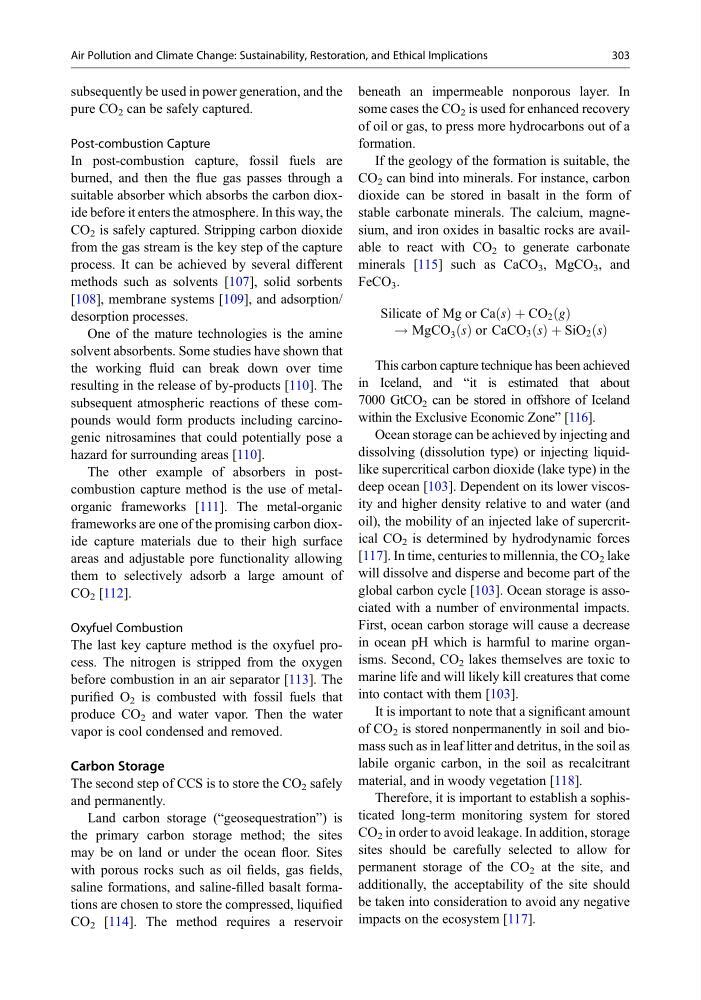
stable carbonate minerals. The calcium, magnesium, and iron oxides in basaltic rocks are available to react with CO 2 to generate carbonate
minerals [115] such as CaCO 3 , MgCO 3 , and
FeCO 3 .
Silicate of Mg or Ca s
ð Þ þ CO 2 g
ð Þ
! MgCO 3 s
ð Þ or CaCO 3 s
ð Þ þ SiO 2 s
ð Þ
This carbon capture technique has been achieved
in Iceland, and “it is estimated that about
7000 GtCO 2 can be stored in offshore of Iceland
within the Exclusive Economic Zone” [116].
Ocean storage can be achieved by injecting and
dissolving (dissolution type) or injecting liquidlike supercritical carbon dioxide (lake type) in the
deep ocean [103]. Dependent on its lower viscosity and higher density relative to and water (and
oil), the mobility of an injected lake of supercritical CO 2 is determined by hydrodynamic forces
[117]. In time, centuries to millennia, the CO 2 lake
will dissolve and disperse and become part of the
global carbon cycle [103]. Ocean storage is associated with a number of environmental impacts.
First, ocean carbon storage will cause a decrease
in ocean pH which is harmful to marine organisms. Second, CO 2 lakes themselves are toxic to
marine life and will likely kill creatures that come
into contact with them [103].
It is important to note that a significant amount
of CO 2 is stored nonpermanently in soil and biomass such as in leaf litter and detritus, in the soil as
labile organic carbon, in the soil as recalcitrant
material, and in woody vegetation [118].
Therefore, it is important to establish a sophisticated long-term monitoring system for stored
CO 2 in order to avoid leakage. In addition, storage
sites should be carefully selected to allow for
permanent storage of the CO 2 at the site, and
additionally, the acceptability of the site should
be taken into consideration to avoid any negative
impacts on the ecosystem [117].
Air Pollution and Climate Change: Sustainability, Restoration, and Ethical Implications
303
pure CO 2 can be safely captured.
Post-combustion Capture
In post-combustion capture, fossil fuels are
burned, and then the flue gas passes through a
suitable absorber which absorbs the carbon dioxide before it enters the atmosphere. In this way, the
CO 2 is safely captured. Stripping carbon dioxide
from the gas stream is the key step of the capture
process. It can be achieved by several different
methods such as solvents [107], solid sorbents
[108], membrane systems [109], and adsorption/
desorption processes.
One of the mature technologies is the amine
solvent absorbents. Some studies have shown that
the working fluid can break down over time
resulting in the release of by-products [110]. The
subsequent atmospheric reactions of these compounds would form products including carcinogenic nitrosamines that could potentially pose a
hazard for surrounding areas [110].
The other example of absorbers in postcombustion capture method is the use of metalorganic frameworks [111]. The metal-organic
frameworks are one of the promising carbon dioxide capture materials due to their high surface
areas and adjustable pore functionality allowing
them to selectively adsorb a large amount of
CO 2 [112].
Oxyfuel Combustion
The last key capture method is the oxyfuel process. The nitrogen is stripped from the oxygen
before combustion in an air separator [113]. The
purified O 2 is combusted with fossil fuels that
produce CO 2 and water vapor. Then the water
vapor is cool condensed and removed.
Carbon Storage
The second step of CCS is to store the CO 2 safely
and permanently.
Land carbon storage (“geosequestration”) is
the primary carbon storage method; the sites
may be on land or under the ocean floor. Sites
with porous rocks such as oil fields, gas fields,
saline formations, and saline-filled basalt formations are chosen to store the compressed, liquified
CO 2 [114]. The method requires a reservoir
beneath an impermeable nonporous layer. In
some cases the CO 2 is used for enhanced recovery
of oil or gas, to press more hydrocarbons out of a
formation.
If the geology of the formation is suitable, the
CO 2 can bind into minerals. For instance, carbon
dioxide can be stored in basalt in the form of
stable carbonate minerals. The calcium, magnesium, and iron oxides in basaltic rocks are available to react with CO 2 to generate carbonate
minerals [115] such as CaCO 3 , MgCO 3 , and
FeCO 3 .
Silicate of Mg or Ca s
ð Þ þ CO 2 g
ð Þ
! MgCO 3 s
ð Þ or CaCO 3 s
ð Þ þ SiO 2 s
ð Þ
This carbon capture technique has been achieved
in Iceland, and “it is estimated that about
7000 GtCO 2 can be stored in offshore of Iceland
within the Exclusive Economic Zone” [116].
Ocean storage can be achieved by injecting and
dissolving (dissolution type) or injecting liquidlike supercritical carbon dioxide (lake type) in the
deep ocean [103]. Dependent on its lower viscosity and higher density relative to and water (and
oil), the mobility of an injected lake of supercritical CO 2 is determined by hydrodynamic forces
[117]. In time, centuries to millennia, the CO 2 lake
will dissolve and disperse and become part of the
global carbon cycle [103]. Ocean storage is associated with a number of environmental impacts.
First, ocean carbon storage will cause a decrease
in ocean pH which is harmful to marine organisms. Second, CO 2 lakes themselves are toxic to
marine life and will likely kill creatures that come
into contact with them [103].
It is important to note that a significant amount
of CO 2 is stored nonpermanently in soil and biomass such as in leaf litter and detritus, in the soil as
labile organic carbon, in the soil as recalcitrant
material, and in woody vegetation [118].
Therefore, it is important to establish a sophisticated long-term monitoring system for stored
CO 2 in order to avoid leakage. In addition, storage
sites should be carefully selected to allow for
permanent storage of the CO 2 at the site, and
additionally, the acceptability of the site should
be taken into consideration to avoid any negative
impacts on the ecosystem [117].
Air Pollution and Climate Change: Sustainability, Restoration, and Ethical Implications
303