

Atmospheric CO 2 has increased from a preindustrial mixing ratio of around 280 ppm to over
410 ppm today, mainly because of fossil fuel combustion. Fossil fuel combustion has also had other
impacts on the climate and the environment as a
whole. Unburned hydrocarbons are released into
the atmosphere by many sources, leaks in mines
and wells and distribution systems, fuel and solvent
evaporation, and other industrial processes. In
addition, large amounts of naturally occurring volatile organic compounds (VOCs) are released by
plants. The VOCs are fuel for photochemical chain
reactions taking place in the atmosphere. Fossil
fuel combustion produces nitrogen oxides
(NO and NO 2 ) that catalyze these reactions. The
products include CO 2 , ozone, acid rain, and oxidized volatile organic compounds that condense
into secondary organic aerosol (SOA). All of
these components of air pollution impact climate.
While the stratospheric ozone layer protects us
from harmful radiation, tropospheric O 3 is categorized as a pollutant since it has adverse effects on
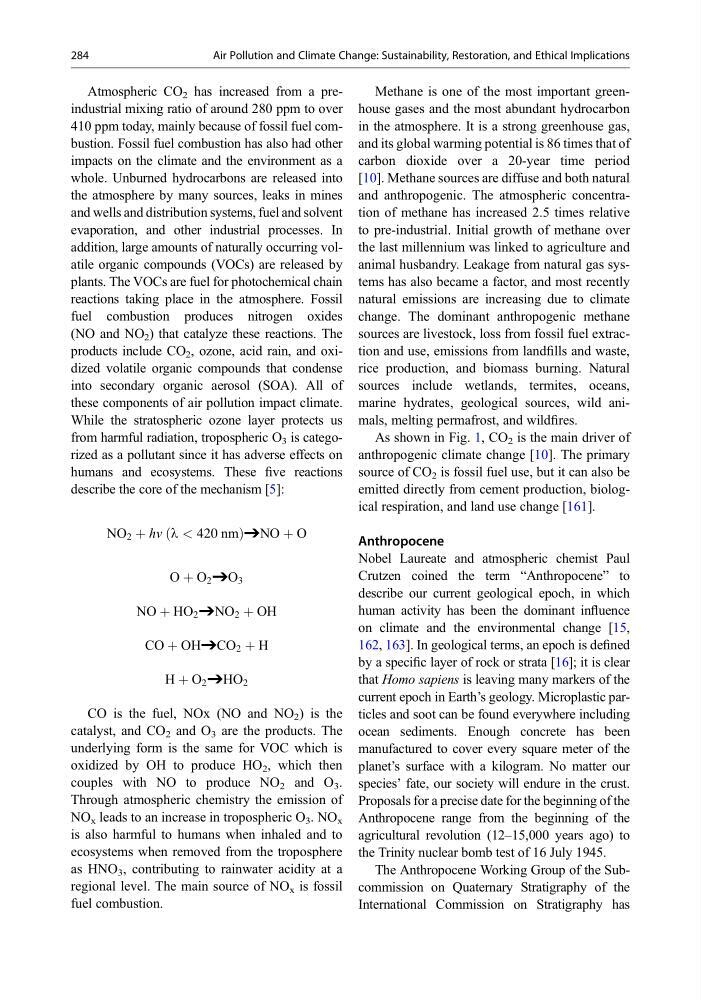
humans and ecosystems. These five reactions
describe the core of the mechanism [5]:
NO 2 þ hv l < 420 nm
ð
Þ ➔NO þ O
O þ O 2 ➔O 3
NO þ HO 2 ➔NO 2 þ OH
CO þ OH➔CO 2 þ H
H þ O 2 ➔HO 2
CO is the fuel, NOx (NO and NO 2 ) is the
catalyst, and CO 2 and O 3 are the products. The
underlying form is the same for VOC which is
oxidized by OH to produce HO 2 , which then
couples with NO to produce NO 2 and O 3 .
Through atmospheric chemistry the emission of
NO x leads to an increase in tropospheric O 3 . NO x
is also harmful to humans when inhaled and to
ecosystems when removed from the troposphere
as HNO 3 , contributing to rainwater acidity at a
regional level. The main source of NO x is fossil
fuel combustion.
Methane is one of the most important greenhouse gases and the most abundant hydrocarbon
in the atmosphere. It is a strong greenhouse gas,
and its global warming potential is 86 times that of
carbon dioxide over a 20-year time period
[10]. Methane sources are diffuse and both natural
and anthropogenic. The atmospheric concentration of methane has increased 2.5 times relative
to pre-industrial. Initial growth of methane over
the last millennium was linked to agriculture and
animal husbandry. Leakage from natural gas systems has also became a factor, and most recently
natural emissions are increasing due to climate
change. The dominant anthropogenic methane
sources are livestock, loss from fossil fuel extraction and use, emissions from landfills and waste,
rice production, and biomass burning. Natural
sources include wetlands, termites, oceans,
marine hydrates, geological sources, wild animals, melting permafrost, and wildfires.
As shown in Fig. 1, CO 2 is the main driver of
anthropogenic climate change [10]. The primary
source of CO 2 is fossil fuel use, but it can also be
emitted directly from cement production, biological respiration, and land use change [161].
Anthropocene
Nobel Laureate and atmospheric chemist Paul
Crutzen coined the term “Anthropocene” to
describe our current geological epoch, in which
human activity has been the dominant influence
on climate and the environmental change [15,
162, 163]. In geological terms, an epoch is defined
by a specific layer of rock or strata [16]; it is clear
that Homo sapiens is leaving many markers of the
current epoch in Earth’s geology. Microplastic particles and soot can be found everywhere including
ocean sediments. Enough concrete has been
manufactured to cover every square meter of the
planet’s surface with a kilogram. No matter our
species’ fate, our society will endure in the crust.
Proposals for a precise date for the beginning of the
Anthropocene range from the beginning of the
agricultural revolution (12–15,000 years ago) to
the Trinity nuclear bomb test of 16 July 1945.
The Anthropocene Working Group of the Subcommission on Quaternary Stratigraphy of the
International Commission on Stratigraphy has
284
Air Pollution and Climate Change: Sustainability, Restoration, and Ethical Implications
410 ppm today, mainly because of fossil fuel combustion. Fossil fuel combustion has also had other
impacts on the climate and the environment as a
whole. Unburned hydrocarbons are released into
the atmosphere by many sources, leaks in mines
and wells and distribution systems, fuel and solvent
evaporation, and other industrial processes. In
addition, large amounts of naturally occurring volatile organic compounds (VOCs) are released by
plants. The VOCs are fuel for photochemical chain
reactions taking place in the atmosphere. Fossil
fuel combustion produces nitrogen oxides
(NO and NO 2 ) that catalyze these reactions. The
products include CO 2 , ozone, acid rain, and oxidized volatile organic compounds that condense
into secondary organic aerosol (SOA). All of
these components of air pollution impact climate.
While the stratospheric ozone layer protects us
from harmful radiation, tropospheric O 3 is categorized as a pollutant since it has adverse effects on
humans and ecosystems. These five reactions
describe the core of the mechanism [5]:
NO 2 þ hv l < 420 nm
ð
Þ ➔NO þ O
O þ O 2 ➔O 3
NO þ HO 2 ➔NO 2 þ OH
CO þ OH➔CO 2 þ H
H þ O 2 ➔HO 2
CO is the fuel, NOx (NO and NO 2 ) is the
catalyst, and CO 2 and O 3 are the products. The
underlying form is the same for VOC which is
oxidized by OH to produce HO 2 , which then
couples with NO to produce NO 2 and O 3 .
Through atmospheric chemistry the emission of
NO x leads to an increase in tropospheric O 3 . NO x
is also harmful to humans when inhaled and to
ecosystems when removed from the troposphere
as HNO 3 , contributing to rainwater acidity at a
regional level. The main source of NO x is fossil
fuel combustion.
Methane is one of the most important greenhouse gases and the most abundant hydrocarbon
in the atmosphere. It is a strong greenhouse gas,
and its global warming potential is 86 times that of
carbon dioxide over a 20-year time period
[10]. Methane sources are diffuse and both natural
and anthropogenic. The atmospheric concentration of methane has increased 2.5 times relative
to pre-industrial. Initial growth of methane over
the last millennium was linked to agriculture and
animal husbandry. Leakage from natural gas systems has also became a factor, and most recently
natural emissions are increasing due to climate
change. The dominant anthropogenic methane
sources are livestock, loss from fossil fuel extraction and use, emissions from landfills and waste,
rice production, and biomass burning. Natural
sources include wetlands, termites, oceans,
marine hydrates, geological sources, wild animals, melting permafrost, and wildfires.
As shown in Fig. 1, CO 2 is the main driver of
anthropogenic climate change [10]. The primary
source of CO 2 is fossil fuel use, but it can also be
emitted directly from cement production, biological respiration, and land use change [161].
Anthropocene
Nobel Laureate and atmospheric chemist Paul
Crutzen coined the term “Anthropocene” to
describe our current geological epoch, in which
human activity has been the dominant influence
on climate and the environmental change [15,
162, 163]. In geological terms, an epoch is defined
by a specific layer of rock or strata [16]; it is clear
that Homo sapiens is leaving many markers of the
current epoch in Earth’s geology. Microplastic particles and soot can be found everywhere including
ocean sediments. Enough concrete has been
manufactured to cover every square meter of the
planet’s surface with a kilogram. No matter our
species’ fate, our society will endure in the crust.
Proposals for a precise date for the beginning of the
Anthropocene range from the beginning of the
agricultural revolution (12–15,000 years ago) to
the Trinity nuclear bomb test of 16 July 1945.
The Anthropocene Working Group of the Subcommission on Quaternary Stratigraphy of the
International Commission on Stratigraphy has
284
Air Pollution and Climate Change: Sustainability, Restoration, and Ethical Implications