

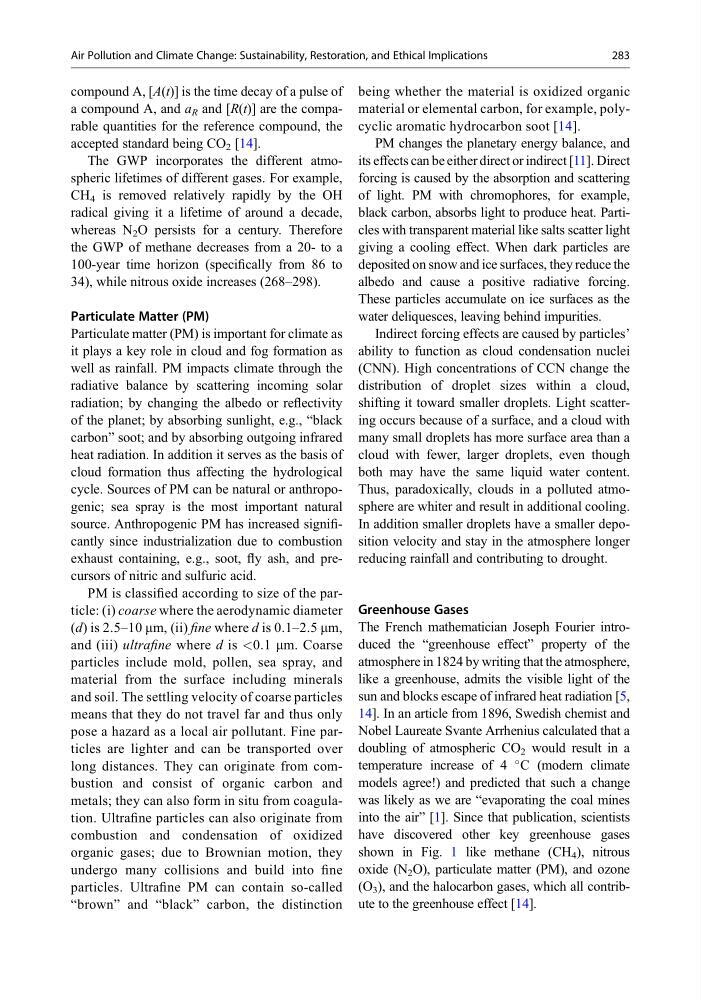
compound A, [A(t)] is the time decay of a pulse of
a compound A, and a R and [R(t)] are the comparable quantities for the reference compound, the
accepted standard being CO 2 [14].
The GWP incorporates the different atmospheric lifetimes of different gases. For example,
CH 4 is removed relatively rapidly by the OH
radical giving it a lifetime of around a decade,
whereas N 2 O persists for a century. Therefore
the GWP of methane decreases from a 20- to a
100-year time horizon (specifically from 86 to
34), while nitrous oxide increases (268–298).
Particulate Matter (PM)
Particulate matter (PM) is important for climate as
it plays a key role in cloud and fog formation as
well as rainfall. PM impacts climate through the
radiative balance by scattering incoming solar
radiation; by changing the albedo or reflectivity
of the planet; by absorbing sunlight, e.g., “black
carbon” soot; and by absorbing outgoing infrared
heat radiation. In addition it serves as the basis of
cloud formation thus affecting the hydrological
cycle. Sources of PM can be natural or anthropogenic; sea spray is the most important natural
source. Anthropogenic PM has increased significantly since industrialization due to combustion
exhaust containing, e.g., soot, fly ash, and precursors of nitric and sulfuric acid.
PM is classified according to size of the particle: (i) coarse where the aerodynamic diameter
(d) is 2.5–10 mm, (ii) fine where d is 0.1–2.5 mm,
and (iii) ultrafine where d is <0.1 mm. Coarse
particles include mold, pollen, sea spray, and
material from the surface including minerals
and soil. The settling velocity of coarse particles
means that they do not travel far and thus only
pose a hazard as a local air pollutant. Fine particles are lighter and can be transported over
long distances. They can originate from combustion and consist of organic carbon and
metals; they can also form in situ from coagulation. Ultrafine particles can also originate from
combustion and condensation of oxidized
organic gases; due to Brownian motion, they
undergo many collisions and build into fine
particles. Ultrafine PM can contain so-called
“brown” and “black” carbon, the distinction
being whether the material is oxidized organic
material or elemental carbon, for example, polycyclic aromatic hydrocarbon soot [14].
PM changes the planetary energy balance, and
its effects can be either direct or indirect [11]. Direct
forcing is caused by the absorption and scattering
of light. PM with chromophores, for example,
black carbon, absorbs light to produce heat. Particles with transparent material like salts scatter light
giving a cooling effect. When dark particles are
deposited on snow and ice surfaces, they reduce the
albedo and cause a positive radiative forcing.
These particles accumulate on ice surfaces as the
water deliquesces, leaving behind impurities.
Indirect forcing effects are caused by particles’
ability to function as cloud condensation nuclei
(CNN). High concentrations of CCN change the
distribution of droplet sizes within a cloud,
shifting it toward smaller droplets. Light scattering occurs because of a surface, and a cloud with
many small droplets has more surface area than a
cloud with fewer, larger droplets, even though
both may have the same liquid water content.
Thus, paradoxically, clouds in a polluted atmosphere are whiter and result in additional cooling.
In addition smaller droplets have a smaller deposition velocity and stay in the atmosphere longer
reducing rainfall and contributing to drought.
Greenhouse Gases
The French mathematician Joseph Fourier introduced the “greenhouse effect” property of the
atmosphere in 1824 by writing that the atmosphere,
like a greenhouse, admits the visible light of the
sun and blocks escape of infrared heat radiation [5,
14]. In an article from 1896, Swedish chemist and
Nobel Laureate Svante Arrhenius calculated that a
doubling of atmospheric CO 2 would result in a
temperature increase of 4
C (modern climate
models agree!) and predicted that such a change
was likely as we are “evaporating the coal mines
into the air” [1]. Since that publication, scientists
have discovered other key greenhouse gases
shown in Fig. 1 like methane (CH 4 ), nitrous
oxide (N 2 O), particulate matter (PM), and ozone
(O 3 ), and the halocarbon gases, which all contribute to the greenhouse effect [14].
Air Pollution and Climate Change: Sustainability, Restoration, and Ethical Implications
283
a compound A, and a R and [R(t)] are the comparable quantities for the reference compound, the
accepted standard being CO 2 [14].
The GWP incorporates the different atmospheric lifetimes of different gases. For example,
CH 4 is removed relatively rapidly by the OH
radical giving it a lifetime of around a decade,
whereas N 2 O persists for a century. Therefore
the GWP of methane decreases from a 20- to a
100-year time horizon (specifically from 86 to
34), while nitrous oxide increases (268–298).
Particulate Matter (PM)
Particulate matter (PM) is important for climate as
it plays a key role in cloud and fog formation as
well as rainfall. PM impacts climate through the
radiative balance by scattering incoming solar
radiation; by changing the albedo or reflectivity
of the planet; by absorbing sunlight, e.g., “black
carbon” soot; and by absorbing outgoing infrared
heat radiation. In addition it serves as the basis of
cloud formation thus affecting the hydrological
cycle. Sources of PM can be natural or anthropogenic; sea spray is the most important natural
source. Anthropogenic PM has increased significantly since industrialization due to combustion
exhaust containing, e.g., soot, fly ash, and precursors of nitric and sulfuric acid.
PM is classified according to size of the particle: (i) coarse where the aerodynamic diameter
(d) is 2.5–10 mm, (ii) fine where d is 0.1–2.5 mm,
and (iii) ultrafine where d is <0.1 mm. Coarse
particles include mold, pollen, sea spray, and
material from the surface including minerals
and soil. The settling velocity of coarse particles
means that they do not travel far and thus only
pose a hazard as a local air pollutant. Fine particles are lighter and can be transported over
long distances. They can originate from combustion and consist of organic carbon and
metals; they can also form in situ from coagulation. Ultrafine particles can also originate from
combustion and condensation of oxidized
organic gases; due to Brownian motion, they
undergo many collisions and build into fine
particles. Ultrafine PM can contain so-called
“brown” and “black” carbon, the distinction
being whether the material is oxidized organic
material or elemental carbon, for example, polycyclic aromatic hydrocarbon soot [14].
PM changes the planetary energy balance, and
its effects can be either direct or indirect [11]. Direct
forcing is caused by the absorption and scattering
of light. PM with chromophores, for example,
black carbon, absorbs light to produce heat. Particles with transparent material like salts scatter light
giving a cooling effect. When dark particles are
deposited on snow and ice surfaces, they reduce the
albedo and cause a positive radiative forcing.
These particles accumulate on ice surfaces as the
water deliquesces, leaving behind impurities.
Indirect forcing effects are caused by particles’
ability to function as cloud condensation nuclei
(CNN). High concentrations of CCN change the
distribution of droplet sizes within a cloud,
shifting it toward smaller droplets. Light scattering occurs because of a surface, and a cloud with
many small droplets has more surface area than a
cloud with fewer, larger droplets, even though
both may have the same liquid water content.
Thus, paradoxically, clouds in a polluted atmosphere are whiter and result in additional cooling.
In addition smaller droplets have a smaller deposition velocity and stay in the atmosphere longer
reducing rainfall and contributing to drought.
Greenhouse Gases
The French mathematician Joseph Fourier introduced the “greenhouse effect” property of the
atmosphere in 1824 by writing that the atmosphere,
like a greenhouse, admits the visible light of the
sun and blocks escape of infrared heat radiation [5,
14]. In an article from 1896, Swedish chemist and
Nobel Laureate Svante Arrhenius calculated that a
doubling of atmospheric CO 2 would result in a
temperature increase of 4
C (modern climate
models agree!) and predicted that such a change
was likely as we are “evaporating the coal mines
into the air” [1]. Since that publication, scientists
have discovered other key greenhouse gases
shown in Fig. 1 like methane (CH 4 ), nitrous
oxide (N 2 O), particulate matter (PM), and ozone
(O 3 ), and the halocarbon gases, which all contribute to the greenhouse effect [14].
Air Pollution and Climate Change: Sustainability, Restoration, and Ethical Implications
283