

A change in the balance between ingoing and
outgoing radiation is called a radiative forcing
(RF) [8]. Different atmospheric compounds affect
climate differently. The change of global average
surface temperature is dependent on the changes
in radiative forcing with DT ¼ l DRF; l is the
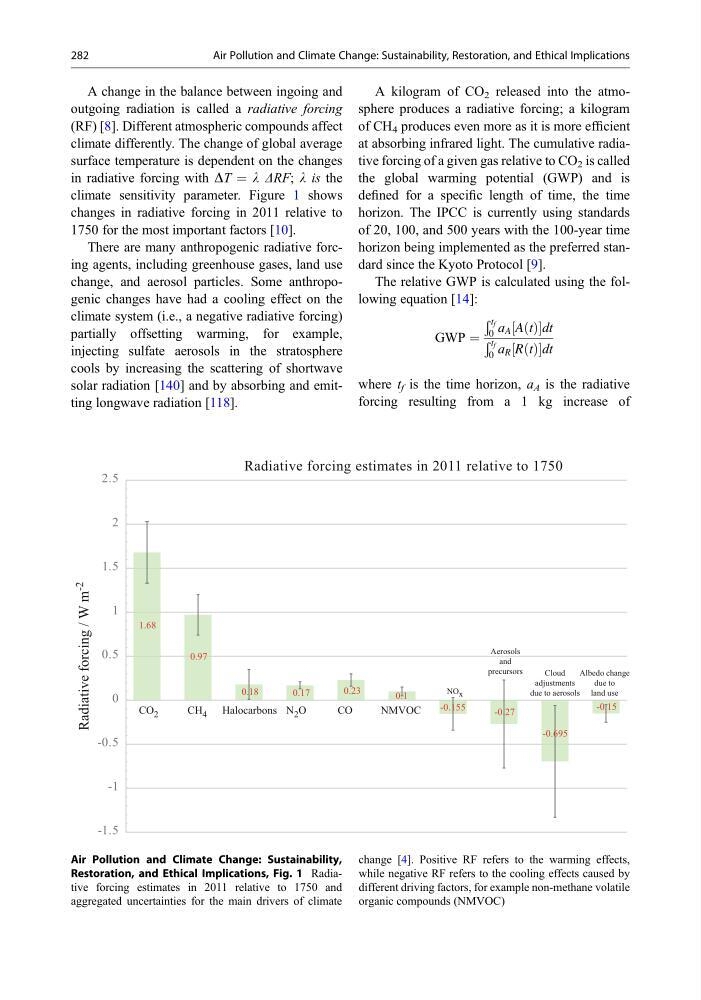
climate sensitivity parameter. Figure 1 shows
changes in radiative forcing in 2011 relative to
1750 for the most important factors [10].
There are many anthropogenic radiative forcing agents, including greenhouse gases, land use
change, and aerosol particles. Some anthropogenic changes have had a cooling effect on the
climate system (i.e., a negative radiative forcing)
partially offsetting warming, for example,
injecting sulfate aerosols in the stratosphere
cools by increasing the scattering of shortwave
solar radiation [140] and by absorbing and emitting longwave radiation [118].
A kilogram of CO 2 released into the atmosphere produces a radiative forcing; a kilogram
of CH 4 produces even more as it is more efficient
at absorbing infrared light. The cumulative radiative forcing of a given gas relative to CO 2 is called
the global warming potential (GWP) and is
defined for a specific length of time, the time
horizon. The IPCC is currently using standards
of 20, 100, and 500 years with the 100-year time
horizon being implemented as the preferred standard since the Kyoto Protocol [9].
The relative GWP is calculated using the following equation [14]:
GWP ¼
Ð t f
0 a A A t
ð Þ
½
dt
Ð t f
0 a R R t
ð Þ
½
dt
where t f is the time horizon, a A is the radiative
forcing resulting from a 1 kg increase of
1.68
0.97
0.18
0.17
0.23
0.1
-0.155
-0.27
-0.695
-0.15
-1.5
-1
-0.5
0
0.5
1
1.5
2
2.5
Radiative forcing / W m -2
Radiative forcing estimates in 2011 relative to 1750
CO 2
CH 4 Halocarbons N 2 O
C O
N M V O C
NO x
Aerosols
and
precursors
Cloud
adjustments
due to aerosols
Albedo change
due to
land use
Air Pollution and Climate Change: Sustainability,
Restoration, and Ethical Implications, Fig. 1 Radiative forcing estimates in 2011 relative to 1750 and
aggregated uncertainties for the main drivers of climate
change [4]. Positive RF refers to the warming effects,
while negative RF refers to the cooling effects caused by
different driving factors, for example non-methane volatile
organic compounds (NMVOC)
282
Air Pollution and Climate Change: Sustainability, Restoration, and Ethical Implications
outgoing radiation is called a radiative forcing
(RF) [8]. Different atmospheric compounds affect
climate differently. The change of global average
surface temperature is dependent on the changes
in radiative forcing with DT ¼ l DRF; l is the
climate sensitivity parameter. Figure 1 shows
changes in radiative forcing in 2011 relative to
1750 for the most important factors [10].
There are many anthropogenic radiative forcing agents, including greenhouse gases, land use
change, and aerosol particles. Some anthropogenic changes have had a cooling effect on the
climate system (i.e., a negative radiative forcing)
partially offsetting warming, for example,
injecting sulfate aerosols in the stratosphere
cools by increasing the scattering of shortwave
solar radiation [140] and by absorbing and emitting longwave radiation [118].
A kilogram of CO 2 released into the atmosphere produces a radiative forcing; a kilogram
of CH 4 produces even more as it is more efficient
at absorbing infrared light. The cumulative radiative forcing of a given gas relative to CO 2 is called
the global warming potential (GWP) and is
defined for a specific length of time, the time
horizon. The IPCC is currently using standards
of 20, 100, and 500 years with the 100-year time
horizon being implemented as the preferred standard since the Kyoto Protocol [9].
The relative GWP is calculated using the following equation [14]:
GWP ¼
Ð t f
0 a A A t
ð Þ
½
dt
Ð t f
0 a R R t
ð Þ
½
dt
where t f is the time horizon, a A is the radiative
forcing resulting from a 1 kg increase of
1.68
0.97
0.18
0.17
0.23
0.1
-0.155
-0.27
-0.695
-0.15
-1.5
-1
-0.5
0
0.5
1
1.5
2
2.5
Radiative forcing / W m -2
Radiative forcing estimates in 2011 relative to 1750
CO 2
CH 4 Halocarbons N 2 O
C O
N M V O C
NO x
Aerosols
and
precursors
Cloud
adjustments
due to aerosols
Albedo change
due to
land use
Air Pollution and Climate Change: Sustainability,
Restoration, and Ethical Implications, Fig. 1 Radiative forcing estimates in 2011 relative to 1750 and
aggregated uncertainties for the main drivers of climate
change [4]. Positive RF refers to the warming effects,
while negative RF refers to the cooling effects caused by
different driving factors, for example non-methane volatile
organic compounds (NMVOC)
282
Air Pollution and Climate Change: Sustainability, Restoration, and Ethical Implications