

management cycle shown should be viewed as an
integrated system. The system is dynamic with
new sources being introduced, old sources
retrofitted with controls, and some sources
removed. In addition, as I will discuss later, the
guidelines and standards are periodically reviewed
and the concentration levels reduced. As some
would say, the goal posts are constantly being
moved to lower concentrations making it more
challenging to achieve success and declare victory.
As will be discussed later, how low is low enough?
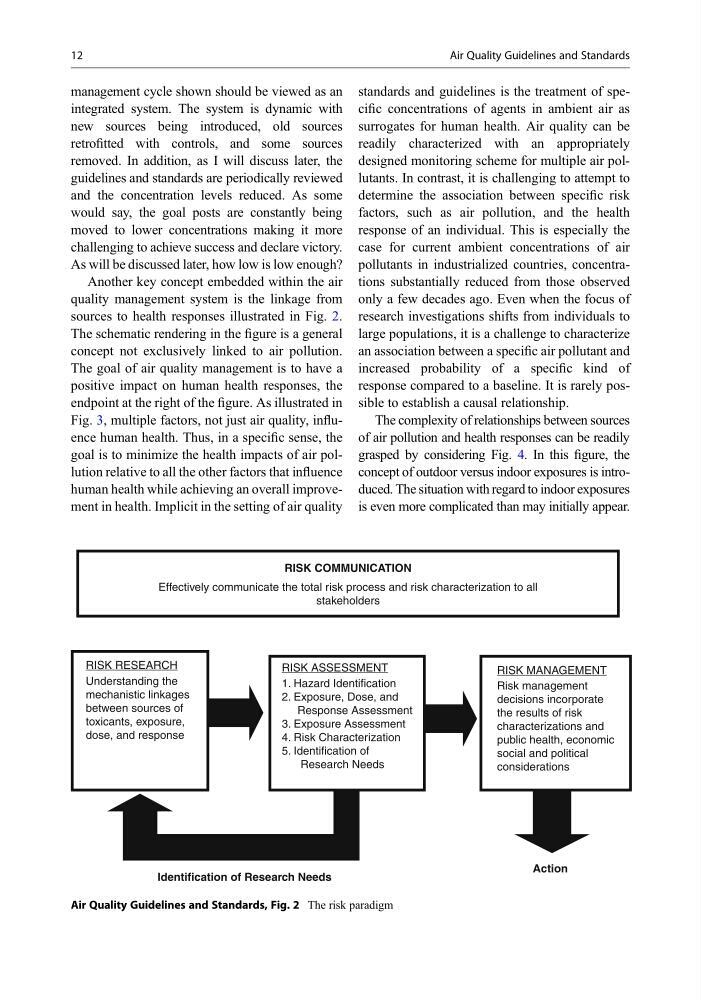
Another key concept embedded within the air
quality management system is the linkage from
sources to health responses illustrated in Fig. 2.
The schematic rendering in the figure is a general
concept not exclusively linked to air pollution.
The goal of air quality management is to have a
positive impact on human health responses, the
endpoint at the right of the figure. As illustrated in
Fig. 3, multiple factors, not just air quality, influence human health. Thus, in a specific sense, the
goal is to minimize the health impacts of air pollution relative to all the other factors that influence
human health while achieving an overall improvement in health. Implicit in the setting of air quality
standards and guidelines is the treatment of specific concentrations of agents in ambient air as
surrogates for human health. Air quality can be
readily characterized with an appropriately
designed monitoring scheme for multiple air pollutants. In contrast, it is challenging to attempt to
determine the association between specific risk
factors, such as air pollution, and the health
response of an individual. This is especially the
case for current ambient concentrations of air
pollutants in industrialized countries, concentrations substantially reduced from those observed
only a few decades ago. Even when the focus of
research investigations shifts from individuals to
large populations, it is a challenge to characterize
an association between a specific air pollutant and
increased probability of a specific kind of
response compared to a baseline. It is rarely possible to establish a causal relationship.
The complexity of relationships between sources
of air pollution and health responses can be readily
grasped by considering Fig. 4. In this figure, the
concept of outdoor versus indoor exposures is introduced. The situation with regard to indoor exposures
is even more complicated than may initially appear.
RISK COMMUNICATION
Identification of Research Needs
Action
Effectively communicate the total risk process and risk characterization to all
stakeholders
RISK RESEARCH
Understanding the
mechanistic linkages
between sources of
toxicants, exposure,
dose, and response
1. Hazard Identification
2. Exposure, Dose, and
Response Assessment
3. Exposure Assessment
4. Risk Characterization
5. Identification of
Research Needs
RISK ASSESSMENT
Risk management
decisions incorporate
the results of risk
characterizations and
public health, economic
social and political
considerations
RISK MANAGEMENT
Air Quality Guidelines and Standards, Fig. 2 The risk paradigm
12
Air Quality Guidelines and Standards
integrated system. The system is dynamic with
new sources being introduced, old sources
retrofitted with controls, and some sources
removed. In addition, as I will discuss later, the
guidelines and standards are periodically reviewed
and the concentration levels reduced. As some
would say, the goal posts are constantly being
moved to lower concentrations making it more
challenging to achieve success and declare victory.
As will be discussed later, how low is low enough?
Another key concept embedded within the air
quality management system is the linkage from
sources to health responses illustrated in Fig. 2.
The schematic rendering in the figure is a general
concept not exclusively linked to air pollution.
The goal of air quality management is to have a
positive impact on human health responses, the
endpoint at the right of the figure. As illustrated in
Fig. 3, multiple factors, not just air quality, influence human health. Thus, in a specific sense, the
goal is to minimize the health impacts of air pollution relative to all the other factors that influence
human health while achieving an overall improvement in health. Implicit in the setting of air quality
standards and guidelines is the treatment of specific concentrations of agents in ambient air as
surrogates for human health. Air quality can be
readily characterized with an appropriately
designed monitoring scheme for multiple air pollutants. In contrast, it is challenging to attempt to
determine the association between specific risk
factors, such as air pollution, and the health
response of an individual. This is especially the
case for current ambient concentrations of air
pollutants in industrialized countries, concentrations substantially reduced from those observed
only a few decades ago. Even when the focus of
research investigations shifts from individuals to
large populations, it is a challenge to characterize
an association between a specific air pollutant and
increased probability of a specific kind of
response compared to a baseline. It is rarely possible to establish a causal relationship.
The complexity of relationships between sources
of air pollution and health responses can be readily
grasped by considering Fig. 4. In this figure, the
concept of outdoor versus indoor exposures is introduced. The situation with regard to indoor exposures
is even more complicated than may initially appear.
RISK COMMUNICATION
Identification of Research Needs
Action
Effectively communicate the total risk process and risk characterization to all
stakeholders
RISK RESEARCH
Understanding the
mechanistic linkages
between sources of
toxicants, exposure,
dose, and response
1. Hazard Identification
2. Exposure, Dose, and
Response Assessment
3. Exposure Assessment
4. Risk Characterization
5. Identification of
Research Needs
RISK ASSESSMENT
Risk management
decisions incorporate
the results of risk
characterizations and
public health, economic
social and political
considerations
RISK MANAGEMENT
Air Quality Guidelines and Standards, Fig. 2 The risk paradigm
12
Air Quality Guidelines and Standards