

This is the case because most individuals, during the
course of their daily lives, spend variable amounts of
time in multiple indoor environments: home (their
bedroom, kitchen, living room, etc.), workplace,
school, automobile, etc. Each of these microenvironments may have a different mix of air pollutants, both as to kind and concentration, arising
from multiple sources. Some variable portion of the
indoor pollution may also arise from outdoors, the
ambient environment.
The outdoor air pollution arises from multiple
sources, some local, some regional, and some
quite remote. Indeed, it is increasingly apparent
that emissions arising in one continent such as
Asia soon reach North America and then Europe.
The air trajectory of emissions from coal-fired
power plants in the Midwest extending to the
Northeastern United States is well known. Dust
originating from deserts in China regularly
reaches the United States and Europe. Dust originating from the Sahara Desert also regularly circulates around the globe.
Context for Air Quality Impacts
Although the focus of this entry is on air quality
and its influence on human health, it is important
that context be provided for considering the role of
air pollution on human health. The introductory
chapter by Ayres et al. [5] in the textbook on
Environmental Medicine [6] provides a useful
review of the multiple factors influencing health.
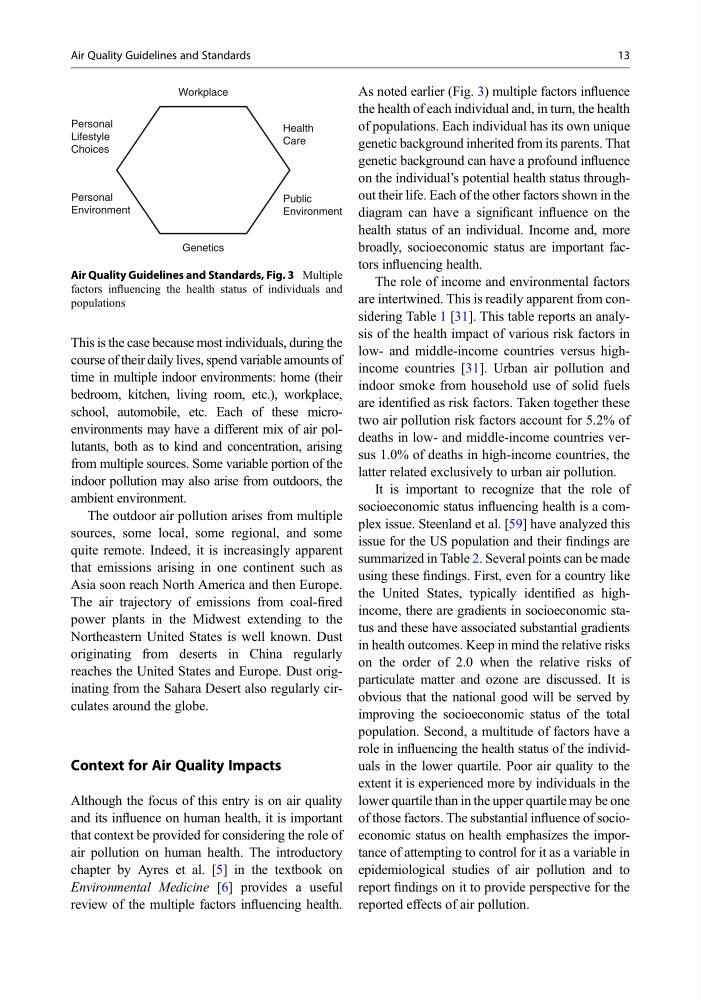
As noted earlier (Fig. 3) multiple factors influence
the health of each individual and, in turn, the health
of populations. Each individual has its own unique
genetic background inherited from its parents. That
genetic background can have a profound influence
on the individual’s potential health status throughout their life. Each of the other factors shown in the
diagram can have a significant influence on the
health status of an individual. Income and, more
broadly, socioeconomic status are important factors influencing health.
The role of income and environmental factors
are intertwined. This is readily apparent from considering Table 1 [31]. This table reports an analysis of the health impact of various risk factors in
low- and middle-income countries versus highincome countries [31]. Urban air pollution and
indoor smoke from household use of solid fuels
are identified as risk factors. Taken together these
two air pollution risk factors account for 5.2% of
deaths in low- and middle-income countries versus 1.0% of deaths in high-income countries, the
latter related exclusively to urban air pollution.
It is important to recognize that the role of
socioeconomic status influencing health is a complex issue. Steenland et al. [59] have analyzed this
issue for the US population and their findings are
summarized in Table 2. Several points can be made
using these findings. First, even for a country like
the United States, typically identified as highincome, there are gradients in socioeconomic status and these have associated substantial gradients
in health outcomes. Keep in mind the relative risks
on the order of 2.0 when the relative risks of
particulate matter and ozone are discussed. It is
obvious that the national good will be served by
improving the socioeconomic status of the total
population. Second, a multitude of factors have a
role in influencing the health status of the individuals in the lower quartile. Poor air quality to the
extent it is experienced more by individuals in the
lower quartile than in the upper quartile may be one
of those factors. The substantial influence of socioeconomic status on health emphasizes the importance of attempting to control for it as a variable in
epidemiological studies of air pollution and to
report findings on it to provide perspective for the
reported effects of air pollution.
Genetics
Workplace
Personal
Lifestyle
Choices
Personal
Environment
Public
Environment
Health
Care
Air Quality Guidelines and Standards, Fig. 3 Multiple
factors influencing the health status of individuals and
populations
Air Quality Guidelines and Standards
13
course of their daily lives, spend variable amounts of
time in multiple indoor environments: home (their
bedroom, kitchen, living room, etc.), workplace,
school, automobile, etc. Each of these microenvironments may have a different mix of air pollutants, both as to kind and concentration, arising
from multiple sources. Some variable portion of the
indoor pollution may also arise from outdoors, the
ambient environment.
The outdoor air pollution arises from multiple
sources, some local, some regional, and some
quite remote. Indeed, it is increasingly apparent
that emissions arising in one continent such as
Asia soon reach North America and then Europe.
The air trajectory of emissions from coal-fired
power plants in the Midwest extending to the
Northeastern United States is well known. Dust
originating from deserts in China regularly
reaches the United States and Europe. Dust originating from the Sahara Desert also regularly circulates around the globe.
Context for Air Quality Impacts
Although the focus of this entry is on air quality
and its influence on human health, it is important
that context be provided for considering the role of
air pollution on human health. The introductory
chapter by Ayres et al. [5] in the textbook on
Environmental Medicine [6] provides a useful
review of the multiple factors influencing health.
As noted earlier (Fig. 3) multiple factors influence
the health of each individual and, in turn, the health
of populations. Each individual has its own unique
genetic background inherited from its parents. That
genetic background can have a profound influence
on the individual’s potential health status throughout their life. Each of the other factors shown in the
diagram can have a significant influence on the
health status of an individual. Income and, more
broadly, socioeconomic status are important factors influencing health.
The role of income and environmental factors
are intertwined. This is readily apparent from considering Table 1 [31]. This table reports an analysis of the health impact of various risk factors in
low- and middle-income countries versus highincome countries [31]. Urban air pollution and
indoor smoke from household use of solid fuels
are identified as risk factors. Taken together these
two air pollution risk factors account for 5.2% of
deaths in low- and middle-income countries versus 1.0% of deaths in high-income countries, the
latter related exclusively to urban air pollution.
It is important to recognize that the role of
socioeconomic status influencing health is a complex issue. Steenland et al. [59] have analyzed this
issue for the US population and their findings are
summarized in Table 2. Several points can be made
using these findings. First, even for a country like
the United States, typically identified as highincome, there are gradients in socioeconomic status and these have associated substantial gradients
in health outcomes. Keep in mind the relative risks
on the order of 2.0 when the relative risks of
particulate matter and ozone are discussed. It is
obvious that the national good will be served by
improving the socioeconomic status of the total
population. Second, a multitude of factors have a
role in influencing the health status of the individuals in the lower quartile. Poor air quality to the
extent it is experienced more by individuals in the
lower quartile than in the upper quartile may be one
of those factors. The substantial influence of socioeconomic status on health emphasizes the importance of attempting to control for it as a variable in
epidemiological studies of air pollution and to
report findings on it to provide perspective for the
reported effects of air pollution.
Genetics
Workplace
Personal
Lifestyle
Choices
Personal
Environment
Public
Environment
Health
Care
Air Quality Guidelines and Standards, Fig. 3 Multiple
factors influencing the health status of individuals and
populations
Air Quality Guidelines and Standards
13