

Bibliography
1. Seinfeld JH, Pandis SN (1998) Atmospheric chemistry and physics: from air pollution to climate change.
Wiley, New York/Chichester, air pollution to climate,
1998
2. Jaenicke R (1998) Atmospheric aerosol size distribution. In: Harrison RM, van Grieken RE (eds) Atmospheric particles. Wiley, Chichester/New York
3. Brasseur GP, Prinn RG, Pszenny AAP (eds)
(2003) Tropospheric aerosols. Atmospheric chemistry in a changing world – an integration and synthesis
of a decade of tropospheric chemistry research.
Springer, Berlin/Heidelberg . ISBN: 3-540-43050-4
4. Gillette DA (1979) Environmental factors affecting
dust emission by wind erosion. In: Morales
C (ed) Saharan Dust, SCOPE 14. Wiley, New York,
pp 71–91
5. Bishop JKB, Davis RE, Sherman JT (25 October
2002) Robotic observations of dust storm enhancement of carbon biomass in the North Pacific. Science
298(5594):817–821
6. Elbert W,Taylor PE, Andreae MO, Pöschl U (2007)
Contribution of fungi to primary biogenic aerosols in
the atmosphere: wet and dry discharged spores, carbohydrates, and inorganic ions. Atmos Chem Phys
7:4569–4588
7. Després VR et al (2007) Characterization of primary
biogenic aerosol particles in urban, rural, and highalpine air by DNA sequence and restriction fragment
analysis of ribosomal RNA genes. Biogeosciences
4:1127–1141
8. Möhler O, DeMott PJ, Vali G, Levin Z (2007) Microbiology and atmospheric processes: the role of biological particles in cloud physics. Biogeosciences
4:1059–1071
9. Lewis ER, Schwartz SE (2004) Sea salt aerosol production: mechanisms, methods, measurements and
models – a critical review. Geophysical monograph,
vol 152. American Geophysical Union, Washington,
DC
10. Monahan EC, Spiel DE, Davidson KL
(1986) A model of marine aerosol generation via
whitecaps and wave disruption. In: Monahan EC,
MacNiocaill G (eds) Oceanic whitecaps and their
role in air-sea exchange processes. Reidel, Dordrecht, pp 167–174
11. Blanchard DC (1963) The electrification of the atmosphere by particles from bubbles in the sea. Progr
Oceanogr 1:71–202
12. O’Dowd CD, Lowe JA, Smith MH (1997) Marine
aerosol, sea-salt, and the marine sulphur cycle: a
short review. Atmos Environ 31:73–80
13. O’Dowd CD, Facchini MC, Cavalli F, Ceburnis D,
Mircea M, Decesari S, Fuzzi S, Yoon YJ, Putaud J-P
(2004) Biogenically-driven organic contribution to
marine aerosol. Nature. https://doi.org/10.1038/
nature02959
1940s
preindustrial
global mean temperature
0
0
1
2
>
s
0
3
0
2
s
0
8
9
1
without LLGHG emission reductions
with LLGHG emission reductions
only aerosol reduction
LLGHG and aerosol reduction
0 . 3 – 0 . 4 ° C / d e c a d e
Imagine: only LLGHG present in the atmosphere
In reality: LLGHG and air pollutants present
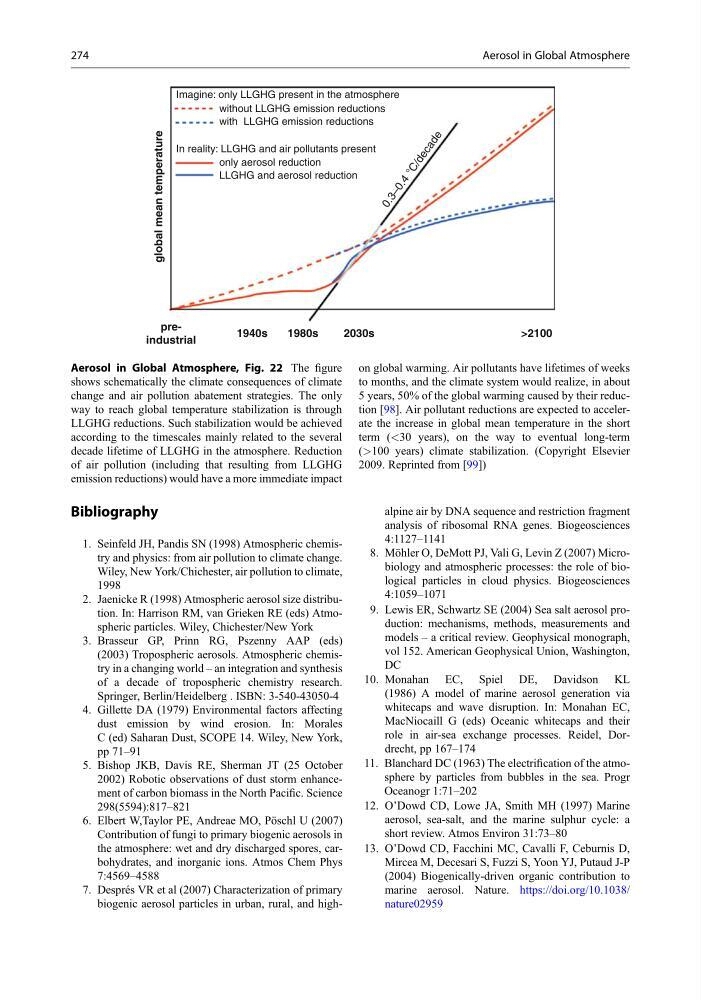
Aerosol in Global Atmosphere, Fig. 22 The figure
shows schematically the climate consequences of climate
change and air pollution abatement strategies. The only
way to reach global temperature stabilization is through
LLGHG reductions. Such stabilization would be achieved
according to the timescales mainly related to the several
decade lifetime of LLGHG in the atmosphere. Reduction
of air pollution (including that resulting from LLGHG
emission reductions) would have a more immediate impact
on global warming. Air pollutants have lifetimes of weeks
to months, and the climate system would realize, in about
5 years, 50% of the global warming caused by their reduction [98]. Air pollutant reductions are expected to accelerate the increase in global mean temperature in the short
term (<30 years), on the way to eventual long-term
(>100 years) climate stabilization. (Copyright Elsevier
2009. Reprinted from [99])
274
Aerosol in Global Atmosphere
1. Seinfeld JH, Pandis SN (1998) Atmospheric chemistry and physics: from air pollution to climate change.
Wiley, New York/Chichester, air pollution to climate,
1998
2. Jaenicke R (1998) Atmospheric aerosol size distribution. In: Harrison RM, van Grieken RE (eds) Atmospheric particles. Wiley, Chichester/New York
3. Brasseur GP, Prinn RG, Pszenny AAP (eds)
(2003) Tropospheric aerosols. Atmospheric chemistry in a changing world – an integration and synthesis
of a decade of tropospheric chemistry research.
Springer, Berlin/Heidelberg . ISBN: 3-540-43050-4
4. Gillette DA (1979) Environmental factors affecting
dust emission by wind erosion. In: Morales
C (ed) Saharan Dust, SCOPE 14. Wiley, New York,
pp 71–91
5. Bishop JKB, Davis RE, Sherman JT (25 October
2002) Robotic observations of dust storm enhancement of carbon biomass in the North Pacific. Science
298(5594):817–821
6. Elbert W,Taylor PE, Andreae MO, Pöschl U (2007)
Contribution of fungi to primary biogenic aerosols in
the atmosphere: wet and dry discharged spores, carbohydrates, and inorganic ions. Atmos Chem Phys
7:4569–4588
7. Després VR et al (2007) Characterization of primary
biogenic aerosol particles in urban, rural, and highalpine air by DNA sequence and restriction fragment
analysis of ribosomal RNA genes. Biogeosciences
4:1127–1141
8. Möhler O, DeMott PJ, Vali G, Levin Z (2007) Microbiology and atmospheric processes: the role of biological particles in cloud physics. Biogeosciences
4:1059–1071
9. Lewis ER, Schwartz SE (2004) Sea salt aerosol production: mechanisms, methods, measurements and
models – a critical review. Geophysical monograph,
vol 152. American Geophysical Union, Washington,
DC
10. Monahan EC, Spiel DE, Davidson KL
(1986) A model of marine aerosol generation via
whitecaps and wave disruption. In: Monahan EC,
MacNiocaill G (eds) Oceanic whitecaps and their
role in air-sea exchange processes. Reidel, Dordrecht, pp 167–174
11. Blanchard DC (1963) The electrification of the atmosphere by particles from bubbles in the sea. Progr
Oceanogr 1:71–202
12. O’Dowd CD, Lowe JA, Smith MH (1997) Marine
aerosol, sea-salt, and the marine sulphur cycle: a
short review. Atmos Environ 31:73–80
13. O’Dowd CD, Facchini MC, Cavalli F, Ceburnis D,
Mircea M, Decesari S, Fuzzi S, Yoon YJ, Putaud J-P
(2004) Biogenically-driven organic contribution to
marine aerosol. Nature. https://doi.org/10.1038/
nature02959
1940s
preindustrial
global mean temperature
0
0
1
2
>
s
0
3
0
2
s
0
8
9
1
without LLGHG emission reductions
with LLGHG emission reductions
only aerosol reduction
LLGHG and aerosol reduction
0 . 3 – 0 . 4 ° C / d e c a d e
Imagine: only LLGHG present in the atmosphere
In reality: LLGHG and air pollutants present
Aerosol in Global Atmosphere, Fig. 22 The figure
shows schematically the climate consequences of climate
change and air pollution abatement strategies. The only
way to reach global temperature stabilization is through
LLGHG reductions. Such stabilization would be achieved
according to the timescales mainly related to the several
decade lifetime of LLGHG in the atmosphere. Reduction
of air pollution (including that resulting from LLGHG
emission reductions) would have a more immediate impact
on global warming. Air pollutants have lifetimes of weeks
to months, and the climate system would realize, in about
5 years, 50% of the global warming caused by their reduction [98]. Air pollutant reductions are expected to accelerate the increase in global mean temperature in the short
term (<30 years), on the way to eventual long-term
(>100 years) climate stabilization. (Copyright Elsevier
2009. Reprinted from [99])
274
Aerosol in Global Atmosphere