

models. Current climate models do not possess
treatments of aerosol emissions, formation, transformations, and radiative effects to a high enough
level of sophistication yet. This limitation results
from the aerosol life cycle being one of the
most complex systems to model and the challenges
of modeling the formation of nanoclusters to
global-scale radiative impacts and interactions
with clouds will remain for some time. Nevertheless, the advances in recent years have been
immense, most notably in the current day improved
understanding of the highly complex nucleation
processes and in the characterization of organic
aerosols, their properties, and their life cycle.
Radiative forcing of climate between 1750 and 2005
Radiative Forcing (watts per square metre)
−2
−1
0
1
2
Natural
s
e
i
t
i
v
i
t
c
a
n
a
m
u
H
s
e
s
s
e
c
o
r
p
Long-lived
greenhouse gases
Ozone
Stratospheric
water vapour
Surface albedo
Direct effect
Linear contrails
Solar irradiance
Total net
human activities
Stratospheric
(−0.05)
Radiative Forcing Terms
(0.01)
Land use
Black carbon
on snow
Halocarbons
CO 2
N 2 O
CH 4
Tropospheric
Cloud albedo
effect
Total
Aerosol
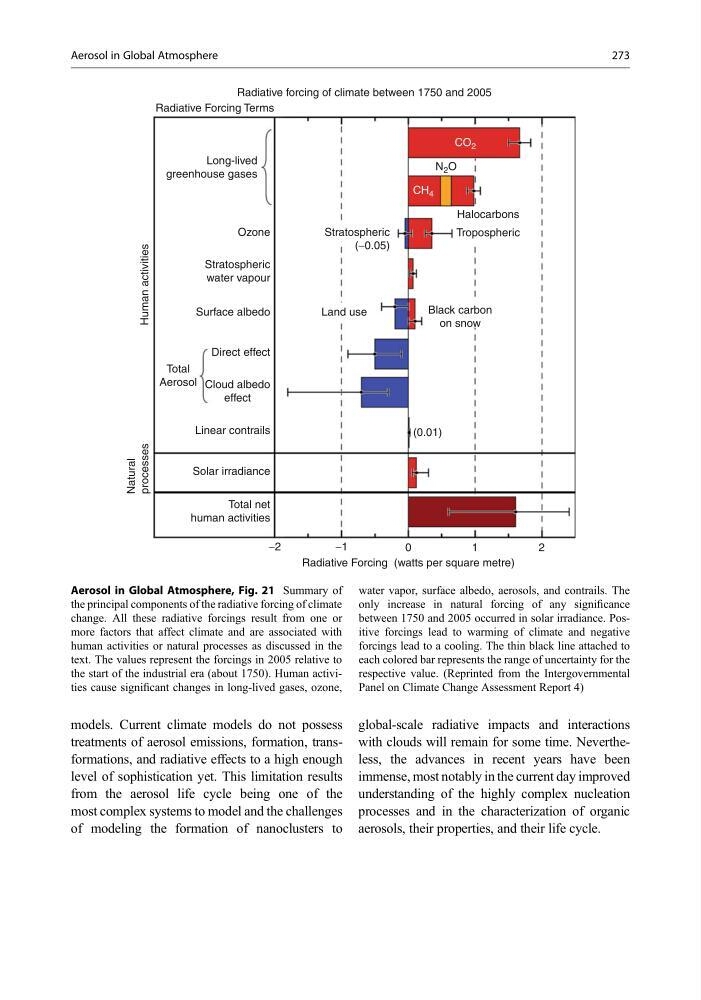
Aerosol in Global Atmosphere, Fig. 21 Summary of
the principal components of the radiative forcing of climate
change. All these radiative forcings result from one or
more factors that affect climate and are associated with
human activities or natural processes as discussed in the
text. The values represent the forcings in 2005 relative to
the start of the industrial era (about 1750). Human activities cause significant changes in long-lived gases, ozone,
water vapor, surface albedo, aerosols, and contrails. The
only increase in natural forcing of any significance
between 1750 and 2005 occurred in solar irradiance. Positive forcings lead to warming of climate and negative
forcings lead to a cooling. The thin black line attached to
each colored bar represents the range of uncertainty for the
respective value. (Reprinted from the Intergovernmental
Panel on Climate Change Assessment Report 4)
Aerosol in Global Atmosphere
273
treatments of aerosol emissions, formation, transformations, and radiative effects to a high enough
level of sophistication yet. This limitation results
from the aerosol life cycle being one of the
most complex systems to model and the challenges
of modeling the formation of nanoclusters to
global-scale radiative impacts and interactions
with clouds will remain for some time. Nevertheless, the advances in recent years have been
immense, most notably in the current day improved
understanding of the highly complex nucleation
processes and in the characterization of organic
aerosols, their properties, and their life cycle.
Radiative forcing of climate between 1750 and 2005
Radiative Forcing (watts per square metre)
−2
−1
0
1
2
Natural
s
e
i
t
i
v
i
t
c
a
n
a
m
u
H
s
e
s
s
e
c
o
r
p
Long-lived
greenhouse gases
Ozone
Stratospheric
water vapour
Surface albedo
Direct effect
Linear contrails
Solar irradiance
Total net
human activities
Stratospheric
(−0.05)
Radiative Forcing Terms
(0.01)
Land use
Black carbon
on snow
Halocarbons
CO 2
N 2 O
CH 4
Tropospheric
Cloud albedo
effect
Total
Aerosol
Aerosol in Global Atmosphere, Fig. 21 Summary of
the principal components of the radiative forcing of climate
change. All these radiative forcings result from one or
more factors that affect climate and are associated with
human activities or natural processes as discussed in the
text. The values represent the forcings in 2005 relative to
the start of the industrial era (about 1750). Human activities cause significant changes in long-lived gases, ozone,
water vapor, surface albedo, aerosols, and contrails. The
only increase in natural forcing of any significance
between 1750 and 2005 occurred in solar irradiance. Positive forcings lead to warming of climate and negative
forcings lead to a cooling. The thin black line attached to
each colored bar represents the range of uncertainty for the
respective value. (Reprinted from the Intergovernmental
Panel on Climate Change Assessment Report 4)
Aerosol in Global Atmosphere
273