

Vertical profiles of total number of concentrations (historically defined as condensation nuclei,
or CN, typically larger than 10 nm), and sizeresolved concentration measurements (with
radius > 0.15 mm to sizes greater than 2 mm) up
to the higher stratosphere are shown in Fig. 12
(taken from [60]). In this figure, concentrations
are shown for 1 year and 15 years after the
Mt. Pinatubo eruption. What is evident is that
total aerosol, or CN, concentration at the surface
is between 500 cm
À3 (typical of clean background
continental air masses) and 3,000 cm
À3 (typical of
polluted continental air masses) and that free troposphere, or upper free tropospheric concentrations are relatively constant at a concentration of
the order of 500 cm
À3 . Above 15 km, in the
stratospheric layer, CN concentrations are typically 1–10 cm
À3 , despite the volcanic eruption.
However, what is evident in the difference in time
lapse following the eruption is that there is a
significant increase in aerosol concentration
(at least an order of magnitude) at sizes greater
than 0.15 mm radius 1 year after the eruption
compared to what is considered the background
stratospheric aerosol burden 15 years after the
eruption. Clearly, volcanic eruptions are a major
source of stratospheric aerosols with injections to
the tune of 30 Tg SO 2 for intense eruptions such as
Pinatubo, producing the main precursor for stratospheric aerosol formation. In terms of stratospheric aerosol chemical composition, the
majority of stratospheric aerosol is composed of
75% sulfuric acid and 25% water, formed from
binary homogeneous nucleation and subsequent
condensation of sulfuric acid as suggested by
boiling point measurements of the stratospheric
aerosol [61]. Other sources of stratospheric aerosols include organic carbonyl sulfide, particularly
above altitudes of 25 km, and meteoritic material,
rocket exhaust, and aircraft emissions are
regarded as having minimal influence on the
stratospheric aerosol layer [[60] and references
therein.].
A particularly interesting stratospheric aerosol is aerosol forming polar stratospheric clouds
(PSCs). These aerosol haze layers, or more often
known as cloud layers, have been the subject of
intense interest after the discovery of their role in
stratospheric ozone loss through converting
chlorine inactive to active chlorine and
denitrifying the stratosphere. Observational, laboratory, and theoretical work has since shown
1000
pressure (hPa)
900
90°S
0
1
2
5
10 20 50 100
Particle concentration [cm
−3 STP]
200 500 750 1000 1500 2500 5000
60°S
30°S
0°
30°N
60°N
90°N
800
700
600
500
400
300
200
100
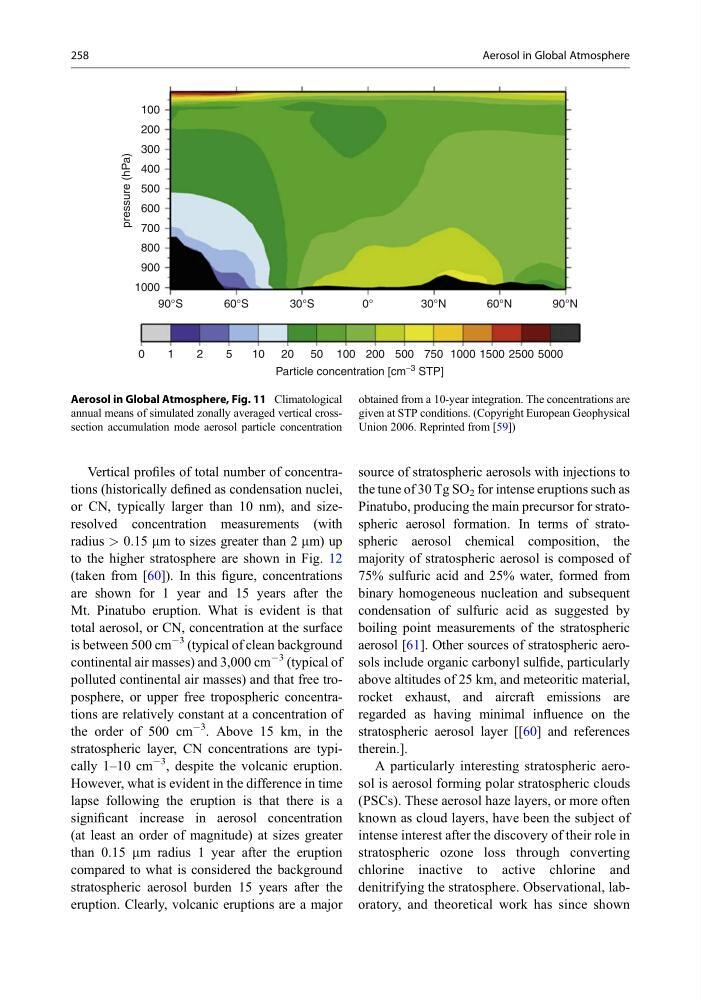
Aerosol in Global Atmosphere, Fig. 11 Climatological
annual means of simulated zonally averaged vertical crosssection accumulation mode aerosol particle concentration
obtained from a 10-year integration. The concentrations are
given at STP conditions. (Copyright European Geophysical
Union 2006. Reprinted from [59])
258
Aerosol in Global Atmosphere
or CN, typically larger than 10 nm), and sizeresolved concentration measurements (with
radius > 0.15 mm to sizes greater than 2 mm) up
to the higher stratosphere are shown in Fig. 12
(taken from [60]). In this figure, concentrations
are shown for 1 year and 15 years after the
Mt. Pinatubo eruption. What is evident is that
total aerosol, or CN, concentration at the surface
is between 500 cm
À3 (typical of clean background
continental air masses) and 3,000 cm
À3 (typical of
polluted continental air masses) and that free troposphere, or upper free tropospheric concentrations are relatively constant at a concentration of
the order of 500 cm
À3 . Above 15 km, in the
stratospheric layer, CN concentrations are typically 1–10 cm
À3 , despite the volcanic eruption.
However, what is evident in the difference in time
lapse following the eruption is that there is a
significant increase in aerosol concentration
(at least an order of magnitude) at sizes greater
than 0.15 mm radius 1 year after the eruption
compared to what is considered the background
stratospheric aerosol burden 15 years after the
eruption. Clearly, volcanic eruptions are a major
source of stratospheric aerosols with injections to
the tune of 30 Tg SO 2 for intense eruptions such as
Pinatubo, producing the main precursor for stratospheric aerosol formation. In terms of stratospheric aerosol chemical composition, the
majority of stratospheric aerosol is composed of
75% sulfuric acid and 25% water, formed from
binary homogeneous nucleation and subsequent
condensation of sulfuric acid as suggested by
boiling point measurements of the stratospheric
aerosol [61]. Other sources of stratospheric aerosols include organic carbonyl sulfide, particularly
above altitudes of 25 km, and meteoritic material,
rocket exhaust, and aircraft emissions are
regarded as having minimal influence on the
stratospheric aerosol layer [[60] and references
therein.].
A particularly interesting stratospheric aerosol is aerosol forming polar stratospheric clouds
(PSCs). These aerosol haze layers, or more often
known as cloud layers, have been the subject of
intense interest after the discovery of their role in
stratospheric ozone loss through converting
chlorine inactive to active chlorine and
denitrifying the stratosphere. Observational, laboratory, and theoretical work has since shown
1000
pressure (hPa)
900
90°S
0
1
2
5
10 20 50 100
Particle concentration [cm
−3 STP]
200 500 750 1000 1500 2500 5000
60°S
30°S
0°
30°N
60°N
90°N
800
700
600
500
400
300
200
100
Aerosol in Global Atmosphere, Fig. 11 Climatological
annual means of simulated zonally averaged vertical crosssection accumulation mode aerosol particle concentration
obtained from a 10-year integration. The concentrations are
given at STP conditions. (Copyright European Geophysical
Union 2006. Reprinted from [59])
258
Aerosol in Global Atmosphere