

that PSC particles above the ice point are either
solid nitric acid trihydrate (NAT) particles or
liquid ternary aerosol (LTA), droplets composed
of nitric acid, sulfuric acid, and water. The composition and phase of the particles determines the
threshold temperatures at which they occur and
persist – specifically, NAT will exist at temperatures 3–5 K above LTA temperatures, while LTA
will begin to appear about 3 K above the ice point
for polar stratospheric levels of gaseous nitric
acid and water [62, 63]. Particle phase also controls the development of particle size, which
plays a large role in the extent and rate of
dehydration/denitrification, thus determining
the time frame during which chlorine will remain
active, and ultimately determining the fundamental processes associated with ozone depletion in the polar stratosphere.
The main open question concerning the formation of PSCs is the process by which NAT forms.
LTA growth is strictly a function of gas-phasemixing ratios and temperature, as the vapor pressures of sulfuric acid, nitric acid, and water adjust
to environmental temperature and molecular collisions. LTA begins to grow on the SA as soon as
temperatures reach about 3 K above the ice point.
10 −3
0
5
10
15
20
N
C
N
C
b) 6 May 2006
a) 24 June 1992
(41°N, 105°W) Laramie, Wyoming
r>0.15,
r>0.25,
r>0.50,
r>0.78,
r>1.08,
r>1.58,
r>2.0 μm
Altitude (km)
25
30
35
40
0
5
10
15
20
25
30
35
40
280
260
240
Temperature (K)
220
200
180
280
260
240
Temperature (K)
220
200
180
10
−2
10 −1
10 0
Concentration (cm
−3
)
10 1
10 2
10 3 10 −3 10 −2 10 −1
10 0
10 1
10 2
10 3
Concentration (cm
−3
)
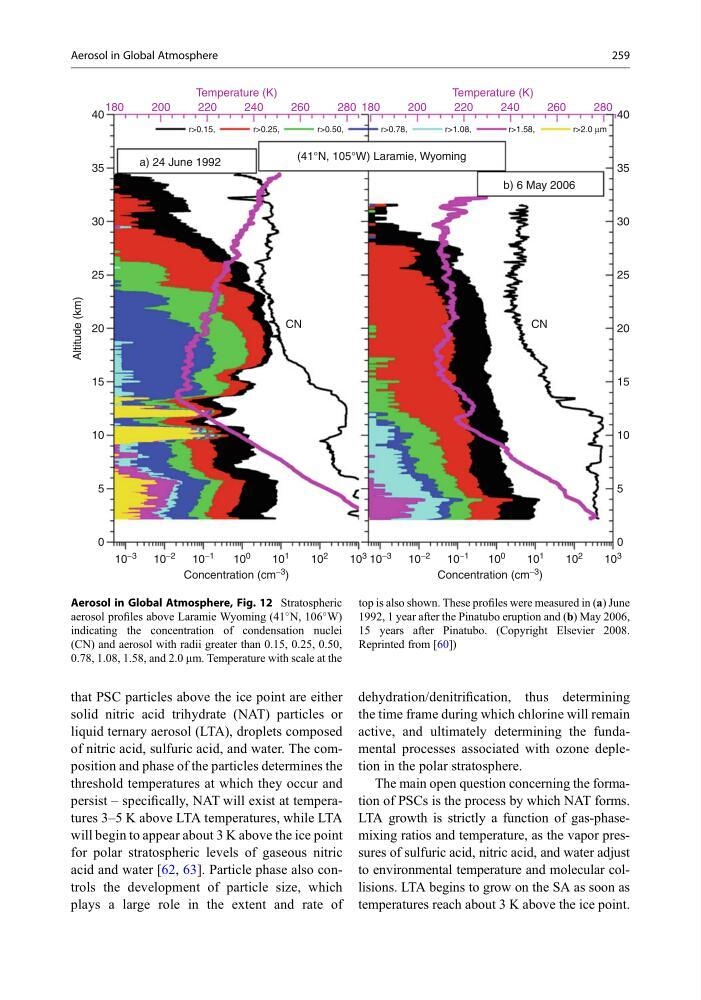
Aerosol in Global Atmosphere, Fig. 12 Stratospheric
aerosol profiles above Laramie Wyoming (41
N, 106
W)
indicating the concentration of condensation nuclei
(CN) and aerosol with radii greater than 0.15, 0.25, 0.50,
0.78, 1.08, 1.58, and 2.0 mm. Temperature with scale at the
top is also shown. These profiles were measured in (a) June
1992, 1 year after the Pinatubo eruption and (b) May 2006,
15 years after Pinatubo. (Copyright Elsevier 2008.
Reprinted from [60])
Aerosol in Global Atmosphere
259
solid nitric acid trihydrate (NAT) particles or
liquid ternary aerosol (LTA), droplets composed
of nitric acid, sulfuric acid, and water. The composition and phase of the particles determines the
threshold temperatures at which they occur and
persist – specifically, NAT will exist at temperatures 3–5 K above LTA temperatures, while LTA
will begin to appear about 3 K above the ice point
for polar stratospheric levels of gaseous nitric
acid and water [62, 63]. Particle phase also controls the development of particle size, which
plays a large role in the extent and rate of
dehydration/denitrification, thus determining
the time frame during which chlorine will remain
active, and ultimately determining the fundamental processes associated with ozone depletion in the polar stratosphere.
The main open question concerning the formation of PSCs is the process by which NAT forms.
LTA growth is strictly a function of gas-phasemixing ratios and temperature, as the vapor pressures of sulfuric acid, nitric acid, and water adjust
to environmental temperature and molecular collisions. LTA begins to grow on the SA as soon as
temperatures reach about 3 K above the ice point.
10 −3
0
5
10
15
20
N
C
N
C
b) 6 May 2006
a) 24 June 1992
(41°N, 105°W) Laramie, Wyoming
r>0.15,
r>0.25,
r>0.50,
r>0.78,
r>1.08,
r>1.58,
r>2.0 μm
Altitude (km)
25
30
35
40
0
5
10
15
20
25
30
35
40
280
260
240
Temperature (K)
220
200
180
280
260
240
Temperature (K)
220
200
180
10
−2
10 −1
10 0
Concentration (cm
−3
)
10 1
10 2
10 3 10 −3 10 −2 10 −1
10 0
10 1
10 2
10 3
Concentration (cm
−3
)
Aerosol in Global Atmosphere, Fig. 12 Stratospheric
aerosol profiles above Laramie Wyoming (41
N, 106
W)
indicating the concentration of condensation nuclei
(CN) and aerosol with radii greater than 0.15, 0.25, 0.50,
0.78, 1.08, 1.58, and 2.0 mm. Temperature with scale at the
top is also shown. These profiles were measured in (a) June
1992, 1 year after the Pinatubo eruption and (b) May 2006,
15 years after Pinatubo. (Copyright Elsevier 2008.
Reprinted from [60])
Aerosol in Global Atmosphere
259