

by a molecule in the liquid phase, S is the supersaturation, T is the temperature, and s is the surface tension. The first term is a function of the
change in free energy for a molecule going from
the gas phase to the liquid phase (ultimately a
function of the saturation ratio, S) and the particle
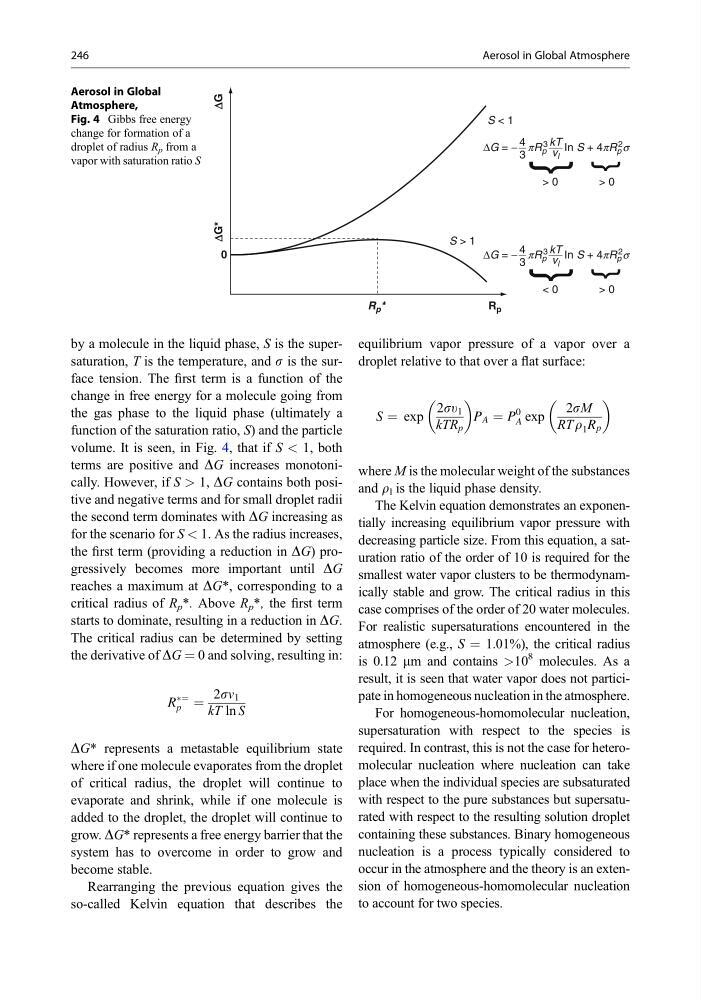
volume. It is seen, in Fig. 4, that if S < 1, both
terms are positive and DG increases monotonically. However, if S > 1, DG contains both positive and negative terms and for small droplet radii
the second term dominates with DG increasing as
for the scenario for S < 1. As the radius increases,
the first term (providing a reduction in DG) progressively becomes more important until DG
reaches a maximum at DG*, corresponding to a
critical radius of R p *. Above R p *, the first term
starts to dominate, resulting in a reduction in DG.
The critical radius can be determined by setting
the derivative of DG ¼ 0 and solving, resulting in:
R
ü
p ¼
2sv 1
kT ln S
DG* represents a metastable equilibrium state
where if one molecule evaporates from the droplet
of critical radius, the droplet will continue to
evaporate and shrink, while if one molecule is
added to the droplet, the droplet will continue to
grow. DG* represents a free energy barrier that the
system has to overcome in order to grow and
become stable.
Rearranging the previous equation gives the
so-called Kelvin equation that describes the
equilibrium vapor pressure of a vapor over a
droplet relative to that over a flat surface:
S ¼ exp
2su 1
kTR p
P A ¼ P
0
A exp
2sM
RT r 1 R p
where M is the molecular weight of the substances
and r l is the liquid phase density.
The Kelvin equation demonstrates an exponentially increasing equilibrium vapor pressure with
decreasing particle size. From this equation, a saturation ratio of the order of 10 is required for the
smallest water vapor clusters to be thermodynamically stable and grow. The critical radius in this
case comprises of the order of 20 water molecules.
For realistic supersaturations encountered in the
atmosphere (e.g., S ¼ 1.01%), the critical radius
is 0.12 mm and contains >10
8 molecules. As a
result, it is seen that water vapor does not participate in homogeneous nucleation in the atmosphere.
For homogeneous-homomolecular nucleation,
supersaturation with respect to the species is
required. In contrast, this is not the case for heteromolecular nucleation where nucleation can take
place when the individual species are subsaturated
with respect to the pure substances but supersaturated with respect to the resulting solution droplet
containing these substances. Binary homogeneous
nucleation is a process typically considered to
occur in the atmosphere and the theory is an extension of homogeneous-homomolecular nucleation
to account for two species.
0
R p
DG
DG*
R p *
S > 1
S < 1
> 0
< 0
ΔG = − pR p
3
In S + 4pR p
2 s
4
3
kT
v l
> 0
> 0
ΔG = − pR p
3
In S + 4pR p
2 s
4
3
kT
v l
Aerosol in Global
Atmosphere,
Fig. 4 Gibbs free energy
change for formation of a
droplet of radius R p from a
vapor with saturation ratio S
246
Aerosol in Global Atmosphere
change in free energy for a molecule going from
the gas phase to the liquid phase (ultimately a
function of the saturation ratio, S) and the particle
volume. It is seen, in Fig. 4, that if S < 1, both
terms are positive and DG increases monotonically. However, if S > 1, DG contains both positive and negative terms and for small droplet radii
the second term dominates with DG increasing as
for the scenario for S < 1. As the radius increases,
the first term (providing a reduction in DG) progressively becomes more important until DG
reaches a maximum at DG*, corresponding to a
critical radius of R p *. Above R p *, the first term
starts to dominate, resulting in a reduction in DG.
The critical radius can be determined by setting
the derivative of DG ¼ 0 and solving, resulting in:
R
ü
p ¼
2sv 1
kT ln S
DG* represents a metastable equilibrium state
where if one molecule evaporates from the droplet
of critical radius, the droplet will continue to
evaporate and shrink, while if one molecule is
added to the droplet, the droplet will continue to
grow. DG* represents a free energy barrier that the
system has to overcome in order to grow and
become stable.
Rearranging the previous equation gives the
so-called Kelvin equation that describes the
equilibrium vapor pressure of a vapor over a
droplet relative to that over a flat surface:
S ¼ exp
2su 1
kTR p
P A ¼ P
0
A exp
2sM
RT r 1 R p
where M is the molecular weight of the substances
and r l is the liquid phase density.
The Kelvin equation demonstrates an exponentially increasing equilibrium vapor pressure with
decreasing particle size. From this equation, a saturation ratio of the order of 10 is required for the
smallest water vapor clusters to be thermodynamically stable and grow. The critical radius in this
case comprises of the order of 20 water molecules.
For realistic supersaturations encountered in the
atmosphere (e.g., S ¼ 1.01%), the critical radius
is 0.12 mm and contains >10
8 molecules. As a
result, it is seen that water vapor does not participate in homogeneous nucleation in the atmosphere.
For homogeneous-homomolecular nucleation,
supersaturation with respect to the species is
required. In contrast, this is not the case for heteromolecular nucleation where nucleation can take
place when the individual species are subsaturated
with respect to the pure substances but supersaturated with respect to the resulting solution droplet
containing these substances. Binary homogeneous
nucleation is a process typically considered to
occur in the atmosphere and the theory is an extension of homogeneous-homomolecular nucleation
to account for two species.
0
R p
DG
DG*
R p *
S > 1
S < 1
> 0
< 0
ΔG = − pR p
3
In S + 4pR p
2 s
4
3
kT
v l
> 0
> 0
ΔG = − pR p
3
In S + 4pR p
2 s
4
3
kT
v l
Aerosol in Global
Atmosphere,
Fig. 4 Gibbs free energy
change for formation of a
droplet of radius R p from a
vapor with saturation ratio S
246
Aerosol in Global Atmosphere