

Air contains many rapidly moving and colliding trace gases of varying vapor pressures. Those
with low saturation vapor pressures, given the
right conditions, prefer to be in the liquid solution
phase or the solid phase from a thermodynamic
perspective. The random collisions of this soup of
molecules result in the continuous formation of
clusters of a few to tens of molecules. Such stable
clusters will then grow in size with each subsequent collision of a low vapor pressure molecule.
The size of a critical cluster is of the order of
0.5 nm; however, at this size, the cluster has a
very high diffusion coefficient and unless it grows
rapidly, it will be scavenged by diffusion to larger,
preexisting aerosol particles. For example, if the
cluster can grow to 3 nm, its diffusion coefficient
is reduced by a factor of 10 and if it grows to 6 nm,
it is reduced further by a factor of 10 [17]. In other
words, if the cluster can grow to 6 nm, its probability of survival is increased by a factor of 100.
In the atmosphere, very few vapors can participate in homogeneous nucleation. The best candidate is sulfuric acid, which in conjunction with
water vapor can participate in binary homogeneous nucleation. It should be noted that the probability of stable cluster formation (or nucleation)
is exponentially inversely dependent on temperature, and as a result, binary nucleation of sulfuric
acid and water vapor is likely to occur only in the
upper troposphere and the stratosphere where
temperatures are sufficiently low to promote
nucleation under atmospheric concentrations of
sulfuric acid. In the troposphere, a different mechanism is required for nucleation to proceed under
atmospheric concentrations of sulfuric acid concentrations (typically 10
6
–10
7 molecules cm
À3 ).
In the presence of ammonia, classical theory predicts that ternary nucleation of ammonia, sulfuric
acid, and water can readily proceed to more readily produce thermonynamically stable clusters
under tropospheric conditions. The presence of
ammonia lowers the thermodynamic barrier
which has to be overcome to form an embryo. In
classical theory, whether binary or ternary nucleation, the number of molecules in a critical cluster
is of the order of 10 or more.
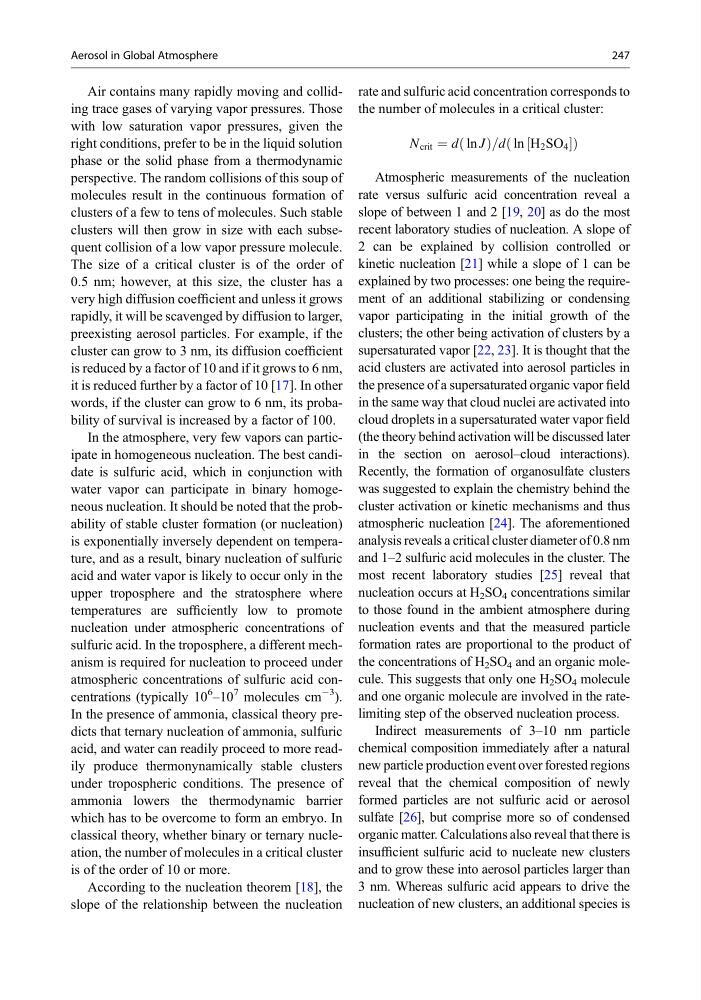
According to the nucleation theorem [18], the
slope of the relationship between the nucleation
rate and sulfuric acid concentration corresponds to
the number of molecules in a critical cluster:
N crit ¼ d ln J
ð
Þ=d ln H 2 SO 4
½
ð
Þ
Atmospheric measurements of the nucleation
rate versus sulfuric acid concentration reveal a
slope of between 1 and 2 [19, 20] as do the most
recent laboratory studies of nucleation. A slope of
2 can be explained by collision controlled or
kinetic nucleation [21] while a slope of 1 can be
explained by two processes: one being the requirement of an additional stabilizing or condensing
vapor participating in the initial growth of the
clusters; the other being activation of clusters by a
supersaturated vapor [22, 23]. It is thought that the
acid clusters are activated into aerosol particles in
the presence of a supersaturated organic vapor field
in the same way that cloud nuclei are activated into
cloud droplets in a supersaturated water vapor field
(the theory behind activation will be discussed later
in the section on aerosol–cloud interactions).
Recently, the formation of organosulfate clusters
was suggested to explain the chemistry behind the
cluster activation or kinetic mechanisms and thus
atmospheric nucleation [24]. The aforementioned
analysis reveals a critical cluster diameter of 0.8 nm
and 1–2 sulfuric acid molecules in the cluster. The
most recent laboratory studies [25] reveal that
nucleation occurs at H 2 SO 4 concentrations similar
to those found in the ambient atmosphere during
nucleation events and that the measured particle
formation rates are proportional to the product of
the concentrations of H 2 SO 4 and an organic molecule. This suggests that only one H 2 SO 4 molecule
and one organic molecule are involved in the ratelimiting step of the observed nucleation process.
Indirect measurements of 3–10 nm particle
chemical composition immediately after a natural
new particle production event over forested regions
reveal that the chemical composition of newly
formed particles are not sulfuric acid or aerosol
sulfate [26], but comprise more so of condensed
organic matter. Calculations also reveal that there is
insufficient sulfuric acid to nucleate new clusters
and to grow these into aerosol particles larger than
3 nm. Whereas sulfuric acid appears to drive the
nucleation of new clusters, an additional species is
Aerosol in Global Atmosphere
247
with low saturation vapor pressures, given the
right conditions, prefer to be in the liquid solution
phase or the solid phase from a thermodynamic
perspective. The random collisions of this soup of
molecules result in the continuous formation of
clusters of a few to tens of molecules. Such stable
clusters will then grow in size with each subsequent collision of a low vapor pressure molecule.
The size of a critical cluster is of the order of
0.5 nm; however, at this size, the cluster has a
very high diffusion coefficient and unless it grows
rapidly, it will be scavenged by diffusion to larger,
preexisting aerosol particles. For example, if the
cluster can grow to 3 nm, its diffusion coefficient
is reduced by a factor of 10 and if it grows to 6 nm,
it is reduced further by a factor of 10 [17]. In other
words, if the cluster can grow to 6 nm, its probability of survival is increased by a factor of 100.
In the atmosphere, very few vapors can participate in homogeneous nucleation. The best candidate is sulfuric acid, which in conjunction with
water vapor can participate in binary homogeneous nucleation. It should be noted that the probability of stable cluster formation (or nucleation)
is exponentially inversely dependent on temperature, and as a result, binary nucleation of sulfuric
acid and water vapor is likely to occur only in the
upper troposphere and the stratosphere where
temperatures are sufficiently low to promote
nucleation under atmospheric concentrations of
sulfuric acid. In the troposphere, a different mechanism is required for nucleation to proceed under
atmospheric concentrations of sulfuric acid concentrations (typically 10
6
–10
7 molecules cm
À3 ).
In the presence of ammonia, classical theory predicts that ternary nucleation of ammonia, sulfuric
acid, and water can readily proceed to more readily produce thermonynamically stable clusters
under tropospheric conditions. The presence of
ammonia lowers the thermodynamic barrier
which has to be overcome to form an embryo. In
classical theory, whether binary or ternary nucleation, the number of molecules in a critical cluster
is of the order of 10 or more.
According to the nucleation theorem [18], the
slope of the relationship between the nucleation
rate and sulfuric acid concentration corresponds to
the number of molecules in a critical cluster:
N crit ¼ d ln J
ð
Þ=d ln H 2 SO 4
½
ð
Þ
Atmospheric measurements of the nucleation
rate versus sulfuric acid concentration reveal a
slope of between 1 and 2 [19, 20] as do the most
recent laboratory studies of nucleation. A slope of
2 can be explained by collision controlled or
kinetic nucleation [21] while a slope of 1 can be
explained by two processes: one being the requirement of an additional stabilizing or condensing
vapor participating in the initial growth of the
clusters; the other being activation of clusters by a
supersaturated vapor [22, 23]. It is thought that the
acid clusters are activated into aerosol particles in
the presence of a supersaturated organic vapor field
in the same way that cloud nuclei are activated into
cloud droplets in a supersaturated water vapor field
(the theory behind activation will be discussed later
in the section on aerosol–cloud interactions).
Recently, the formation of organosulfate clusters
was suggested to explain the chemistry behind the
cluster activation or kinetic mechanisms and thus
atmospheric nucleation [24]. The aforementioned
analysis reveals a critical cluster diameter of 0.8 nm
and 1–2 sulfuric acid molecules in the cluster. The
most recent laboratory studies [25] reveal that
nucleation occurs at H 2 SO 4 concentrations similar
to those found in the ambient atmosphere during
nucleation events and that the measured particle
formation rates are proportional to the product of
the concentrations of H 2 SO 4 and an organic molecule. This suggests that only one H 2 SO 4 molecule
and one organic molecule are involved in the ratelimiting step of the observed nucleation process.
Indirect measurements of 3–10 nm particle
chemical composition immediately after a natural
new particle production event over forested regions
reveal that the chemical composition of newly
formed particles are not sulfuric acid or aerosol
sulfate [26], but comprise more so of condensed
organic matter. Calculations also reveal that there is
insufficient sulfuric acid to nucleate new clusters
and to grow these into aerosol particles larger than
3 nm. Whereas sulfuric acid appears to drive the
nucleation of new clusters, an additional species is
Aerosol in Global Atmosphere
247