

they are generally thermodynamically unstable. If
a sufficient number of the right low-vapor pressure molecules collide, the cluster can achieve a
critical radius and achieve thermodynamic equilibrium (i.e., where the evaporation rate is zero).
The nucleation rate is the net number of clusters
per unit time that will grow past the critical size.
In addition to the kinetic aspect of forming
clusters, the thermodynamics of the phase change
has to be considered. In a thermodynamic process,
such as a phase change resulting in chemical
potential equilibrium of the molecular components, the change in the Gibbs free energy (G)
must be zero or negative. This condition must
also hold for a curved surface of an aerosol particle or droplet. The curved surface will affect the
equilibrium vapor pressure in a manner that a
higher vapor pressure is required to maintain equilibrium for a smaller droplet (i.e., higher curvature
effect). The change in Gibb’s free energy DG
associated with the formation of a single drop of
a pure substance or radius R p is given by:
DG ¼ DG droplet À DG pure vapor
which after expanding and rearranging, the righthand side terms become:
DG ¼ À
4
3
pR
3
p
kT
v l
ln S þ 4pR
2
p s
The second term on the right-hand side is the
free energy associated with an interface with
radius of curvature R p , v l is the volume occupied
Mace Head
Mass fraction (%)
Not detectable
Chlorophyll concentration (mg m −3 )
Sea salt
NH 4
nss SO 4
NO 3
WSOC
WIOC
BC
100
90
80
70
60
50
40
a
b
d
30
20
10
100
90
80
70
D (μm)
Mass (μg
m
–3
)
60
50
40
30
20
10
0
0.06
0.01 0.03 0.1 0.3
1
3
10
30 60
0.125 0.25
0.5
1
2
4
8
0
1
2
3
4
5
6
7
8
9
10
1
2
3
4
5
6
7
8
9
10
c
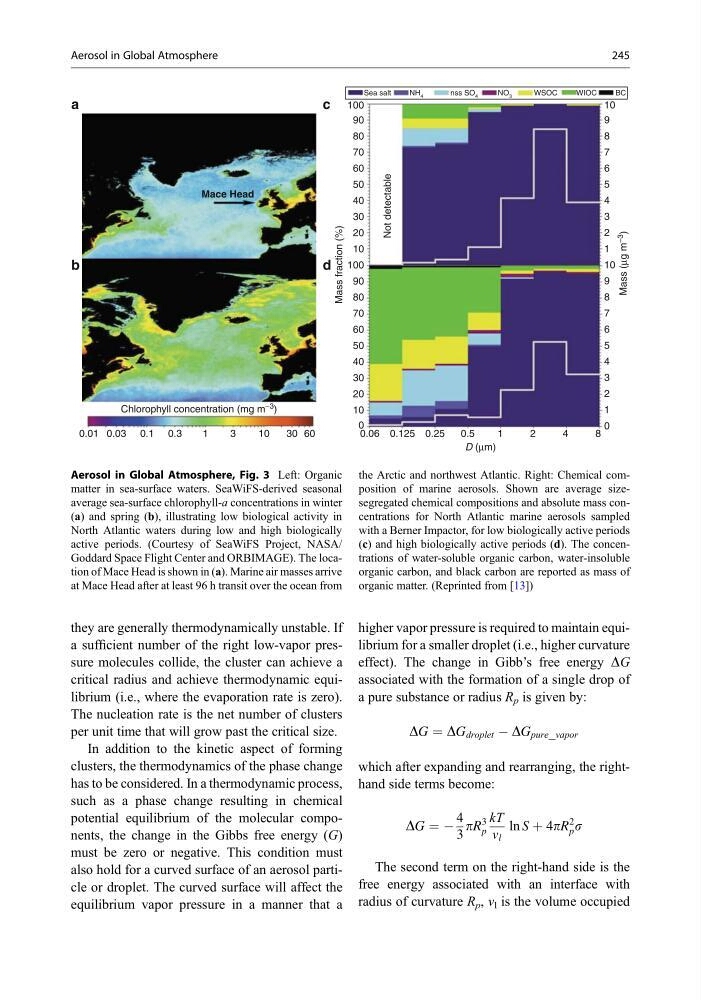
Aerosol in Global Atmosphere, Fig. 3 Left: Organic
matter in sea-surface waters. SeaWiFS-derived seasonal
average sea-surface chlorophyll-a concentrations in winter
(a) and spring (b), illustrating low biological activity in
North Atlantic waters during low and high biologically
active periods. (Courtesy of SeaWiFS Project, NASA/
Goddard Space Flight Center and ORBIMAGE). The location of Mace Head is shown in (a). Marine air masses arrive
at Mace Head after at least 96 h transit over the ocean from
the Arctic and northwest Atlantic. Right: Chemical composition of marine aerosols. Shown are average sizesegregated chemical compositions and absolute mass concentrations for North Atlantic marine aerosols sampled
with a Berner Impactor, for low biologically active periods
(c) and high biologically active periods (d). The concentrations of water-soluble organic carbon, water-insoluble
organic carbon, and black carbon are reported as mass of
organic matter. (Reprinted from [13])
Aerosol in Global Atmosphere
245
a sufficient number of the right low-vapor pressure molecules collide, the cluster can achieve a
critical radius and achieve thermodynamic equilibrium (i.e., where the evaporation rate is zero).
The nucleation rate is the net number of clusters
per unit time that will grow past the critical size.
In addition to the kinetic aspect of forming
clusters, the thermodynamics of the phase change
has to be considered. In a thermodynamic process,
such as a phase change resulting in chemical
potential equilibrium of the molecular components, the change in the Gibbs free energy (G)
must be zero or negative. This condition must
also hold for a curved surface of an aerosol particle or droplet. The curved surface will affect the
equilibrium vapor pressure in a manner that a
higher vapor pressure is required to maintain equilibrium for a smaller droplet (i.e., higher curvature
effect). The change in Gibb’s free energy DG
associated with the formation of a single drop of
a pure substance or radius R p is given by:
DG ¼ DG droplet À DG pure vapor
which after expanding and rearranging, the righthand side terms become:
DG ¼ À
4
3
pR
3
p
kT
v l
ln S þ 4pR
2
p s
The second term on the right-hand side is the
free energy associated with an interface with
radius of curvature R p , v l is the volume occupied
Mace Head
Mass fraction (%)
Not detectable
Chlorophyll concentration (mg m −3 )
Sea salt
NH 4
nss SO 4
NO 3
WSOC
WIOC
BC
100
90
80
70
60
50
40
a
b
d
30
20
10
100
90
80
70
D (μm)
Mass (μg
m
–3
)
60
50
40
30
20
10
0
0.06
0.01 0.03 0.1 0.3
1
3
10
30 60
0.125 0.25
0.5
1
2
4
8
0
1
2
3
4
5
6
7
8
9
10
1
2
3
4
5
6
7
8
9
10
c
Aerosol in Global Atmosphere, Fig. 3 Left: Organic
matter in sea-surface waters. SeaWiFS-derived seasonal
average sea-surface chlorophyll-a concentrations in winter
(a) and spring (b), illustrating low biological activity in
North Atlantic waters during low and high biologically
active periods. (Courtesy of SeaWiFS Project, NASA/
Goddard Space Flight Center and ORBIMAGE). The location of Mace Head is shown in (a). Marine air masses arrive
at Mace Head after at least 96 h transit over the ocean from
the Arctic and northwest Atlantic. Right: Chemical composition of marine aerosols. Shown are average sizesegregated chemical compositions and absolute mass concentrations for North Atlantic marine aerosols sampled
with a Berner Impactor, for low biologically active periods
(c) and high biologically active periods (d). The concentrations of water-soluble organic carbon, water-insoluble
organic carbon, and black carbon are reported as mass of
organic matter. (Reprinted from [13])
Aerosol in Global Atmosphere
245