

resuspended dust [46, 47] with relatively large
mass and thus quickly deposits by gravitational
settling, such as road dust.
Due to the quick deposition, coarse particles,
therefore, generally have a relatively short lifetime in the atmosphere when compared with fine
particles.
Particles of low-temperature combustion processes from wood-burning stoves and other
poorly controlled burning processes may be soot
particles which often have high contents of polycyclic aromatic hydrocarbons (PAH) and other
carcinogens or just generally degrade the air quality in the urban environment, despite the “charm”
or, in developing countries, necessity, for burning
with these methods.
Air Quality Measurement Locations
When comparing observed levels of particulate
matter or air quality in different cities, aside
from assuring that the indices are the same, the
location of the monitoring stations must be considered, as they may be very different. An index
that reports the “average” might consist of a
station in the urban center and one on the outskirts. There is a real risk of comparing sites in the
vicinity of large pollution sources with sites at
some distance from local sources. The location
of measurement stations must be very carefully
considered, and it is not generally good enough to
just replicate what another town is doing. For all
the physical and anthropogenic factors previously
discussed, locating stations is critical and must be
done in conjunctions with city planners. Recently
in the Danish press, scientists speculated if air
quality levels improved as a result of newly laid
road tar thus keeping down the dust at a roadway
at the measurement station.
In addition to the ambient measurements, modern air quality management is starting to consider
locating measurement stations where many people spend most of their time: indoors. Exposure to
air pollution in the home is an important fraction
of a person’s overall exposure. A Danish study in
an uninhabited apartment in central Copenhagen
revealed that particle pollution inside the apartment was to some extent linked to the activity
level of the neighboring apartments [48]
NO x
0
20
40
60
80
100
200
300
400
500
600
Concentration relative to urban background (=100)
Urban background
Near-city location
Rural background
Curb side
ToN
PM 10
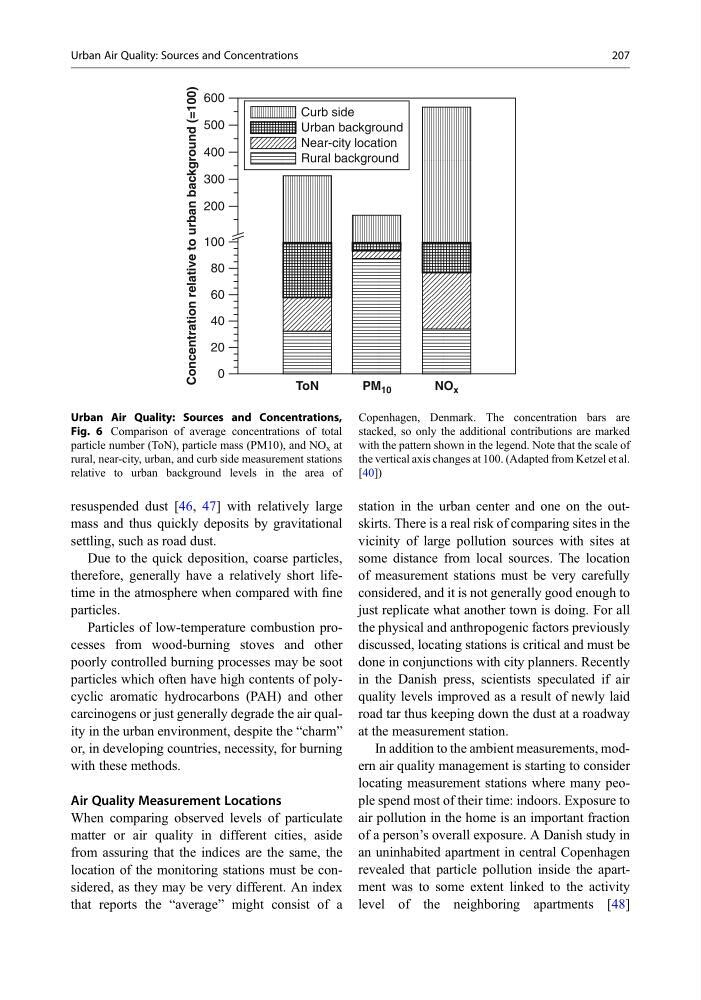
Urban Air Quality: Sources and Concentrations,
Fig. 6 Comparison of average concentrations of total
particle number (ToN), particle mass (PM10), and NO x at
rural, near-city, urban, and curb side measurement stations
relative to urban background levels in the area of
Copenhagen, Denmark. The concentration bars are
stacked, so only the additional contributions are marked
with the pattern shown in the legend. Note that the scale of
the vertical axis changes at 100. (Adapted from Ketzel et al.
[40])
Urban Air Quality: Sources and Concentrations
207
mass and thus quickly deposits by gravitational
settling, such as road dust.
Due to the quick deposition, coarse particles,
therefore, generally have a relatively short lifetime in the atmosphere when compared with fine
particles.
Particles of low-temperature combustion processes from wood-burning stoves and other
poorly controlled burning processes may be soot
particles which often have high contents of polycyclic aromatic hydrocarbons (PAH) and other
carcinogens or just generally degrade the air quality in the urban environment, despite the “charm”
or, in developing countries, necessity, for burning
with these methods.
Air Quality Measurement Locations
When comparing observed levels of particulate
matter or air quality in different cities, aside
from assuring that the indices are the same, the
location of the monitoring stations must be considered, as they may be very different. An index
that reports the “average” might consist of a
station in the urban center and one on the outskirts. There is a real risk of comparing sites in the
vicinity of large pollution sources with sites at
some distance from local sources. The location
of measurement stations must be very carefully
considered, and it is not generally good enough to
just replicate what another town is doing. For all
the physical and anthropogenic factors previously
discussed, locating stations is critical and must be
done in conjunctions with city planners. Recently
in the Danish press, scientists speculated if air
quality levels improved as a result of newly laid
road tar thus keeping down the dust at a roadway
at the measurement station.
In addition to the ambient measurements, modern air quality management is starting to consider
locating measurement stations where many people spend most of their time: indoors. Exposure to
air pollution in the home is an important fraction
of a person’s overall exposure. A Danish study in
an uninhabited apartment in central Copenhagen
revealed that particle pollution inside the apartment was to some extent linked to the activity
level of the neighboring apartments [48]
NO x
0
20
40
60
80
100
200
300
400
500
600
Concentration relative to urban background (=100)
Urban background
Near-city location
Rural background
Curb side
ToN
PM 10
Urban Air Quality: Sources and Concentrations,
Fig. 6 Comparison of average concentrations of total
particle number (ToN), particle mass (PM10), and NO x at
rural, near-city, urban, and curb side measurement stations
relative to urban background levels in the area of
Copenhagen, Denmark. The concentration bars are
stacked, so only the additional contributions are marked
with the pattern shown in the legend. Note that the scale of
the vertical axis changes at 100. (Adapted from Ketzel et al.
[40])
Urban Air Quality: Sources and Concentrations
207