

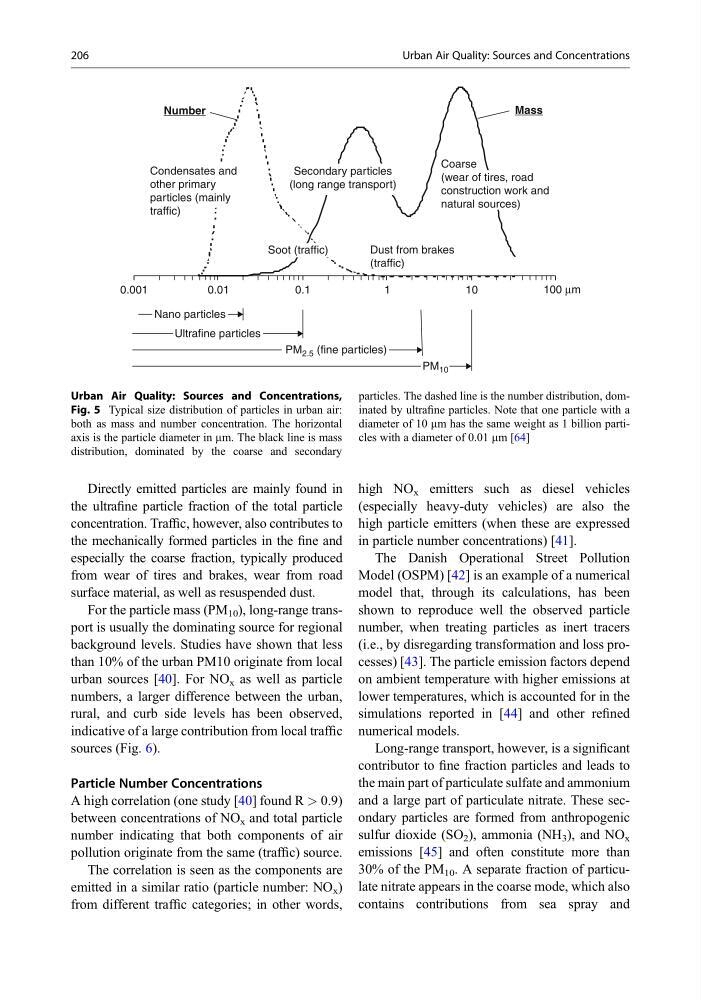
Directly emitted particles are mainly found in
the ultrafine particle fraction of the total particle
concentration. Traffic, however, also contributes to
the mechanically formed particles in the fine and
especially the coarse fraction, typically produced
from wear of tires and brakes, wear from road
surface material, as well as resuspended dust.
For the particle mass (PM 10 ), long-range transport is usually the dominating source for regional
background levels. Studies have shown that less
than 10% of the urban PM10 originate from local
urban sources [40]. For NO x as well as particle
numbers, a larger difference between the urban,
rural, and curb side levels has been observed,
indicative of a large contribution from local traffic
sources (Fig. 6).
Particle Number Concentrations
A high correlation (one study [40] found R > 0.9)
between concentrations of NO x and total particle
number indicating that both components of air
pollution originate from the same (traffic) source.
The correlation is seen as the components are
emitted in a similar ratio (particle number: NO x )
from different traffic categories; in other words,
high NO x emitters such as diesel vehicles
(especially heavy-duty vehicles) are also the
high particle emitters (when these are expressed
in particle number concentrations) [41].
The Danish Operational Street Pollution
Model (OSPM) [42] is an example of a numerical
model that, through its calculations, has been
shown to reproduce well the observed particle
number, when treating particles as inert tracers
(i.e., by disregarding transformation and loss processes) [43]. The particle emission factors depend
on ambient temperature with higher emissions at
lower temperatures, which is accounted for in the
simulations reported in [44] and other refined
numerical models.
Long-range transport, however, is a significant
contributor to fine fraction particles and leads to
the main part of particulate sulfate and ammonium
and a large part of particulate nitrate. These secondary particles are formed from anthropogenic
sulfur dioxide (SO 2 ), ammonia (NH 3 ), and NO x
emissions [45] and often constitute more than
30% of the PM 10 . A separate fraction of particulate nitrate appears in the coarse mode, which also
contains contributions from sea spray and
0.001
0.01
0.1
1
10
100 µm
Number
PM 10
PM 2.5 (fine particles)
Ultrafine particles
Condensates and
other primary
particles (mainly
traffic)
Soot (traffic)
Mass
Nano particles
Dust from brakes
(traffic)
Secondary particles
(long range transport)
Coarse
(wear of tires, road
construction work and
natural sources)
Urban Air Quality: Sources and Concentrations,
Fig. 5 Typical size distribution of particles in urban air:
both as mass and number concentration. The horizontal
axis is the particle diameter in mm. The black line is mass
distribution, dominated by the coarse and secondary
particles. The dashed line is the number distribution, dominated by ultrafine particles. Note that one particle with a
diameter of 10 mm has the same weight as 1 billion particles with a diameter of 0.01 mm [64]
206
Urban Air Quality: Sources and Concentrations
the ultrafine particle fraction of the total particle
concentration. Traffic, however, also contributes to
the mechanically formed particles in the fine and
especially the coarse fraction, typically produced
from wear of tires and brakes, wear from road
surface material, as well as resuspended dust.
For the particle mass (PM 10 ), long-range transport is usually the dominating source for regional
background levels. Studies have shown that less
than 10% of the urban PM10 originate from local
urban sources [40]. For NO x as well as particle
numbers, a larger difference between the urban,
rural, and curb side levels has been observed,
indicative of a large contribution from local traffic
sources (Fig. 6).
Particle Number Concentrations
A high correlation (one study [40] found R > 0.9)
between concentrations of NO x and total particle
number indicating that both components of air
pollution originate from the same (traffic) source.
The correlation is seen as the components are
emitted in a similar ratio (particle number: NO x )
from different traffic categories; in other words,
high NO x emitters such as diesel vehicles
(especially heavy-duty vehicles) are also the
high particle emitters (when these are expressed
in particle number concentrations) [41].
The Danish Operational Street Pollution
Model (OSPM) [42] is an example of a numerical
model that, through its calculations, has been
shown to reproduce well the observed particle
number, when treating particles as inert tracers
(i.e., by disregarding transformation and loss processes) [43]. The particle emission factors depend
on ambient temperature with higher emissions at
lower temperatures, which is accounted for in the
simulations reported in [44] and other refined
numerical models.
Long-range transport, however, is a significant
contributor to fine fraction particles and leads to
the main part of particulate sulfate and ammonium
and a large part of particulate nitrate. These secondary particles are formed from anthropogenic
sulfur dioxide (SO 2 ), ammonia (NH 3 ), and NO x
emissions [45] and often constitute more than
30% of the PM 10 . A separate fraction of particulate nitrate appears in the coarse mode, which also
contains contributions from sea spray and
0.001
0.01
0.1
1
10
100 µm
Number
PM 10
PM 2.5 (fine particles)
Ultrafine particles
Condensates and
other primary
particles (mainly
traffic)
Soot (traffic)
Mass
Nano particles
Dust from brakes
(traffic)
Secondary particles
(long range transport)
Coarse
(wear of tires, road
construction work and
natural sources)
Urban Air Quality: Sources and Concentrations,
Fig. 5 Typical size distribution of particles in urban air:
both as mass and number concentration. The horizontal
axis is the particle diameter in mm. The black line is mass
distribution, dominated by the coarse and secondary
particles. The dashed line is the number distribution, dominated by ultrafine particles. Note that one particle with a
diameter of 10 mm has the same weight as 1 billion particles with a diameter of 0.01 mm [64]
206
Urban Air Quality: Sources and Concentrations