

distance the air flow above the buildings first
accelerates as a result of the vertical displacement
by the buildings, and then decelerates as slow
moving fluid is expelled from below the level of
the building envelope or canopy. Downwind of
the adjustment distance (Fig. 2a), if the neighborhood scale is large enough (i.e., L N > L A ~ 30 H),
the air flow (speed U c ) within the canopy is largely
driven by turbulent shear stresses generated in the
shear layer just above buildings H c < Z < Z * < l N (x)
(rather than by the oncoming airflow). Above this
shear layer, Z * > Z > l N (x), the airflow is characteristic of a surface layer with displacement height
z d , so that
U z
ð Þ ffi
u Ã
k
ln
z À z d
z 0
,
ð1Þ
where z 0 is the aerodynamic roughness length,
and k is von Karman’s constant as discussed by
Grimmond and Oke [10], Britter and Hanna [11],
and Belcher et al. [9]. Application of Eq. 1
requires knowledge of z 0 , z d , and u * . The estimation of these parameters is not straightforward in
urban areas. The determination of the friction
velocity is also difficult because of the large variability of momentum fluxes inside the urban
canopy [12].
The aerodynamic roughness length z 0 is a measure of the turbulence-generating capacity of the
ground. The larger the roughness length, the more
turbulent the air for a given wind speed. Generally, tall features such as buildings have a larger
roughness length than short features. However a
densely built area may have a smaller roughness
length than a less dense one because the interaction between the air and the region beneath is
reduced. The wind speed close to a rough surface
is reduced by friction and a velocity profile can be
plotted from the surface to the free fluid. This
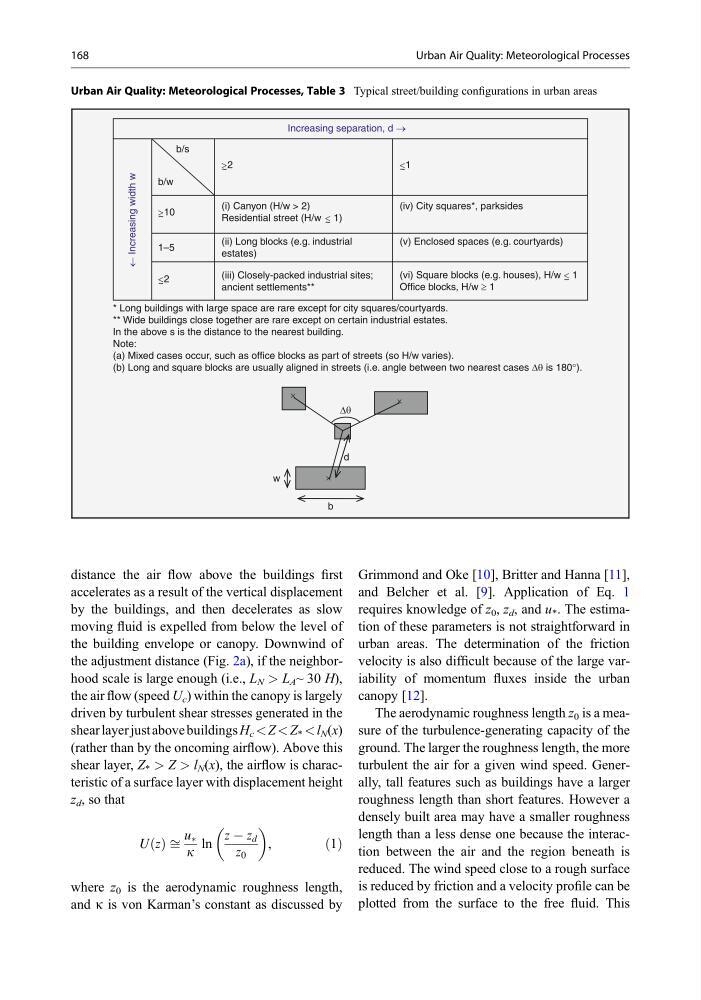
Urban Air Quality: Meteorological Processes, Table 3 Typical street/building configurations in urban areas
Increasing separation, d →
← Increasing width w
b/s
b/w
> ~ 10
> ~ 2
< ~ 2
< ~ 1
(i) Canyon (H/w > 2)
Residential street (H/w < ~ 1)
(iv) City squares*, parksides
1–5
(ii) Long blocks (e.g. industrial
estates)
(v) Enclosed spaces (e.g. courtyards)
(iii) Closely-packed industrial sites;
ancient settlements**
(vi) Square blocks (e.g. houses), H/w < ~ 1
Office blocks, H/w ≥ 1
* Long buildings with large space are rare except for city squares/courtyards.
** Wide buildings close together are rare except on certain industrial estates.
In the above s is the distance to the nearest building.
Note:
(a) Mixed cases occur, such as office blocks as part of streets (so H/w varies).
(b) Long and square blocks are usually aligned in streets (i.e. angle between two nearest cases Δθ is 180°).
b
w
d
×
×
×
Δθ
168
Urban Air Quality: Meteorological Processes
accelerates as a result of the vertical displacement
by the buildings, and then decelerates as slow
moving fluid is expelled from below the level of
the building envelope or canopy. Downwind of
the adjustment distance (Fig. 2a), if the neighborhood scale is large enough (i.e., L N > L A ~ 30 H),
the air flow (speed U c ) within the canopy is largely
driven by turbulent shear stresses generated in the
shear layer just above buildings H c < Z < Z * < l N (x)
(rather than by the oncoming airflow). Above this
shear layer, Z * > Z > l N (x), the airflow is characteristic of a surface layer with displacement height
z d , so that
U z
ð Þ ffi
u Ã
k
ln
z À z d
z 0
,
ð1Þ
where z 0 is the aerodynamic roughness length,
and k is von Karman’s constant as discussed by
Grimmond and Oke [10], Britter and Hanna [11],
and Belcher et al. [9]. Application of Eq. 1
requires knowledge of z 0 , z d , and u * . The estimation of these parameters is not straightforward in
urban areas. The determination of the friction
velocity is also difficult because of the large variability of momentum fluxes inside the urban
canopy [12].
The aerodynamic roughness length z 0 is a measure of the turbulence-generating capacity of the
ground. The larger the roughness length, the more
turbulent the air for a given wind speed. Generally, tall features such as buildings have a larger
roughness length than short features. However a
densely built area may have a smaller roughness
length than a less dense one because the interaction between the air and the region beneath is
reduced. The wind speed close to a rough surface
is reduced by friction and a velocity profile can be
plotted from the surface to the free fluid. This
Urban Air Quality: Meteorological Processes, Table 3 Typical street/building configurations in urban areas
Increasing separation, d →
← Increasing width w
b/s
b/w
> ~ 10
> ~ 2
< ~ 2
< ~ 1
(i) Canyon (H/w > 2)
Residential street (H/w < ~ 1)
(iv) City squares*, parksides
1–5
(ii) Long blocks (e.g. industrial
estates)
(v) Enclosed spaces (e.g. courtyards)
(iii) Closely-packed industrial sites;
ancient settlements**
(vi) Square blocks (e.g. houses), H/w < ~ 1
Office blocks, H/w ≥ 1
* Long buildings with large space are rare except for city squares/courtyards.
** Wide buildings close together are rare except on certain industrial estates.
In the above s is the distance to the nearest building.
Note:
(a) Mixed cases occur, such as office blocks as part of streets (so H/w varies).
(b) Long and square blocks are usually aligned in streets (i.e. angle between two nearest cases Δθ is 180°).
b
w
d
×
×
×
Δθ
168
Urban Air Quality: Meteorological Processes