

Where there are significant buoyancy forces or
orographic effects, the boundary layer profiles
over the urban area and downwind may not simply adjust toward the equilibrium states found in
neutral, stable, and unstable boundary layers over
flat terrain. In fact there are characteristic features
of the air flow on these scales, especially near
hills, coasts, and urban/rural boundaries, that can
significantly affect dispersion, such as blocked
flow, unsteady slope flows, gravity currents, and
boundary layer jets [7, 8].
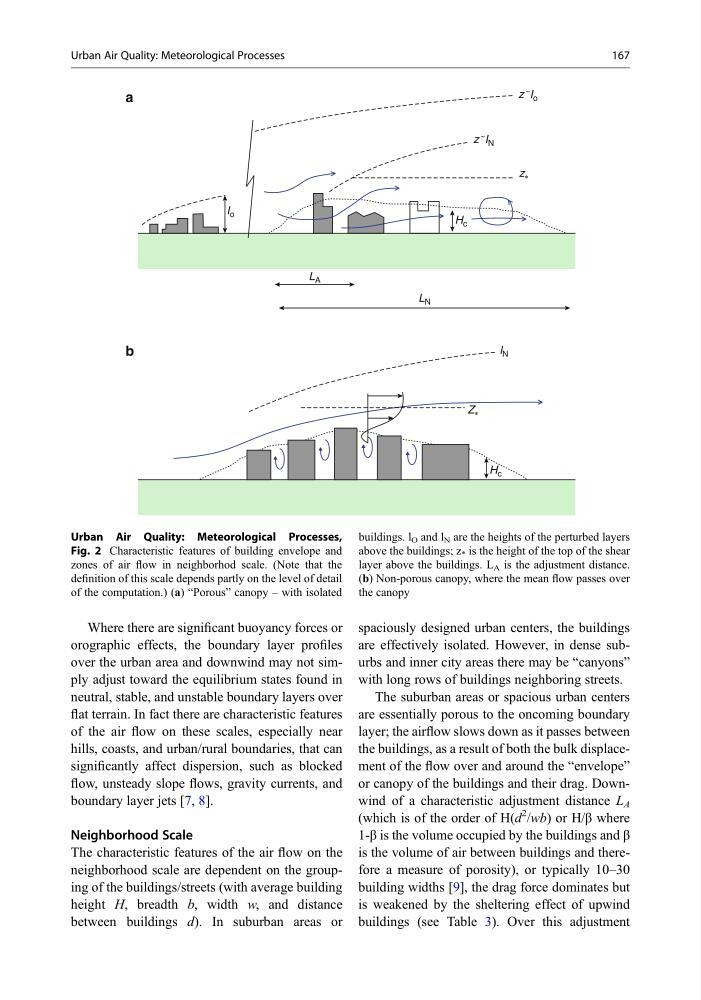
Neighborhood Scale
The characteristic features of the air flow on the
neighborhood scale are dependent on the grouping of the buildings/streets (with average building
height H, breadth b, width w, and distance
between buildings d). In suburban areas or
spaciously designed urban centers, the buildings
are effectively isolated. However, in dense suburbs and inner city areas there may be “canyons”
with long rows of buildings neighboring streets.
The suburban areas or spacious urban centers
are essentially porous to the oncoming boundary
layer; the airflow slows down as it passes between
the buildings, as a result of both the bulk displacement of the flow over and around the “envelope”
or canopy of the buildings and their drag. Downwind of a characteristic adjustment distance L A
(which is of the order of H(d
2 /wb) or H/β where
1-β is the volume occupied by the buildings and β
is the volume of air between buildings and therefore a measure of porosity), or typically 10–30
building widths [9], the drag force dominates but
is weakened by the sheltering effect of upwind
buildings (see Table 3). Over this adjustment
I o
L A
L N
H c
l N
Z ∗
H c
z ∗
z
~ I N
z
~ I o
a
b
Urban Air Quality: Meteorological Processes,
Fig. 2 Characteristic features of building envelope and
zones of air flow in neighborhod scale. (Note that the
definition of this scale depends partly on the level of detail
of the computation.) (a) “Porous” canopy – with isolated
buildings. l O and l N are the heights of the perturbed layers
above the buildings; z * is the height of the top of the shear
layer above the buildings. L A is the adjustment distance.
(b) Non-porous canopy, where the mean flow passes over
the canopy
Urban Air Quality: Meteorological Processes
167
orographic effects, the boundary layer profiles
over the urban area and downwind may not simply adjust toward the equilibrium states found in
neutral, stable, and unstable boundary layers over
flat terrain. In fact there are characteristic features
of the air flow on these scales, especially near
hills, coasts, and urban/rural boundaries, that can
significantly affect dispersion, such as blocked
flow, unsteady slope flows, gravity currents, and
boundary layer jets [7, 8].
Neighborhood Scale
The characteristic features of the air flow on the
neighborhood scale are dependent on the grouping of the buildings/streets (with average building
height H, breadth b, width w, and distance
between buildings d). In suburban areas or
spaciously designed urban centers, the buildings
are effectively isolated. However, in dense suburbs and inner city areas there may be “canyons”
with long rows of buildings neighboring streets.
The suburban areas or spacious urban centers
are essentially porous to the oncoming boundary
layer; the airflow slows down as it passes between
the buildings, as a result of both the bulk displacement of the flow over and around the “envelope”
or canopy of the buildings and their drag. Downwind of a characteristic adjustment distance L A
(which is of the order of H(d
2 /wb) or H/β where
1-β is the volume occupied by the buildings and β
is the volume of air between buildings and therefore a measure of porosity), or typically 10–30
building widths [9], the drag force dominates but
is weakened by the sheltering effect of upwind
buildings (see Table 3). Over this adjustment
I o
L A
L N
H c
l N
Z ∗
H c
z ∗
z
~ I N
z
~ I o
a
b
Urban Air Quality: Meteorological Processes,
Fig. 2 Characteristic features of building envelope and
zones of air flow in neighborhod scale. (Note that the
definition of this scale depends partly on the level of detail
of the computation.) (a) “Porous” canopy – with isolated
buildings. l O and l N are the heights of the perturbed layers
above the buildings; z * is the height of the top of the shear
layer above the buildings. L A is the adjustment distance.
(b) Non-porous canopy, where the mean flow passes over
the canopy
Urban Air Quality: Meteorological Processes
167