

in natural light, to reduce electricity use
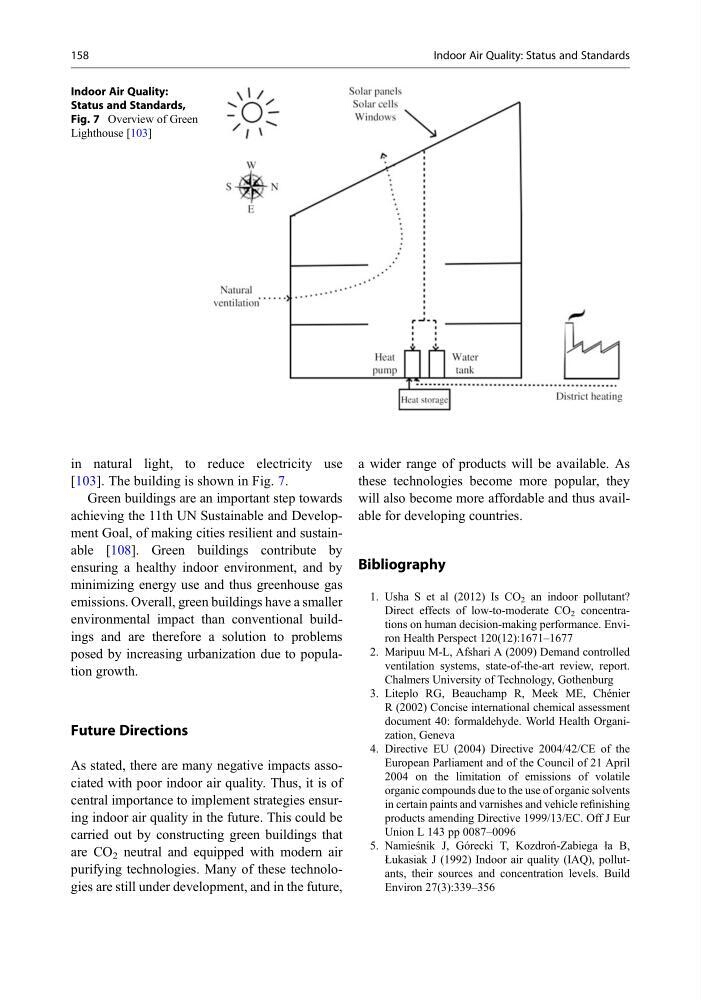
[103]. The building is shown in Fig. 7.
Green buildings are an important step towards
achieving the 11th UN Sustainable and Development Goal, of making cities resilient and sustainable [108]. Green buildings contribute by
ensuring a healthy indoor environment, and by
minimizing energy use and thus greenhouse gas
emissions. Overall, green buildings have a smaller
environmental impact than conventional buildings and are therefore a solution to problems
posed by increasing urbanization due to population growth.
Future Directions
As stated, there are many negative impacts associated with poor indoor air quality. Thus, it is of
central importance to implement strategies ensuring indoor air quality in the future. This could be
carried out by constructing green buildings that
are CO 2 neutral and equipped with modern air
purifying technologies. Many of these technologies are still under development, and in the future,
a wider range of products will be available. As
these technologies become more popular, they
will also become more affordable and thus available for developing countries.
Bibliography
1. Usha S et al (2012) Is CO 2 an indoor pollutant?
Direct effects of low-to-moderate CO 2 concentrations on human decision-making performance. Environ Health Perspect 120(12):1671–1677
2. Maripuu M-L, Afshari A (2009) Demand controlled
ventilation systems, state-of-the-art review, report.
Chalmers University of Technology, Gothenburg
3. Liteplo RG, Beauchamp R, Meek ME, Chénier
R (2002) Concise international chemical assessment
document 40: formaldehyde. World Health Organization, Geneva
4. Directive EU (2004) Directive 2004/42/CE of the
European Parliament and of the Council of 21 April
2004 on the limitation of emissions of volatile
organic compounds due to the use of organic solvents
in certain paints and varnishes and vehicle refinishing
products amending Directive 1999/13/EC. Off J Eur
Union L 143 pp 0087–0096
5. Namieśnik J, Górecki T, Kozdroń-Zabiega ła B,
Łukasiak J (1992) Indoor air quality (IAQ), pollutants, their sources and concentration levels. Build
Environ 27(3):339–356
Indoor Air Quality:
Status and Standards,
Fig. 7 Overview of Green
Lighthouse [103]
158
Indoor Air Quality: Status and Standards
[103]. The building is shown in Fig. 7.
Green buildings are an important step towards
achieving the 11th UN Sustainable and Development Goal, of making cities resilient and sustainable [108]. Green buildings contribute by
ensuring a healthy indoor environment, and by
minimizing energy use and thus greenhouse gas
emissions. Overall, green buildings have a smaller
environmental impact than conventional buildings and are therefore a solution to problems
posed by increasing urbanization due to population growth.
Future Directions
As stated, there are many negative impacts associated with poor indoor air quality. Thus, it is of
central importance to implement strategies ensuring indoor air quality in the future. This could be
carried out by constructing green buildings that
are CO 2 neutral and equipped with modern air
purifying technologies. Many of these technologies are still under development, and in the future,
a wider range of products will be available. As
these technologies become more popular, they
will also become more affordable and thus available for developing countries.
Bibliography
1. Usha S et al (2012) Is CO 2 an indoor pollutant?
Direct effects of low-to-moderate CO 2 concentrations on human decision-making performance. Environ Health Perspect 120(12):1671–1677
2. Maripuu M-L, Afshari A (2009) Demand controlled
ventilation systems, state-of-the-art review, report.
Chalmers University of Technology, Gothenburg
3. Liteplo RG, Beauchamp R, Meek ME, Chénier
R (2002) Concise international chemical assessment
document 40: formaldehyde. World Health Organization, Geneva
4. Directive EU (2004) Directive 2004/42/CE of the
European Parliament and of the Council of 21 April
2004 on the limitation of emissions of volatile
organic compounds due to the use of organic solvents
in certain paints and varnishes and vehicle refinishing
products amending Directive 1999/13/EC. Off J Eur
Union L 143 pp 0087–0096
5. Namieśnik J, Górecki T, Kozdroń-Zabiega ła B,
Łukasiak J (1992) Indoor air quality (IAQ), pollutants, their sources and concentration levels. Build
Environ 27(3):339–356
Indoor Air Quality:
Status and Standards,
Fig. 7 Overview of Green
Lighthouse [103]
158
Indoor Air Quality: Status and Standards