

flowing in through low windows and out through
rooftop windows creating a natural stack effect
(cf. Fig. 5c). In winter, ventilation occurs through
a heat exchanger to minimize heat loss [103]. The
floors are made from concrete that acts as a thermal reservoir [104]. In winter, the floors are
heated by energy from the solar thermal panels
and from district heating. Sixty-five percent of
the district heating is eco-friendly, detailed
below, with a thirty-five percent share of renewable fuel [103]. In Copenhagen, 98% of district
heating is provided by the public utilities company HOFOR, which produces heat by waste
incineration in a combined heat and power
(CHP) system. The CHP system generates
energy by combustion of biomass (a renewable
source) and gas and oil. The fossil energy is in the
process of being replaced by renewables, mainly
wind [105]. In the Green Lighthouse, energy
generated by the solar thermal panels is used to
heat the building’s water tank, and windows and
walls are highly insulated to avoid heat loss.
A healthy indoor environment is created by natural ventilation, as mentioned earlier, which
introduces outdoor air and removes indoor air
pollutants [103]. As the Green Lighthouse is
located in Copenhagen, the ambient air is
urban, but air pollution in Copenhagen is generally below threshold values [106]. Roof windows
provide light which is distributed to all rooms
with a minimum daylight factor (DF) of 2%
[103]. The DF is a measure of available daylight
in a room compared to available outdoor daylight
under an overcast sky, given in percentage
[107]. A room with a DF of 2% is considered
daylit, but still requires some artificial lighting to
perform visual tasks. Lamps in the Green Lighthouse are adjusted to compensate for variations
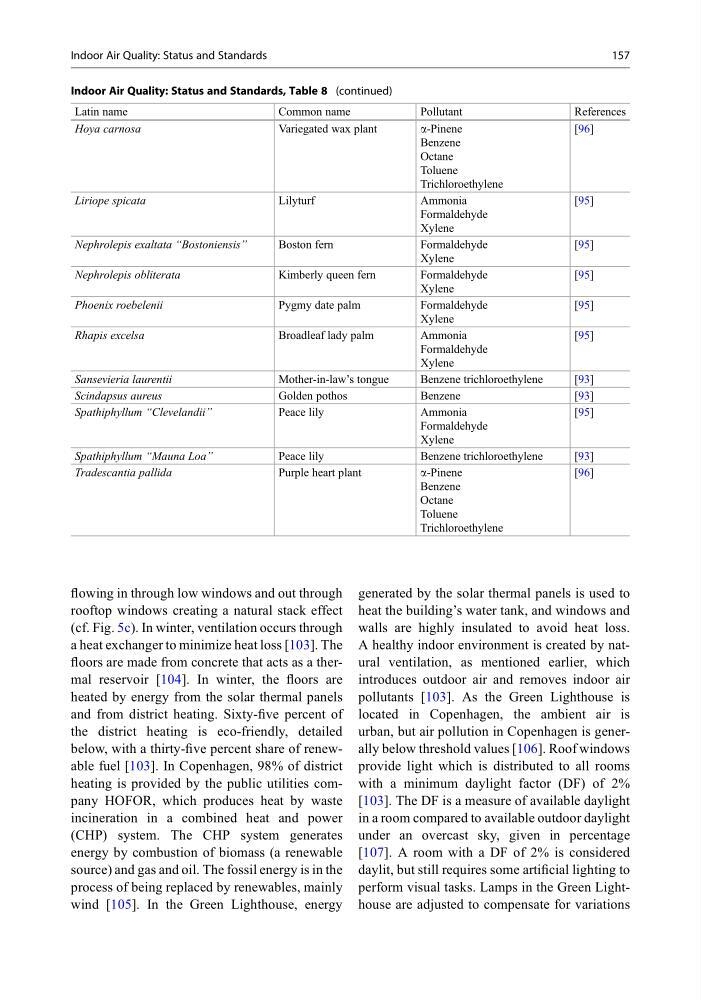
Indoor Air Quality: Status and Standards, Table 8 (continued)
Latin name
Common name
Pollutant
References
Hoya carnosa
Variegated wax plant
a-Pinene
Benzene
Octane
Toluene
Trichloroethylene
[96]
Liriope spicata
Lilyturf
Ammonia
Formaldehyde
Xylene
[95]
Nephrolepis exaltata “Bostoniensis”
Boston fern
Formaldehyde
Xylene
[95]
Nephrolepis obliterata
Kimberly queen fern
Formaldehyde
Xylene
[95]
Phoenix roebelenii
Pygmy date palm
Formaldehyde
Xylene
[95]
Rhapis excelsa
Broadleaf lady palm
Ammonia
Formaldehyde
Xylene
[95]
Sansevieria laurentii
Mother-in-law’s tongue
Benzene trichloroethylene
[93]
Scindapsus aureus
Golden pothos
Benzene
[93]
Spathiphyllum “Clevelandii”
Peace lily
Ammonia
Formaldehyde
Xylene
[95]
Spathiphyllum “Mauna Loa”
Peace lily
Benzene trichloroethylene
[93]
Tradescantia pallida
Purple heart plant
a-Pinene
Benzene
Octane
Toluene
Trichloroethylene
[96]
Indoor Air Quality: Status and Standards
157
rooftop windows creating a natural stack effect
(cf. Fig. 5c). In winter, ventilation occurs through
a heat exchanger to minimize heat loss [103]. The
floors are made from concrete that acts as a thermal reservoir [104]. In winter, the floors are
heated by energy from the solar thermal panels
and from district heating. Sixty-five percent of
the district heating is eco-friendly, detailed
below, with a thirty-five percent share of renewable fuel [103]. In Copenhagen, 98% of district
heating is provided by the public utilities company HOFOR, which produces heat by waste
incineration in a combined heat and power
(CHP) system. The CHP system generates
energy by combustion of biomass (a renewable
source) and gas and oil. The fossil energy is in the
process of being replaced by renewables, mainly
wind [105]. In the Green Lighthouse, energy
generated by the solar thermal panels is used to
heat the building’s water tank, and windows and
walls are highly insulated to avoid heat loss.
A healthy indoor environment is created by natural ventilation, as mentioned earlier, which
introduces outdoor air and removes indoor air
pollutants [103]. As the Green Lighthouse is
located in Copenhagen, the ambient air is
urban, but air pollution in Copenhagen is generally below threshold values [106]. Roof windows
provide light which is distributed to all rooms
with a minimum daylight factor (DF) of 2%
[103]. The DF is a measure of available daylight
in a room compared to available outdoor daylight
under an overcast sky, given in percentage
[107]. A room with a DF of 2% is considered
daylit, but still requires some artificial lighting to
perform visual tasks. Lamps in the Green Lighthouse are adjusted to compensate for variations
Indoor Air Quality: Status and Standards, Table 8 (continued)
Latin name
Common name
Pollutant
References
Hoya carnosa
Variegated wax plant
a-Pinene
Benzene
Octane
Toluene
Trichloroethylene
[96]
Liriope spicata
Lilyturf
Ammonia
Formaldehyde
Xylene
[95]
Nephrolepis exaltata “Bostoniensis”
Boston fern
Formaldehyde
Xylene
[95]
Nephrolepis obliterata
Kimberly queen fern
Formaldehyde
Xylene
[95]
Phoenix roebelenii
Pygmy date palm
Formaldehyde
Xylene
[95]
Rhapis excelsa
Broadleaf lady palm
Ammonia
Formaldehyde
Xylene
[95]
Sansevieria laurentii
Mother-in-law’s tongue
Benzene trichloroethylene
[93]
Scindapsus aureus
Golden pothos
Benzene
[93]
Spathiphyllum “Clevelandii”
Peace lily
Ammonia
Formaldehyde
Xylene
[95]
Spathiphyllum “Mauna Loa”
Peace lily
Benzene trichloroethylene
[93]
Tradescantia pallida
Purple heart plant
a-Pinene
Benzene
Octane
Toluene
Trichloroethylene
[96]
Indoor Air Quality: Status and Standards
157