

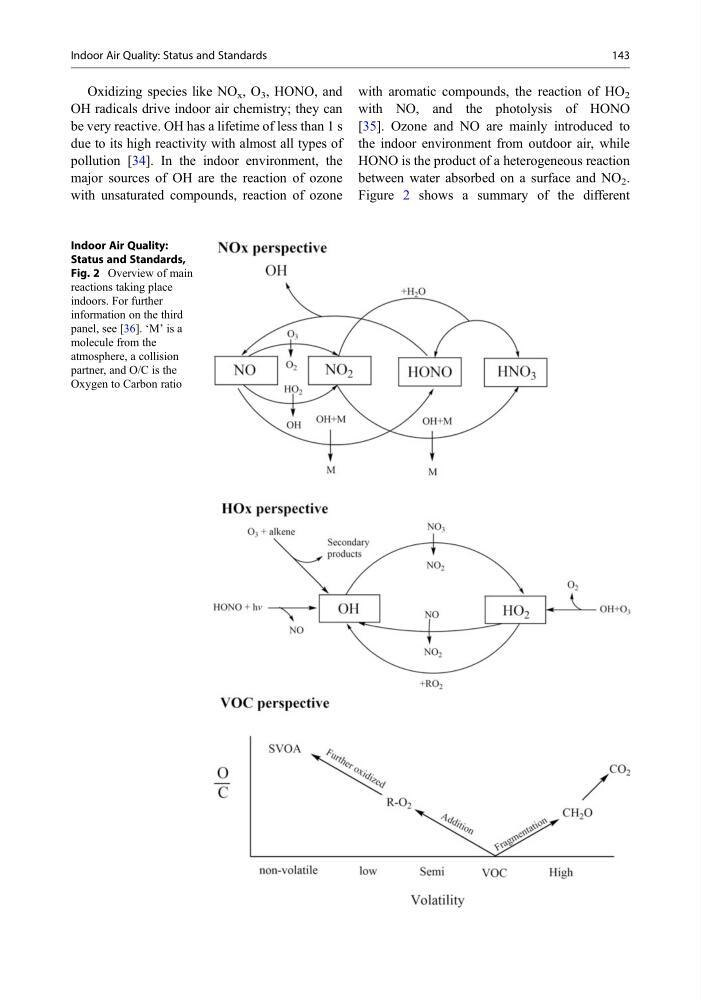
Oxidizing species like NO x , O 3 , HONO, and
OH radicals drive indoor air chemistry; they can
be very reactive. OH has a lifetime of less than 1 s
due to its high reactivity with almost all types of
pollution [34]. In the indoor environment, the
major sources of OH are the reaction of ozone
with unsaturated compounds, reaction of ozone
with aromatic compounds, the reaction of HO 2
with NO, and the photolysis of HONO
[35]. Ozone and NO are mainly introduced to
the indoor environment from outdoor air, while
HONO is the product of a heterogeneous reaction
between water absorbed on a surface and NO 2 .
Figure 2 shows a summary of the different
Indoor Air Quality:
Status and Standards,
Fig. 2 Overview of main
reactions taking place
indoors. For further
information on the third
panel, see [36]. ‘M’ is a
molecule from the
atmosphere, a collision
partner, and O/C is the
Oxygen to Carbon ratio
Indoor Air Quality: Status and Standards
143
OH radicals drive indoor air chemistry; they can
be very reactive. OH has a lifetime of less than 1 s
due to its high reactivity with almost all types of
pollution [34]. In the indoor environment, the
major sources of OH are the reaction of ozone
with unsaturated compounds, reaction of ozone
with aromatic compounds, the reaction of HO 2
with NO, and the photolysis of HONO
[35]. Ozone and NO are mainly introduced to
the indoor environment from outdoor air, while
HONO is the product of a heterogeneous reaction
between water absorbed on a surface and NO 2 .
Figure 2 shows a summary of the different
Indoor Air Quality:
Status and Standards,
Fig. 2 Overview of main
reactions taking place
indoors. For further
information on the third
panel, see [36]. ‘M’ is a
molecule from the
atmosphere, a collision
partner, and O/C is the
Oxygen to Carbon ratio
Indoor Air Quality: Status and Standards
143