

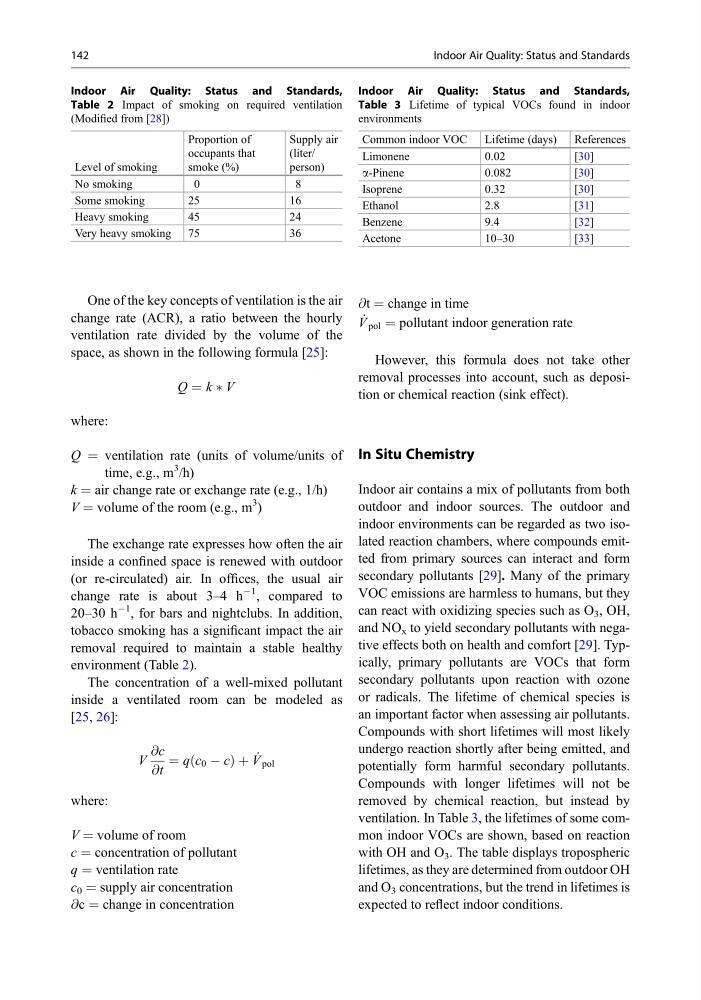
One of the key concepts of ventilation is the air
change rate (ACR), a ratio between the hourly
ventilation rate divided by the volume of the
space, as shown in the following formula [25]:
Q ¼ k à V
where:
Q = ventilation rate (units of volume/units of
time, e.g., m
3 /h)
k = air change rate or exchange rate (e.g., 1/h)
V = volume of the room (e.g., m
3 )
The exchange rate expresses how often the air
inside a confined space is renewed with outdoor
(or re-circulated) air. In offices, the usual air
change rate is about 3–4 h
À1 , compared to
20–30 h
À1 , for bars and nightclubs. In addition,
tobacco smoking has a significant impact the air
removal required to maintain a stable healthy
environment (Table 2).
The concentration of a well-mixed pollutant
inside a ventilated room can be modeled as
[25, 26]:
V
@c
@t
¼ q c 0 À c
ð
Þþ _
V pol
where:
V = volume of room
c = concentration of pollutant
q = ventilation rate
c 0 = supply air concentration
@c = change in concentration
@t = change in time
_
V pol = pollutant indoor generation rate
However, this formula does not take other
removal processes into account, such as deposition or chemical reaction (sink effect).
In Situ Chemistry
Indoor air contains a mix of pollutants from both
outdoor and indoor sources. The outdoor and
indoor environments can be regarded as two isolated reaction chambers, where compounds emitted from primary sources can interact and form
secondary pollutants [29]. Many of the primary
VOC emissions are harmless to humans, but they
can react with oxidizing species such as O 3 , OH,
and NO x to yield secondary pollutants with negative effects both on health and comfort [29]. Typically, primary pollutants are VOCs that form
secondary pollutants upon reaction with ozone
or radicals. The lifetime of chemical species is
an important factor when assessing air pollutants.
Compounds with short lifetimes will most likely
undergo reaction shortly after being emitted, and
potentially form harmful secondary pollutants.
Compounds with longer lifetimes will not be
removed by chemical reaction, but instead by
ventilation. In Table 3, the lifetimes of some common indoor VOCs are shown, based on reaction
with OH and O 3 . The table displays tropospheric
lifetimes, as they are determined from outdoor OH
and O 3 concentrations, but the trend in lifetimes is
expected to reflect indoor conditions.
Indoor Air Quality: Status and Standards,
Table 2 Impact of smoking on required ventilation
(Modified from [28])
Level of smoking
Proportion of
occupants that
smoke (%)
Supply air
(liter/
person)
No smoking
0
8
Some smoking
25
16
Heavy smoking
45
24
Very heavy smoking 75
36
Indoor Air Quality: Status and Standards,
Table 3 Lifetime of typical VOCs found in indoor
environments
Common indoor VOC Lifetime (days)
References
Limonene
0.02
[30]
a-Pinene
0.082
[30]
Isoprene
0.32
[30]
Ethanol
2.8
[31]
Benzene
9.4
[32]
Acetone
10–30
[33]
142
Indoor Air Quality: Status and Standards
change rate (ACR), a ratio between the hourly
ventilation rate divided by the volume of the
space, as shown in the following formula [25]:
Q ¼ k à V
where:
Q = ventilation rate (units of volume/units of
time, e.g., m
3 /h)
k = air change rate or exchange rate (e.g., 1/h)
V = volume of the room (e.g., m
3 )
The exchange rate expresses how often the air
inside a confined space is renewed with outdoor
(or re-circulated) air. In offices, the usual air
change rate is about 3–4 h
À1 , compared to
20–30 h
À1 , for bars and nightclubs. In addition,
tobacco smoking has a significant impact the air
removal required to maintain a stable healthy
environment (Table 2).
The concentration of a well-mixed pollutant
inside a ventilated room can be modeled as
[25, 26]:
V
@c
@t
¼ q c 0 À c
ð
Þþ _
V pol
where:
V = volume of room
c = concentration of pollutant
q = ventilation rate
c 0 = supply air concentration
@c = change in concentration
@t = change in time
_
V pol = pollutant indoor generation rate
However, this formula does not take other
removal processes into account, such as deposition or chemical reaction (sink effect).
In Situ Chemistry
Indoor air contains a mix of pollutants from both
outdoor and indoor sources. The outdoor and
indoor environments can be regarded as two isolated reaction chambers, where compounds emitted from primary sources can interact and form
secondary pollutants [29]. Many of the primary
VOC emissions are harmless to humans, but they
can react with oxidizing species such as O 3 , OH,
and NO x to yield secondary pollutants with negative effects both on health and comfort [29]. Typically, primary pollutants are VOCs that form
secondary pollutants upon reaction with ozone
or radicals. The lifetime of chemical species is
an important factor when assessing air pollutants.
Compounds with short lifetimes will most likely
undergo reaction shortly after being emitted, and
potentially form harmful secondary pollutants.
Compounds with longer lifetimes will not be
removed by chemical reaction, but instead by
ventilation. In Table 3, the lifetimes of some common indoor VOCs are shown, based on reaction
with OH and O 3 . The table displays tropospheric
lifetimes, as they are determined from outdoor OH
and O 3 concentrations, but the trend in lifetimes is
expected to reflect indoor conditions.
Indoor Air Quality: Status and Standards,
Table 2 Impact of smoking on required ventilation
(Modified from [28])
Level of smoking
Proportion of
occupants that
smoke (%)
Supply air
(liter/
person)
No smoking
0
8
Some smoking
25
16
Heavy smoking
45
24
Very heavy smoking 75
36
Indoor Air Quality: Status and Standards,
Table 3 Lifetime of typical VOCs found in indoor
environments
Common indoor VOC Lifetime (days)
References
Limonene
0.02
[30]
a-Pinene
0.082
[30]
Isoprene
0.32
[30]
Ethanol
2.8
[31]
Benzene
9.4
[32]
Acetone
10–30
[33]
142
Indoor Air Quality: Status and Standards